

I had eleven minutes to get out of the door, and one foot in a gold platform heel. The other foot was bare on a cold bathroom tile because the strap on the left shoe had twisted and I couldn’t see it in the mirror. That’s the honest version of getting ready in gold heels: the shoes aren’t the hard part. The decisions around them are.
What saved that night was a rule I now use every time. Three decisions, made in order, and the shoe is the last one. Hem first, because it changes what the shoe does to your leg. Bag second, because it changes what the outfit says. Everything else either happens or doesn’t.
Gold is louder than most people expect. It doesn’t blend the way a nude or a black heel does, so everything it sits next to gets judged against it. That cuts both ways. Get the three decisions right and a 79-euro pair looks like the most deliberate thing in the room. Get them wrong and it looks like you borrowed shoes.
Three decisions, and the shoe is the easy one
Here’s the order, and why it’s that order.
Hem. A gold platform under a cropped trouser shows the whole shoe and makes the ankle the loudest part of the silhouette. The same shoe under a hem that finishes just above the ankle bone shows 40mm of gold and reads as a flash of light instead of a statement. Same shoe, two completely different outfits.
Bag. Gold doesn’t need a gold bag, and matching gold to gold is where outfits go costume. One metal in the outfit, one metal in the hand, maximum. If the shoes are gold, the bag can be black leather, ivory, or a deep red. If the bag is also gold, drop one of them.
Shoe. By the time you’ve settled the first two, the shoe choice is usually made for you. If the hem is long, you need height. If the hem is short, you need a lower platform or you’ll spend the night looking at your own knees.
That’s the whole system. It takes about 90 seconds if you’re decisive and four minutes if you’re not, which is still faster than trying on four outfits in front of a mirror.
The reason the order matters is that the two big decisions don’t need a mirror. Hem and bag can be settled by holding two hangers up side by side. Only the shoe decision needs you to be standing up, and standing up in a bathroom with bad light is where the eleven minutes go.
The pair below is the version I’d start with if you’re buying your first gold-adjacent heel: a one-piece rhinestone upper on a platform, 107 euros, EU 35 to 41. It’s not pure gold; it’s a silver-toned crystal finish that photographs warm under tungsten light, which is the useful trick most people don’t know about.
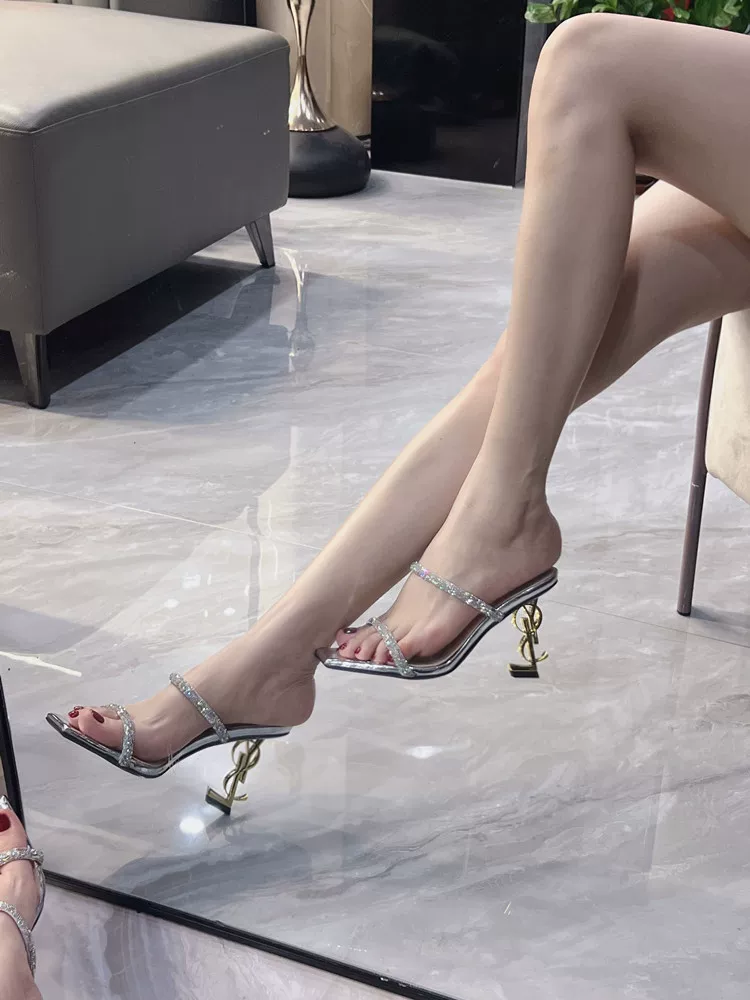
Those are the rhinestone one-piece platforms that read gold at night. The one-piece construction is why they hold their shape: no strap joins to loosen, and nothing to twist at the last minute when you’re already late.
Decision one: hem, because it changes the whole read
Three hems, three different shoes in the eye of anyone looking at you. I’ve tested this enough times to be boring about it.
- Mini, 10cm above the knee: the platform dominates. Good for a club, bad for a dinner where people talk.
- Midi, just below the calf: the most useful length. You see the toe and the front of the platform, and the leg line stays unbroken.
- Full length, skimming the floor: the shoe becomes a rumour. You need at least 90mm or the hem drags, and you’ll feel every step in your calf.
If you’re late and can’t decide, choose the midi. It works with every platform height from 60mm to 100mm, it forgives a shoe that’s slightly the wrong gold, and it doesn’t require you to think about your legs for the rest of the night.
There’s one hem I’d avoid with a platform: the wide cropped culotte that ends mid-calf. It cuts the leg at the widest point and puts the shoe in a gap. Gold in a gap looks stranded. Black in a gap looks intentional. That’s a colour rule as much as a hem rule, and it’s why platforms are easier to wear in dark colours than in metallics.
The other thing about hem and platform together is weight. A platform adds visual mass at the bottom of the silhouette, so anything you wear on top needs to hold its own. A thin silk slip with a heavy platform looks unbalanced. A structured jacket with the same platform looks correct. You’re balancing 20mm of sole against the shoulder line, whether you think about it or not.
There’s a cheap way to test a hem without trying on three outfits. Stand in front of a mirror holding the skirt against yourself at three heights, and look at where the line of the hem meets the line of the shoe. A hem that ends level with the top of the platform makes the leg look short. A hem that ends 5cm to 10cm higher makes it look longer, because the eye reads the gap as part of the leg.
That’s the entire trick with cropped hems and platforms, and it’s why the same shoe flatters one person and looks clumsy on another. It was never the shoe.
What gold does to a photo at night
Metallic finishes behave differently under flash than under continuous light. Flash bounces straight back off a mirrored surface, so a gold platform photographed at 10 p.m. with a phone flash reads as a bright white blob with no shape. Under tungsten or warm LED it reads as actual gold, because the light source is already warm.
Practically, that means two things. If you’re going somewhere with a photographer and a flash, wear the matte gold or the rhinestone version rather than the mirror-finish metallic. And if you’re taking your own photos, turn the flash off and use whatever light is in the room.
I learned this the expensive way at a birthday dinner in February. The shoes looked incredible in the bathroom mirror and like tinfoil in every photo from the table. Fourteen photos, one usable. The fix isn’t the shoes. It’s knowing which finish survives a flash, and the runway coverage that gets published is a decent place to study how metallics are lit, because those images are shot by people who do this for a living.
Rhinestone and crystal finishes are the safest bet for photographs. They break the light into small points instead of one big reflection, so the shoe keeps its shape on camera. That’s the same reason bridal shoes are usually crystal rather than mirror-metallic.
One practical habit before you leave the house: take a single photo in the room where you’ll spend the evening, then look at it. If the shoe has turned into a white blob, you still have time to change it. Ten seconds of checking beats fourteen photos nobody will post.
Video is a third case, and it’s the one people forget. A phone camera at a party records in low light and boosts contrast, so a matte gold shoe looks darker than it does in person while a crystal one sparkles more than it does in person. If someone is filming the toast, the crystal pair is the one that survives it.
The 20mm platform and why your calf notices by 11 p.m.
A platform doesn’t make a high heel comfortable. It makes a high heel possible for longer, which is a different claim. At 100mm with a 20mm platform you’re standing at an 80mm effective angle. That’s still a lot, and your calf is doing the work of holding that angle all night.
What I notice, in order: the ball of the foot at about 90 minutes, the calf at two hours, and the lower back the next morning. The ball of the foot is fixable with a gel pad. The calf isn’t, beyond sitting down occasionally. And the lower back is the one that tells you the platform was 10mm too high for the evening you had planned.
There’s a physical reason the platform helps at all. Raising the front of the foot by 20mm reduces the ankle angle by roughly 11 degrees, and that’s the difference between “I can stand at this bar” and “I need a chair.” The trade is weight and a stiffer sole, which is why a platform feels clunky on stairs and why you should never take a new pair up a spiral staircase in the dark.
The design itself is old. A raised sole under the whole foot shows up in theatre and ceremony long before it shows up in fashion, and the reason is always the same: it gives height without demanding the ankle angle of a stiletto. You’re wearing a piece of engineering that predates the heel most people think of as classic.
If the plan involves more than 3,000 steps, go down 10mm. If it involves a car, a restaurant and a car home, take the height. Most evenings are the second kind, and most people buy for the first.
One more thing I’d check before committing to a platform: the front sole edge. A square, blunt front edge catches on carpet and on the lip of a step. A slightly rounded edge slides. It sounds trivial until you’ve tripped in front of a room.
Decision two: the bag, and the one metal rule
One metal in the outfit, one metal in the hand. That’s the rule, and it’s about proportion as much as taste.
A gold shoe with a gold bag and gold jewellery makes three separate gold objects competing for the same attention, and the eye doesn’t know where to land. Drop one. Usually the bag, because a black leather bag next to gold shoes looks expensive and a gold bag next to gold shoes looks like a set.
Size matters as much as colour. A platform shoe is visually heavy, so a tiny bag makes the outfit look bottom-heavy. A medium shoulder bag or a structured top-handle balances it. A giant tote over one shoulder with 90mm platforms is a lot of visual weight in two places at once, and it’s why that combination always looks like a commute rather than an evening.
If the tote is non-negotiable because you’re coming straight from work, fold it flat and leave it at the door, and carry the small bag inside it. That’s a two-second decision that fixes the whole silhouette.
If you want the metallic hit without a second metal object, a bag in deep burgundy or forest green does the same job. Both colours sit next to gold without fighting it, and both photograph better than gold-on-gold under flash.
Strap length is the detail that decides whether a bag works with a platform. A bag that hangs at hip level sits right where the eye already is, which is the shoe. A bag that hangs at waist level lifts the eye up and lets the shoes stay the accent. If you’re short, that difference is worth more than the colour of the bag, and it’s free.
I keep one bag for this. Black leather, medium, top handle, and it has been in every gold-shoe outfit I’ve worn for two years. It isn’t exciting. It’s the reason those outfits look considered instead of assembled at the last minute.
What I skip when I’m late
Four things I’ve stopped bothering with, because they cost time and change nothing.
- Matching jewellery to the shoe. Nobody has ever noticed. Wear what you always wear.
- A pedicure refresh. If the shoe is closed at the toe, skip it. If it’s open, one coat of clear takes 40 seconds and that’s enough.
- Heel grips on a platform. They flatten under the extra weight and make the fit worse. If the shoe slips, the strap is wrong, not the grip.
- A second pair in the bag. If you’re already planning the escape, wear different shoes.
What I do instead, and this is the one thing that’s earned its place: a 30-second check that both heel tips are intact. A worn tip on a platform is worse than on a stiletto, because the platform’s weight drives the pin through the heel faster. I lost a heel cap on a wet pavement in March and walked the last 200 metres on the metal pin. Not an experience worth repeating.
If you want the time budget in numbers, here’s mine. Four minutes for a shower and hair, three for makeup, two to dress, one to check the heel tips, and one to find the bag I already decided on. That’s eleven. The margin comes from deciding the hem and the bag before I get in the shower, which sounds obsessive and takes less time than standing in front of a wardrobe in a towel.
The thing I refuse to skip, even at eleven minutes, is the walk to the front door in the actual shoes. Not to the mirror. To the door, on the floor I’ll be walking on, and back. It takes 20 seconds and it catches the twisted strap, the slipping heel and the loose buckle before anyone else sees them. Every other shortcut on this list saves less time than that one check saves embarrassment.
What I’ve also stopped doing is buying a new pair the week of an event. Platforms need two or three wears before the sole flexes at the ball and the strap settles. A pair worn for the first time at a wedding behaves like a pair worn for the first time at a wedding, which is to say badly.
I also keep two spare heel tips in a drawer. They cost about six euros, weigh nothing, and turn a snapped tip into a two-minute fix instead of a ruined evening. That’s the last item on the list and the only one that has ever saved a whole night.
The fallback combination that never fails
Black trousers, a black top, gold platform heels, no bag. That’s it. It works because the outfit is a frame and the shoes are the only thing anyone looks at, and it takes 90 seconds to put on if the trousers are already ironed.
If it’s cold, add a long coat in charcoal and keep the shoes as the only warm colour in the outfit. If it’s warm, swap the trousers for a black midi skirt and keep everything else identical. The gold does the same work in both versions because there’s nothing else competing.
I’ve used this combination for a gallery opening, a leaving drinks, and one very ill-advised karaoke birthday. It has never been the wrong choice, which is more than I can say for any other outfit I own.
The one adjustment: if the room is going to be mostly standing on a hard floor, take the lower platform. There’s a pair in the range at 79 euros that sits about 10mm lower than the rhinestone version, and the difference at midnight is real. These are the lower silver sandals that work as the standing-room version, and they’re the pair I’d hand to someone who says they can’t do platforms at all.
I’ve also used this combination with a leather jacket instead of a coat, in September, when the evening was warm enough that a coat was a lie. The shoes stopped being the loudest thing in the outfit and started being the only thing. That’s a better result, and it’s what happens when you stop treating the gold as the point of the outfit.
If you don’t own black trousers, a straight-leg dark denim works with the same logic. The only rule is that the top half stays quiet. Grey, black, ivory, one colour. The moment you add a print, the shoes stop reading as deliberate and start reading as accidental.

When gold platforms are the wrong call
Three situations where I’d take a different shoe, without hesitation.
Daylight weddings. Gold platforms in full sun look like evening shoes that arrived early. Unless the invitation says black tie, a nude or a metallic-neutral heel does the same job with less friction.
Anything with grass. A platform tip on soft ground sinks twice as deep as a stiletto tip because there’s more weight above it. You’ll be walking on the balls of your feet by the second hour.
Long walks between venues. If the evening involves 15 minutes of pavement between each stop, the platform is the wrong tool. Not because it’s uncomfortable, but because a 20mm front sole on uneven pavement is a rolled ankle waiting to happen. I’ve watched it happen to someone else and it ended their night at 9:40.
If you’re between two sizes, size up in a platform and add a gel pad. The extra 5mm at the front costs nothing in looks and gives your toes somewhere to go when your feet swell. There’s a longer explanation of that in the piece on half sizes in metallic sandals, and it applies to platforms more than to any other style.
For the pair that costs more and lasts longer, the leather option at 169 euros is the one I’d buy with my own money. Leather uppers mould to the foot over three or four wears, and a platform that moulds stops feeling like a block. The fine-heeled leather pair in silver only comes in EU 37 to 40, which is a real limitation, and it’s the first thing I’d check before falling for the photo.
The rest of the platform and heel range is worth a slow scroll if you’re choosing a first pair, because the height is listed and that’s the number that decides whether you’ll wear them twice or twenty times.
Eleven minutes, three decisions, and one pair of shoes by the door. That’s the whole method. The night I learned it, I got out of the door with four minutes to spare and spent them looking for a bag I didn’t need.
