

I bought a pair of multicolour heels at 7pm under a 3000K spotlight, and they looked like the best decision I’d made all month. Two days later I stood at a bus stop at 8:40am in flat grey light and the same shoe looked like it belonged to someone else. Nothing had changed except the light.
That’s the trap with colour-blocked women’s shoes. One colour is hard enough to judge in a shop. Three colours on the same shoe means three surfaces doing three different things to the same bulb, and you’re making the call in the worst possible room.
Here’s what I do now before I keep a pair. It takes about ten minutes and it has saved me from two returns and one very expensive mistake.
The three lights a multicolour heel has to survive
Every light source has a colour temperature, measured in kelvin, and every surface reflects that temperature differently. Shop lighting sits around 3000K to 3500K, which is warm and forgiving. Overcast daylight runs 6500K to 7500K, which is cool and unforgiving. The lamp in your living room is about 2700K, warmer than the shop and slightly yellow.
Your shoe will be seen in all three, usually in the same week. A shoe that reads rich burgundy at 3000K can read muddy brown at 6500K, and then read almost black under your hallway light. None of those versions is fake. That’s the part that took me a while to accept.
Colour rendering index matters as much as temperature, and almost nobody mentions it. A shop that wants to sell shoes uses high-CRI fittings, usually 90 or above, because they make leather and satin look saturated (see how CRI is measured). The cheap LED bulb in your bedroom is often 80, which flattens reds and makes teal look grey. So the shoe didn’t dull. Your bulb did.
The test I run, in order:
- Walk the shoe to the shop doorway and look at it in natural light, out of direct sun.
- Hold it against a sheet of white printer paper. Paper is the neutral reference you always have.
- Hold it next to your bare leg, because that’s what it will sit against for eight hours.
- Take one photo in the doorway and one under the shop lights, then compare them at home on a different screen.
If the second colour in the shoe disappears against paper, it’s a colour that only exists under warm light. Keep that in mind before you plan an outfit around it.
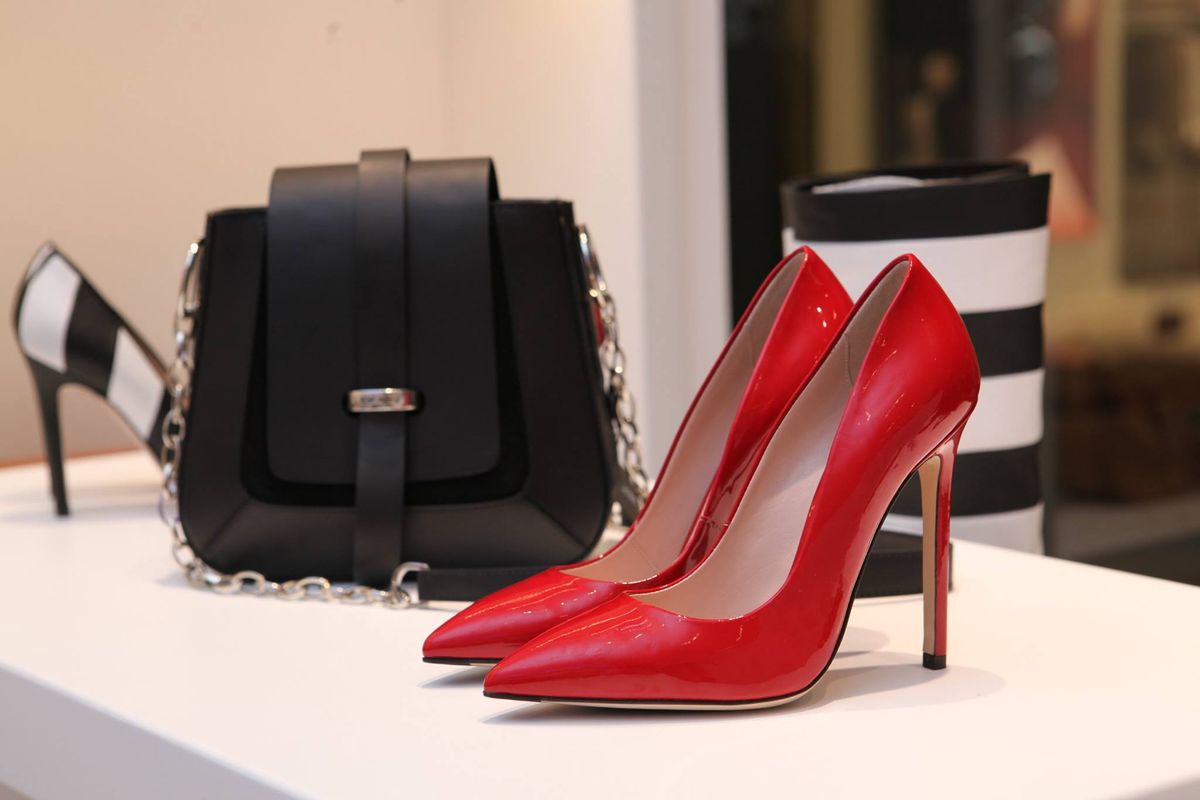
Why two colours on one shoe shift more than one
Your eye doesn’t measure colour. It measures difference. That’s colour constancy at work, and it’s the reason a pair of black and white high heels feels stable while a coral and lilac pair feels like it’s vibrating.
Put two colours side by side and each one pushes the other away. Warm orange next to cool blue makes both look more extreme than they are alone. Move that same shoe under 2700K lamp light and the orange goes redder while the blue goes greener, because the two pigments respond to the same warm shift in opposite directions.
Then there’s metamerism, which is the technical name for two colours that match under one light and clash under another (the standard explanation is worth ten minutes). Dyes and coatings are built to hit a target under a specific illuminant. A burgundy panel and a plum panel can be a perfect pair in the shop and completely separate colours at your desk.
This is why multicolour shoes are riskier than they look in photos. You’re not buying two colours. You’re buying two colours multiplied by every light source in your week.
Photograph each panel, not the whole shoe
Phone cameras lie in a specific, predictable way. Auto white balance averages the entire frame, so whichever colour covers the most pixels drags everything else toward neutral. Shoot a mostly red shoe with a small blue strap and the blue will come out duller than it is in real life. Not because the camera is bad, but because you asked it to average.
Fix it by tapping to focus and meter on each panel separately. Three shots, one per colour, plus one full-shoe shot for reference. Then look at all four together on a laptop screen rather than the phone, because phone screens boost saturation by default.
Take one more with flash at night, indoors. Flash is brutal and useful. It shows you the sheen on coated leather, any scuff that’s already there, and whether the metallic finish has that flat foil look that photographs well and wears badly. My last pair passed the daylight test and failed the flash test. The gold panel went chalky white.
One caveat about product pages: shoes are shot under controlled light with a colour reference card, then corrected. What you’re seeing is the ideal version. It’s not dishonest, but it isn’t the shoe on your foot at 5pm in November either.
If you can only do one check, do the flash one. It’s the closest thing to a lie detector.
The combinations that hold up in bad light
Some colour pairs are stable and some are a coin toss. After a few years of buying and returning, the pattern is clear enough to write down.
Stable pairs share a hue family and differ in depth. Navy with teal. Oxblood with burgundy. Chocolate with tan. These survive 6500K because the difference between the two colours is value, not hue, and value doesn’t shift much with light temperature. You can wear them to a wedding and to a supermarket and they’ll read the same.
Unstable pairs differ in saturation, and they get worse in cool light. Neon coral beside pastel lilac is the classic example. Under warm shop light the two look playful and close. Under overcast daylight the coral goes flat and the lilac goes grey, and suddenly you’re wearing two sad colours instead of one bold one.
The rule I use: keep the saturation gap small and the hue gap wide. A deep green and a bright red are far apart on the wheel and roughly matched in intensity, so they hold. A hot pink and a dusty pink are neighbours on the wheel and miles apart in intensity, so one always looks tired next to the other.
Prints break this rule by accident. A floral cherry print pointed heel might carry five colours, and under warm light the pinks merge into one blob. If the print has more than three colours, assume two of them will vanish together in daylight.
Where the colour sits on your foot changes your leg
Position matters more than palette, and this is the part multicolour shoes make complicated. A dark band across the ankle reads as a cut. A light band in the same place reads as an extension. Same shoe, same colours, opposite effect, decided entirely by which one sits higher.
If you have a two-tone shoe with a horizontal seam at the vamp, the line runs straight across the widest part of your foot and shortens the whole leg visually. That’s not a flaw in the shoe. It’s geometry, and you can work with it by keeping the trouser hem above the seam or going full-length so the line disappears.
Pointed toes in a lighter colour than the rest of the shoe stretch the foot forward. That’s why so many metallic finishes work on a pointed toe: the shine reads as light, and light reads as length. A dark toe box on a pale shoe does the reverse and makes the foot look blunt.
Slingback straps are the sneaky one. A strap that matches your skin tone almost disappears and you get the elongation without the fuss. A strap in a contrasting colour draws a visible band across the heel and lowers the visual hem of your leg. On a multicolour shoe, check which colour landed on the strap. It’s usually the smallest panel and it does the most work.
Nude is not a colour, by the way. It’s a range that runs from pale sand to deep umber, and the wrong one on your foot is worse than a deliberate contrast. Test it against your inner ankle in daylight, not against your hand in a shop.
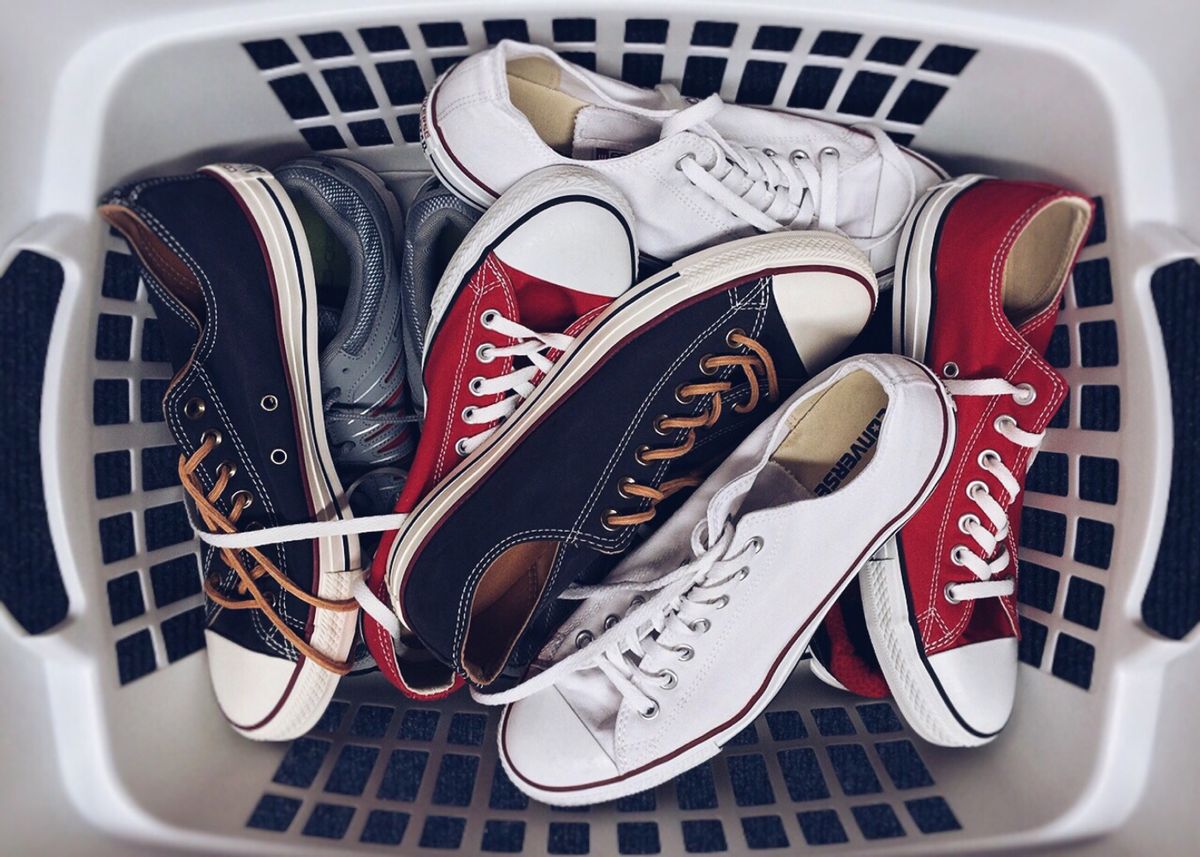
What to wear with a shoe that’s already doing two jobs
Here’s the mistake I made for a whole season: I tried to match both colours in the outfit. Navy and cream shoe, navy skirt, cream blouse. The result looked like a uniform, and a slightly costume-y one.
Pick one colour from the shoe and let the other one be the surprise. Wear the cream, ignore the navy, and put the navy nowhere else. That single move makes the shoe look chosen instead of coordinated.
Denim is the shortcut. Indigo behaves like a third colour that sits between almost anything, and it gives a loud shoe something calm to land on. Dark straight-leg jeans with a multicolour heel is the outfit I fall back on when I have four minutes and no ideas.
If the shoe has a print, keep everything else solid. If the shoe is colour-blocked in two flat panels, you can wear one print, but only at a small scale, like a thin stripe or a small check.
The bag shouldn’t match. Matching the bag to the shoe is the fastest way to make both look cheaper than they are. Pick the minority colour in the shoe, or go with a neutral that has texture instead of colour, like a grained leather or a woven straw. See how a patterned blue heel behaves with a plain canvas tote and you’ll understand the principle in about four seconds.
Tights decide the whole thing in winter. Sheer 15 denier keeps the shoe legible. Opaque black tights swallow a dark panel and make a light one look like a bandage. If your shoe has any depth in it, go sheer or go bare.
The finish is a fourth colour, and it lies the most
You can pick three pigments correctly and still get the shoe wrong, because the surface changes what the pigment looks like. Patent leather is a mirror with colour behind it, so it picks up everything around it: the grey carpet, the green wall, the red of the person standing next to you. Under a shop’s warm spots it looks liquid and expensive. Under 6500K daylight it goes slightly plastic, and under flash it turns into a hard white highlight that hides the actual colour underneath.
Suede does the opposite. It absorbs light instead of reflecting it, so every colour in the shoe reads about ten percent darker and considerably softer than the swatch suggested. A multicolour suede heel that looks balanced in the shop will look muddy at home after dark, because the lamp doesn’t have enough intensity to lift the nap. If your pair mixes suede and smooth leather, expect the suede panel to pull the whole shoe down a stop.
Metallic finishes are their own category, and they’re the ones that most often disappoint. Foil-coated synthetics reflect almost everything and hold almost no colour, which is why a gold heel photographs as bright yellow-white and then looks brassy in a hallway mirror. Real metallic leather, where the finish is applied to the hide rather than laminated on top, keeps more depth and ages into a patina. The quick test is pressure: press a thumb into the panel. Foil creases sharply and springs back flat. Leather creases softly and stays slightly marked (the patina process is what you’re looking at).
Patent also scuffs white, and there’s no fixing it. A scuff on matte leather can be polished back into the surface. A scuff on patent breaks the coating and shows the pale layer underneath, and on a multicolour shoe that white mark lands next to two saturated colours and becomes the first thing people see. If you’re hard on shoes, keep the patent to a small panel near the heel and put the matte finish where the collisions happen.
Cheap colour and expensive colour, from a metre away
There’s a difference between a shoe that’s colour-blocked and a shoe that’s been assembled from whatever panels were left on the table, and you can usually see it from a metre away without touching anything. Expensive colour has depth, meaning the pigment sits at different densities across a panel so the surface shifts as you move. Cheap colour is flat and even, because it’s sprayed on top of a corrected leather or a synthetic base and there’s nothing underneath for light to travel through.
The edges tell you more than the middle. Look at where two colours meet, then look at the raw edge of the sole and the strap. A well-made shoe paints or stains the edge so the colour continues around the material. A cheap one leaves a pale, chalky line where the leather was cut, and on a multicolour shoe those pale lines multiply. Three colours means six visible edges, and six pale lines read as pale piping that nobody designed.
Lining is the other giveaway, and it’s the part you can check in ten seconds. A cheap multicolour heel usually has a white or cream synthetic lining regardless of the outside colour, because lining in matching dye costs money. Pull the shoe toward a window and look inside. If the lining is a completely different colour family from the upper, the whole shoe will feel like it’s wearing a costume, and it will also smell like adhesive for the first month.
None of this means you need to spend a lot. It means you should look at the joints first and the overall impression second, because your eye forgives the overall impression in about four seconds and then spends the next four hours noticing the seams. A $70 pair with clean edges and a matching lining will outlast a $150 pair with pale cut lines, and it will look better doing it.
The honest case for sending them back
I have to admit something about my own multicolour pair. They got more compliments than any other shoe I own, and I wore them six times in a year. Cost per wear worked out to about $19 a go, which is fine for a coat and terrible for a heel.
The reason is boring. A multicolour shoe is a statement, and statements don’t repeat well. You can wear a black pump three days a week and nobody notices. Wear the coral and lilac pair twice in ten days and it’s the first thing people mention both times.
So the return decision comes down to one question: can you name three outfits in sixty seconds? Not three outfits you could build with effort. Three you already own and would actually wear this month. If you can’t, the shoe is a photograph, and you should send it back while the window is open. Returns are free. Closet space isn’t.
Keep them if one of the shoe’s colours already repeats in your wardrobe three or more times. That colour is your anchor, and the second colour becomes a detail instead of a demand. That’s the difference between a shoe you wear and a shoe you own.
And if you’re buying online and can’t test in person, buy two sizes in the same pair, test both in your hallway light, and send one back. It costs nothing but a trip to the post office, and it beats guessing at 11pm with a size chart.
Which light is your shoe actually living in? Most of us spend our week under office fluorescents and only see daylight on the walk to the car. Judge the pair in that light, not the one in the shop window, and you’ll return far fewer of them.
