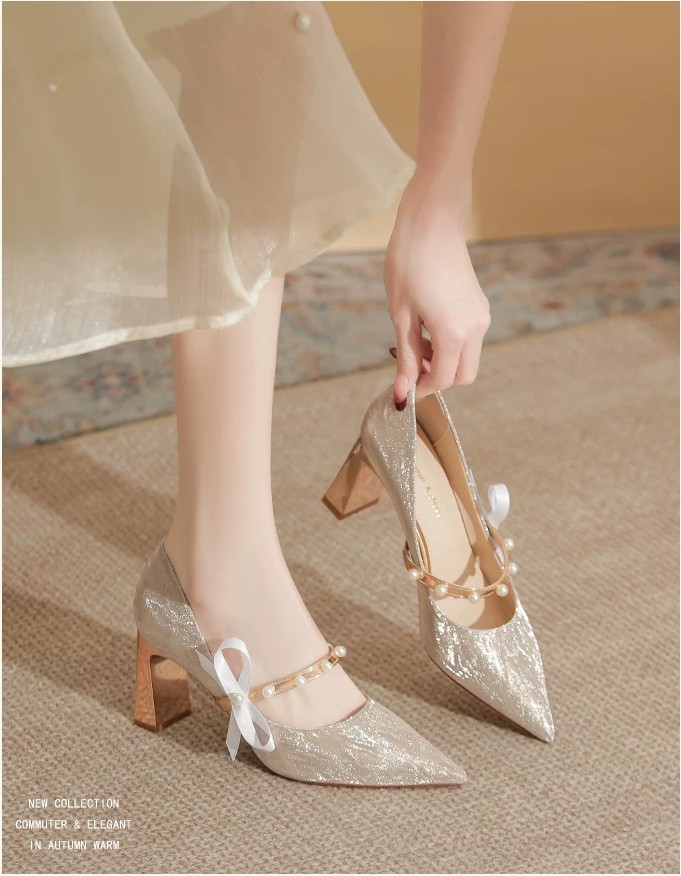
You wear them four times, put them away, take them out in June, and the pink has gone slightly peach. Nothing has spilled. Nothing has scratched. The colour simply moved, and there’s no polish on earth that will move it back.
That’s the thing about pink heels for women: the colour is the whole point and the colour is the first thing to fail. Before you spend money, three things decide whether a pair still looks right after a season. The shade you pick, the material it’s dyed into, and where you store them. Everything else is secondary, including the price.
Here’s the order to check them in, with the failure modes I’d expect at each stage.
What five wears actually do to a pink finish
Assume you’ll wear them five times in the first month, which is realistic for a new pair that goes with everything. By wear five, three things will have happened.
The heel counter will have softened, so the shoe holds your heel slightly differently. The toe will have creased, and on pink the crease shows as a pale line rather than a dark one. And the top line, where your foot enters, will have picked up a thin grey edge from friction against socks, tights or skin.
None of that is damage. All of it is visible, and on a pale pink it’s more visible than on any other colour except white.
What matters is whether the finish is dyed through or applied on top. Dyed-through leather or suede wears to a slightly lighter version of the same colour. Applied finishes, which is most patent and most satin-backed synthetic, wear to a white or grey core, and that’s the point of no return. Ask directly: is the colour through-dyed? A seller who can’t answer is usually selling an applied finish.
A useful test in person: bend the shoe at the ball and look at the crease under good light. If you can see a lighter line already, in a shop, on a shoe nobody has worn, that’s the core showing through. Put it down.
The three pinks, and which one survives a season
Pink isn’t a colour, it’s a range, and the range behaves differently. Sort them into three groups and the buying decision gets much simpler.
- Blush and nude-pink. The most wearable and the most forgiving. Slight fading is almost invisible because the colour is already close to skin. Scuffs blend. This is the pink that survives a season and still looks deliberate in year two.
- Hot pink and fuchsia. Saturated, high-contrast, and the least forgiving. Every scuff reads as a white mark because the contrast is so high. Fading is dramatic rather than subtle. Beautiful for a season, then visibly tired.
- Dusty rose, mauve-pink, anything with grey in it. The most stable under light, because the grey base masks yellowing. Slightly harder to match to an outfit, considerably easier to keep.
If you want one pair that lasts, buy blush. If you want one pair for a specific event, buy the hot pink and accept a short life. What doesn’t work is buying fuchsia expecting durability, which is the single most common disappointment in this category.
There’s a seasonal wrinkle too. Pink reads warm under tungsten light and cool in daylight, so a pair that looks soft in a shop can look sharp outdoors. Check any pair near a window before you commit, and if you’re buying online, look at customer photos rather than studio shots. Studio lighting flatters pink more than any other colour.
Dye transfer, the failure nobody warns you about
Pink suede and pink satin both transfer colour, and they transfer in both directions. Dark denim will mark a pale pink heel at the counter within an afternoon. A saturated pink lining will tint a bare foot, or a white sock, on a warm day.
Denim is the worst offender because indigo crocks. If you’re wearing raw or dark jeans, expect a blue-grey shadow at the heel within two hours, and expect it to be permanent on suede. The fix is prevention: a protective spray before the first wear, and a different outfit for the first few outings.
On the return direction, the risk is your foot. Cheap pink linings bleed onto skin, and it looks alarming. It washes off, but it stains the inside of the shoe unevenly, which then shows through on lighter styles.
Three precautions that cost almost nothing:
- Spray suede and satin with a protector before the first wear, outdoors, two thin coats.
- Don’t wear new pink shoes with dark denim for the first month.
- Keep thin no-show socks for the first few wears, until the lining has stopped releasing dye.
If a transfer has already happened on smooth leather, a leather eraser or a little saddle soap on a cloth will lift most of it. On suede, a suede brush and patience. On satin, nothing works, and that’s worth knowing before you buy satin.
Cleaning by material: four different jobs
Pink makes every cleaning mistake visible, so match the method to the material rather than reaching for one product.
Smooth leather. Damp cloth, then a pH-neutral cleaner worked in small circles, then dry away from heat. Pink leather responds well to this because the pigment is usually in the finish rather than on the surface. Never use a coloured polish. A neutral cream is the only safe option, and even that can darken a pale shade.
Suede. Dry brush first, always. A suede brush lifts the nap and takes surface dust with it. For marks, a suede eraser, then brush again. Water on pink suede leaves a tide line that is very hard to remove, so if it gets wet, stuff it and let it dry slowly, away from any heat source. If you’re unsure which way the nap runs, the way suede is finished explains why brushing in one direction matters more than brushing hard.
Satin. The hardest of the four. Satin shows water marks, and pink satin shows them twice. Blot, don’t rub, and use distilled water if you must use any. Most satin damage is caused by well-intentioned cleaning rather than by wear.
Patent. A damp cloth and nothing else. Patent is a plasticised finish, and its shine comes from the surface coating rather than from a polish, so anything abrasive removes the shine permanently. A small amount of petroleum jelly on a scuff, buffed with a soft cloth, is the only trick worth knowing.
One rule covers all four: clean the same day, not the same week. Pink holds a stain better than it releases one, and a mark that lifts in five minutes on day one will not lift at all on day ten.
Why pink fades faster than black or tan
Pink sits at the high end of the visible spectrum’s warm side, and the dyes that produce it are less light-stable than the iron-based blacks and browns. That’s not a manufacturing fault. It’s chemistry, and it’s why an old pink shoe almost always looks paler and slightly yellower than a new one, while an old black shoe just looks dusty.
What you can control is exposure. A pair worn twice a month outdoors gets a fraction of the ultraviolet that a pair displayed on a shelf gets, which is the counterintuitive part: the shoes you don’t wear fade faster than the ones you do, if they’re stored in the light.
The other variable is the base colour under the pink. Over a white base, fading goes pale and chalky. Over a tan or grey base, fading goes warmer, which is usually more forgiving. If you’re choosing between two pairs of pink heels for women and can see the edge of the upper where it meets the sole, look at the colour there. That sliver tells you what’s underneath.
This is why blush beats fuchsia on longevity, and why a mauve-pink with grey in it can look better in year three than it did in year one. The colour isn’t failing. It’s drifting toward something neutral, and neutral ages well.
Sun, storage, and the slow fade
Ultraviolet light breaks down the dyes used in most pink finishes, and it does it slowly enough that people blame the shoes rather than the windowsill. A pair kept on an open shelf in a bright room will visibly shift within one summer. The same pair in a cupboard will not.
Heat is the second factor. A cupboard above a radiator, a car boot in July, a plastic box in a warm loft: all of these speed up the shift, and all of them also dry out leather, which makes the creases sharper and the colour paler at the fold.
What actually works:
- A cotton dust bag, not plastic, so moisture can escape.
- Tissue in the toe to hold the shape, unbleached, because printed paper transfers ink.
- Stored heel-down or on a shelf, never stacked under other shoes.
- Out of direct sun, and out of any room above 25°C in summer.
If your only storage is a bright room, a lidded box with two silica sachets is a reasonable compromise, as long as you air it occasionally. Trapped damp is worse than light, and pink leather with mould is finished.
One detail people miss: the inside of the shoe fades too, just slower. A pink lining that’s been worn barefoot will lose colour at the heel where the skin rubs, and that pale patch shows through on any open-back style. If the pair is a slingback or a mule, that’s the area to check before you buy second-hand.
Scuffs at the heel: what’s fixable, what isn’t
Most scuffs on pink heels happen at the heel counter, the part that hits kerbs, car doors and the underside of desks. The good news is that this is also the easiest area to repair invisibly, because it’s low and rarely examined.
On smooth leather, a scuff that hasn’t broken the surface will lift with a leather eraser and a neutral cream. A scuff that has gone through to a lighter layer is colour loss, and the only real fix is a matching cream, built up in tiny amounts over two or three goes. On pale pink, getting the match right is genuinely difficult, and a visible patch is worse than the scuff.
On suede, a scuff is usually just flattened nap. Steam it lightly and brush, and most of it disappears. On patent, a scuff that has gone matte can sometimes come back with a drop of petroleum jelly, and sometimes can’t, because the coating is gone rather than displaced.
The repair that’s almost always worth it is a new heel tip. If the tip has worn to the pin, the heel starts to lean, and a leaning heel on a pink shoe is obvious because the colour line goes crooked. Tips are cheap and quick, and they’re the difference between two seasons and five.
What’s not worth repairing: cracked patent at the flex point, water-damaged satin, and any suede that has been through a washing machine. Those are replacements, not repairs.
What I’d tell you before you buy pale pink
Pale pink is the most photogenic and the least practical. If you want it, buy it with two things in mind. First, it will need cleaning after most wears, not occasionally. Second, it will look slightly different in eighteen months than it did in the shop, and that’s not a defect.
The practical alternative is blush with a slightly warmer base, which reads pink without being a statement, and which ages into something closer to a neutral. A pair like these soft pink heels with a simple shape will get worn to lunch, to work, to a wedding, and wear count is what makes a colour survive visually, because a shoe in rotation gets cleaned.
Decision criteria, in order. Colour depth first: blush over fuchsia unless the shoe is for one event. Material second: smooth leather over satin unless you enjoy maintenance. Finish third: matte over high-shine, because shine shows every fingerprint. Price last, because at this point a €90 pair and a €250 pair differ mostly in how long the colour holds, and that’s the thing you can’t see on the shelf.
One number worth remembering: a pair worn twice a month for two years is twenty-four wears. If the colour is still right at wear twenty-four, you bought well. If it isn’t, no amount of care would have saved it.
And a last check that takes ten seconds. Hold the shoe at arm’s length and look at it the way a stranger would, from a metre away, in daylight. Most of what you’ve been worrying about at close range disappears at that distance. Pink heels are viewed from a metre, not from thirty centimetres, and that’s the distance the colour has to work at.
A five-minute routine that actually gets done
Most care advice fails because it asks for twenty minutes nobody has. This version takes five, and it’s the one I’d keep if I could only keep one.
The night you wear them: wipe with a dry microfibre cloth, ten seconds per shoe. If there’s a mark, deal with it then. Then tissue in the toe, into the dust bag, into the cupboard.
Once a month: check the heel tips with a thumbnail. If the tip has worn to the pin, book the repair. Brush suede, wipe patent, condition smooth leather. Five minutes a pair, and it prevents most of the damage these shoes normally collect.
Once a season: look at the colour in daylight next to a photo from the day you bought them. If the shift is noticeable, stop wearing them with pale outfits and keep them for darker ones. That’s not surrender, it’s getting another year out of a colour that’s already moving.
Two comparisons are useful if you’re deciding between pink and something safer. There’s a piece on what hides dirt and what shows it which covers the same problem in a different colour, and the logic transfers almost completely. And if you end up with a high-shine pair, the patent care rules apply to pink patent exactly as they do to black.
Finally, the honest version. Pink heels are a maintenance colour. That’s the trade for how they look, and it’s a fair trade if you go in knowing it. Buy the shade that fades gracefully, spray them before the first wear, keep them out of the sun, and they’ll hold their colour long enough to be worth the money. Skip those four things and they’ll be the pair you stop wearing by August.
If you want to see how different pink tones and heel shapes sit next to each other before deciding, the pink slim heel styles and the rest of the heels range are worth twenty minutes of comparison, because the shade you pick matters more than the price you pay.