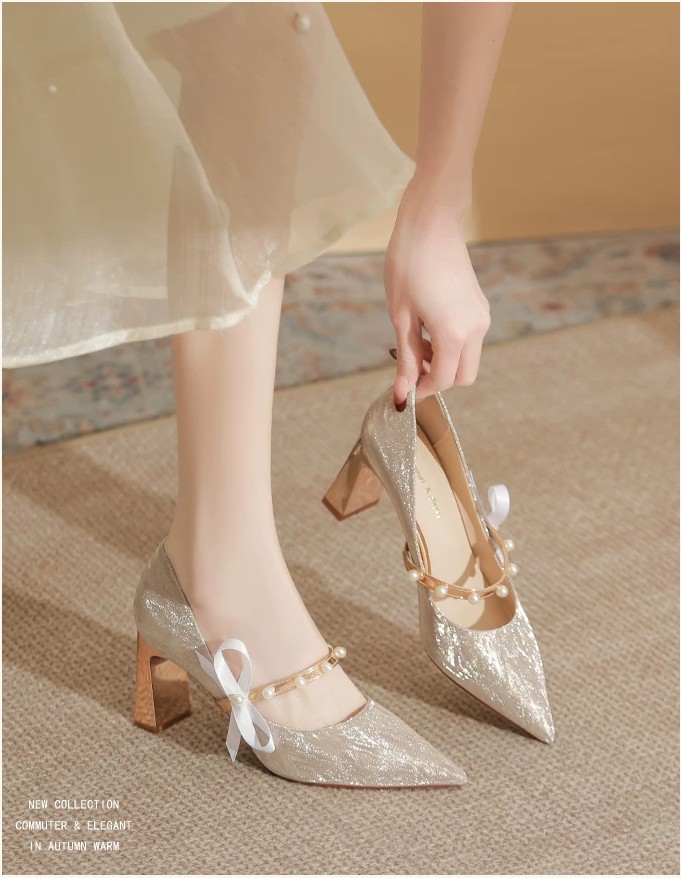
You bought the dress in March. The wedding is Saturday. And the silver shoes you ordered in a hopeful moment are still sitting in the box, because they looked warmer on your phone screen than they do under the hallway light.
That gap between the photo and your feet is where most shoe regrets start. Womens silver block heels are one of the few styles that can close it. The block gives you something to stand on. The silver gives you something to look at. Get the height and the finish right, and you can wear the same pair to a wedding, a work dinner and your own birthday without changing anything but the bag.
Get them wrong and you’ll be barefoot by 9pm with your shoes in your hand.
Here’s what actually matters when you’re choosing a pair, based on the things that go wrong after hour four, not the things that look good in the first photo.
Heel height first: 65mm beats 90mm for a long day
Start with the number, because it decides everything else. A block heel spreads your weight across a wider surface than a stiletto, which is why a 75mm block feels closer to a 50mm stiletto than the tape measure suggests. The block doesn’t remove the angle, though. It just makes the landing softer.
For a day that includes standing, walking from a car park to a church and then dancing badly, 60mm to 75mm is the range most people can handle without thinking about their feet. Above 80mm, the pressure shifts forward onto the ball of your foot no matter how wide the heel is. That’s basic mechanics of the high-heeled shoe, and no amount of padding fixes it for eight hours.
If you’re tall and self-conscious about it, a 60mm block in silver reads dressy without adding much height. If you’re short and want the length, 75mm is the honest ceiling for a long event. A 90mm block usually looks like a mistake to anyone who has worn one past lunch.
Try this before you buy: stand on the ball of your foot with the heel lifted to the height you’re considering, and hold it for 30 seconds. If your toes curl to grip, the pitch is too steep for a full day.
There’s a second number people forget: the platform. A 20mm platform under the toe buys you 20mm of height for free, because it takes the angle out of the shoe. That’s why a 90mm heel with a platform feels closer to a 70mm. If you want height and a long day, look for a small platform and a wide heel together.
Weight matters here too. Pick the pair up with one hand. If it feels heavier than a paperback, you’ll feel it on stairs at hour six, and no insole fixes that.
Silver is three different materials, and they age differently
The word silver covers at least three finishes, and they behave nothing alike after ten wears.
Foil or metallic-coated leather is the shiniest and the most fragile. It looks like liquid metal for the first month. Then the coating starts to lift at the flex point near the toe, usually in a thin white line that catches the light more than the shine does. If you drive in them, the inner heel will scuff first.
Matte silver leather is the quietest option and the one that survives longest. It reads silver in daylight and almost grey at night, which makes it easier to wear with more than one outfit. Scuffs blend in because there’s no mirror surface to break.
Glitter and rhinestone finishes are the ones people photograph. They’re also the ones that shed. A rhinestone pair will lose two or three stones in the first month, always from the inner edge where your other foot brushes past. Glitter transfers onto tights and car seats.
If you want a pair that still looks deliberate in November, matte wins. If the event is one night and the photos matter more than the lifespan, glitter is fine, and this silver rhinestone pair is built for exactly that kind of night.
The strap question: ankle strap, slingback, or nothing at all
An ankle strap keeps your heel from lifting out of the shoe, which matters more than most people admit. It also cuts your leg at the narrowest point, so if you’re wearing a midi dress, the strap and the hem can fight each other visually.
A slingback is easier to walk in than a pump because the back strap gives a little as your foot swells. The trade-off is that elastic slingbacks stretch out over a season. By month three they flap.
No strap at all, a true pump, looks the cleanest and is the least forgiving. Your heel lifts slightly with every step, the shoe slips, and you end up walking with your toes clenched. If you have a narrow heel, skip it.
For most people, a thin ankle strap on a block heel is the practical middle. Look at where the strap sits: it should cross just above the ankle bone, not on it. A strap that presses the bone will leave a red mark by 3pm and you’ll feel it every time you stand up.
Check the buckle as well. A buckle on the outside of the ankle rubs against the other shoe when you walk, and it’s the first thing to scratch. A hidden elastic insert or a small hook closure is kinder.
If you’re between sizes, size for the strap, not the toe. A strap that’s too short will pull the shoe tight across the top of your foot, and that’s the pressure you’ll remember the next morning.
What silver block heels go with, and the one pairing I’d skip
If you only buy one pair of womens silver block heels, make them matte. Silver is cooler than gold, which means it sits better next to navy, charcoal, true black and denim than it does next to cream, camel or ivory. That’s the short version.
The longer version: women’s shoes in metallic finishes tend to look expensive when the rest of the outfit is matte. A silver block heel with a wool coat and dark jeans reads like you know what you’re doing. The same shoe with a satin dress in a warm tone can look like two outfits that met in a lift.
Pairings that work without thinking:
- Black tailored trousers, white shirt, silver block heel. Nothing else metallic.
- Navy midi dress, no jewellery, silver shoe. Let the shoe be the shine.
- Straight-leg blue jeans, grey knit, silver block heel. This is the weekend version.
- All-black outfit with one silver shoe and a silver bag that doesn’t match exactly. Close enough is better than identical.
The pairing I’d skip is silver shoes with a warm cream or ivory dress. It’s not a rule anyone will arrest you for, but in photos the two tones argue, and the shoes look colder than they did in the mirror.
Break them in over three days, not one morning
New shoes fail on the day you need them most. The fix is boring and it works.
Day one: wear them indoors for 20 minutes with thin socks. Not to stretch them, just to find the three places that rub. Day two: two hours, including a walk to the shop and back. Day three: a full workday, or as close to one as you can manage. By the wedding you’ll know exactly where to put a plaster before it becomes a problem.
The spots that rub on block heels are predictable: the achilles, the top of the toe box if the leather is stiff, and the inner edge of the strap. A dab of beeswax or a bit of clear lip balm on the inside seam softens the friction without staining. Friction blisters form fast once skin is warm and damp, so deal with hot spots at the first sign, not at the end of the night.
Don’t soak them in water and wear them wet. That trick works on heavy leather boots and ruins a lined heel.
Pack a small kit for the day itself: two fabric plasters, a spare pair of heel tips if the shoe came with them, and a folded flat shoe in your bag. The flat isn’t defeat. It’s the reason you can still walk to the car at midnight.
One more habit that helps: rotate. Don’t wear the new pair for three days straight before the event. Give the leather a day to dry out between wears, especially if it rains.
Where silver block heels actually disappoint
They’re not a black-tie shoe. If the invitation says floor-length and the room is candlelit, silver block heels will look like you came from the office. Satin sandals or a pointed pump do that job better.
They’re also heavier than they look. A block adds material under the heel, and a pair with a thick sole and a metal buckle can weigh 700g or more. On a day with a lot of stairs, you’ll notice.
Rhinestone and glitter versions snag tights, and the stones catch on the hem of long dresses. If you’re wearing anything sheer, check the shoe against the fabric in daylight before you commit.
And cheap metallic foil will look cheap by the second season. Not always, but often enough that I’d rather spend the money on matte leather and a better insole than on a shinier finish.
Silver also shows every mark. A scuff on a black shoe is invisible. The same scuff on a silver toe looks like a scratch on a car. Keep a soft cloth in your bag and wipe the toe when you arrive, before the light gets to it.
The last disappointment is noise. A hard sole on a stone floor clacks, and in a quiet room that’s all anyone hears. A rubber half-sole costs very little and fixes it.
Sizing, width, and the four o’clock swelling problem
Most womens silver block heels run true to size, but the toe shape decides whether you need to size up. Your feet are bigger at the end of the day. Measure at 5pm, not at 9am, and use that number. Half a size up is the safer call for a closed toe with a pointed or almond shape, because the toe box doesn’t stretch much and your toes need somewhere to sit.
If you have wide feet, a block heel is still workable, but check the width at the ball, not at the heel. Look for a shoe that lists a wide fit or has a rounded toe. A wide-width wedge is often the easier first step if block heels still pinch across the top.
For a very long event, buy a gel insole that’s 3mm thick, not 6mm. Anything thicker pushes your heel up and out of the shoe, and then the strap does all the work.
One more thing: try them on with the tights or socks you’ll actually wear. A pair that fits bare will feel tight with 40 denier, and November weddings are cold.
If one foot is bigger than the other, which is normal, fit the bigger one. Nobody notices a slightly loose shoe on the smaller foot, but everybody notices the face you make when your toe hits the end.
Returns are part of the decision. Buy from somewhere with a real return window and walk on carpet first, not pavement. Once the sole is scuffed, the pair is yours.
A matte silver block heel at 70mm, ankle strap, closed toe, leather lining, and a rubber cap on the heel tip so you don’t sound like a tap dancer on stone floors. That pair will handle a wedding, a Christmas party and a Tuesday dinner without anyone asking why you’re wearing the same shoes.
If you want the shine for one specific night, go glitter and accept the shedding. If you want something that survives three winters, matte is the only finish worth the money.
And if you’re still deciding between two pairs, pick the one with the wider heel every time. Your feet will vote at 6pm, and they always vote for the block. You can browse a pointed pair if you would rather skip the block, or start with a thicker heel that doesn’t punish you by dinner.