

You walk into a shoe shop with one picture in your head. You walk out with something else entirely. That gap is almost always a vocabulary problem. “Heels” sounds like one shoe. It isn’t. It’s a whole family of shoes that behave nothing alike once they’re on your feet.
I learned this the expensive way. Bought a pair of 90mm pointed pumps for a wedding in April, wore them for four hours, spent the next two days hobbling around in flats. The shoes weren’t bad. I’d just picked the wrong branch of the family for a day that involved standing on grass.
Two days in flats. Lesson learned.
So here’s the honest map, sorted by what actually matters when you’re buying. The types of ladies shoes heels that get worn instead of stored split into six or seven shapes, and the differences between them matter far more than the brand on the insole. Once you can name the heeled shoes you’re looking at, the whole category stops being a guessing game.
Heel height first, the label later
Most people shop the other way round. They look at the label, fall for the colour, then find out at the till that a 100mm stiletto is a different animal from a 100mm block. It’s the height and the footprint together that decide whether you’ll wear the pair twice or two hundred times.
Here’s the rough sorting most women end up with after a few years of trial and error. Under 50mm reads casual and works with trousers better than with dresses. Between 60 and 80mm is the daily zone, the one you can commute in if the pavement isn’t a nightmare. Above 90mm, the shoe starts running the day instead of you. Shorter walks, more sitting, a spare pair in the bag.
None of that is a rule you can fail. It’s just how the load lands on the ball of your foot. Fair warning though: heel height on the box is measured at the back, and a shoe with a 10mm platform under the toe effectively loses 10mm of that. Two pairs both labelled 90 can feel a full size apart.
If your feet are wide or you’ve got a high instep, drop one notch from whatever you think you want. The types of ladies shoes heels that sell best online are almost always built on a fairly narrow last, which is why half the returns come back saying “too tight across the top.”
Worth adding one thing about the last, since almost nobody explains it. The last is the foot-shaped block the shoe is built over, and it decides the shape at the ball, the width across the instep and how high the vamp sits. Two shoes in the same size can fit completely differently because they were built on different lasts. That’s why the pair you loved in one shop feels wrong in another, and it’s not you being difficult.
Pumps and pointed toes: the workhorse
A pump is the plain one. Closed toe, closed back, no straps, one clean line from the vamp to the tip. If you own exactly one pair of heels, this is what it should be, and it should be boring enough to wear with everything.
The pointed toe is doing specific visual work. It lengthens the line of the leg and makes the foot look smaller than it is, which is why pointy courts have survived every trend cycle since the fifties. The trade-off is space. A pointed toe box has less room at the front, so if your second toe is longer than your big toe, size up half a size or look for an almond or round toe instead.
Heel shape changes the whole vibe. A slim tapered heel reads dressy. A block or stacked heel reads practical, and it distributes weight across a wider surface, so you stay steadier on uneven ground. That matters more than most buying guides admit. I’ve watched women in beautiful stilettos tip sideways on cobblestone while the friend in blocks walked on without breaking stride.
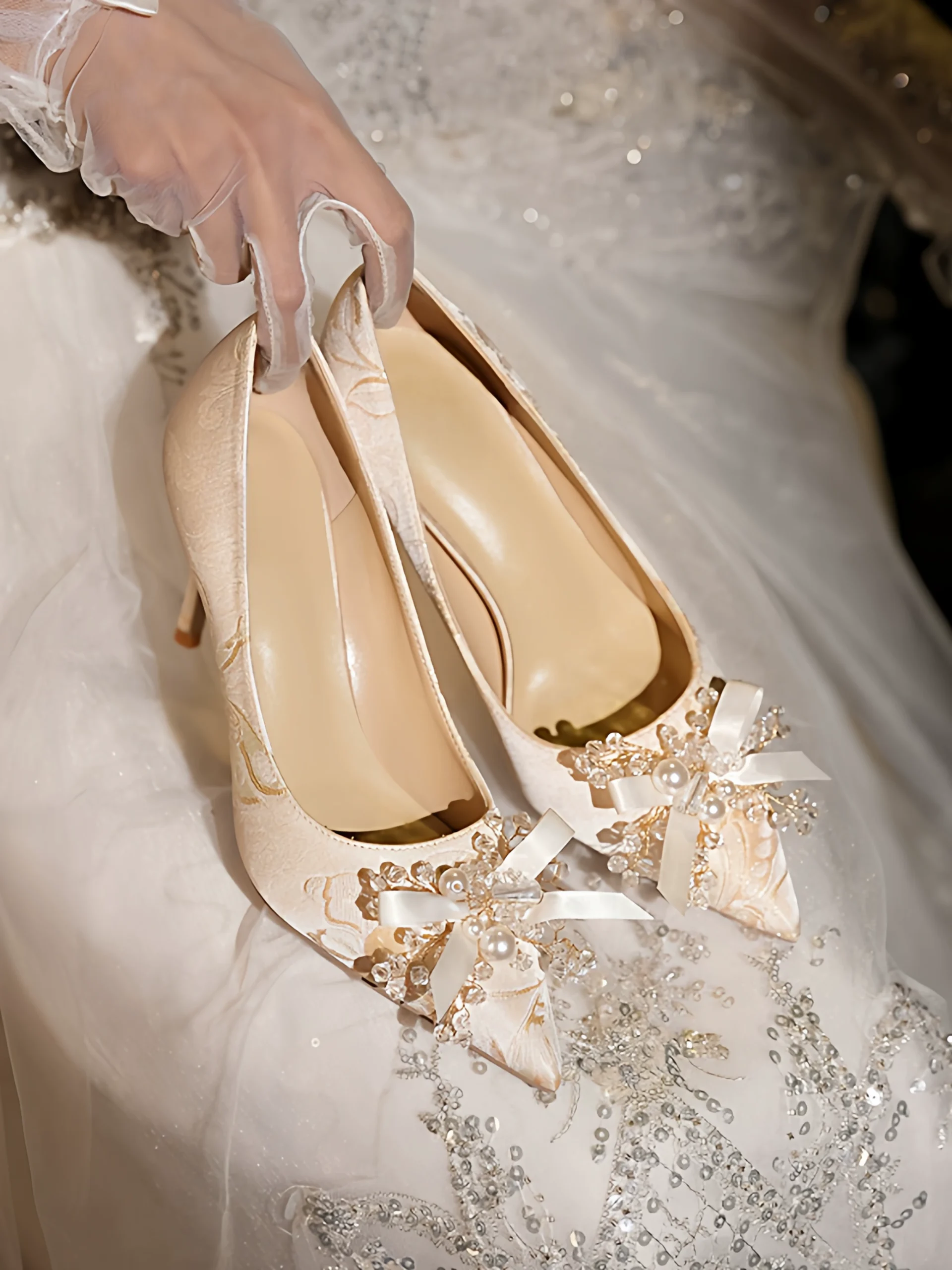
Black patent pumps are the classic, and they earn their keep. Just know that patent creases visibly across the vamp after a few wears and shows every scuff at the toe, so they need a wipe-down more often than leather. Matte leather and suede hide the wear better. High-heeled shoes have been around in roughly this form for centuries, and the pump is the version that never went away.
Stilettos: fun, gorgeous, and not for a Tuesday
A true stiletto has a slim heel under about 10mm across the tip, usually 70mm or taller. It’s the shape most people picture when they hear the word heels, and it’s also the one that gets bought and then sits in the closet for eight months.
Not gonna lie, nothing else does what a stiletto does to a silhouette. The narrow heel lengthens the ankle and makes the whole leg read longer. That’s the entire reason the shoe has survived a century of orthopaedic complaints.
They’re a mood, not a shoe.
The thing nobody warns you about is what they do to your gait. With a thin heel, your ankle has to do the stabilising work that a block heel would share. On carpet, fine. On wet pavement or a wooden deck, you’ll feel every wobble, and the little plastic heel tips wear down fast. Get them replaced early. A metal tip on stone stairs is genuinely dangerous, and a worn-down tip is how the heel itself gets damaged.
My take: own one pair, keep it for evenings and weddings, and don’t pretend it’s a commuting shoe. If you want the look with more forgiveness, look at a stiletto with a slightly thicker profile or a 70mm rather than 100mm. The visual difference on the foot is smaller than the comfort difference.
Kitten heels: the quiet comeback
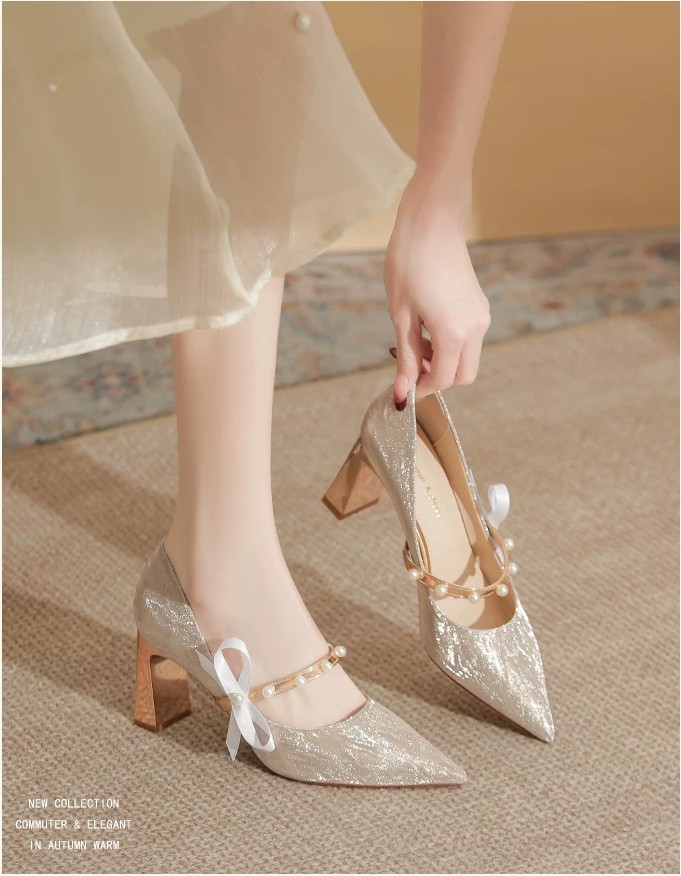
A kitten heel sits between 30 and 50mm and usually tapers to a small, slightly curved tip. It looks delicate, and for years it was treated as the shoe you wore when you’d given up. That reputation was nonsense, and the last few seasons have quietly corrected it.
They’re the easiest way into heels if you’re out of practice. The low pitch keeps your foot closer to flat, so your calf isn’t permanently shortened and your lower back isn’t complaining by mid-afternoon. They also photograph well with tailoring, which is why so many people who work in offices end up with three pairs.
The catch is the heel tip. Kitten heels have a small surface area, so a worn tip makes the shoe feel unstable long before it looks broken. Check the tip every few months. Also, a kitten heel with a very pointed toe can look dated fast. Almond or softly squared toes hold up better over time.
They also work well if you spend the day moving between carpet and pavement. The low pitch means you’re not constantly rebalancing, and that alone cuts the end-of-day ache more than any gel insole will. A lot of the types of ladies shoes heels marketed as “all-day” are really just kitten heels with better padding, and you can usually find the same thing for less without the label.
Slingbacks and mules: the open-back branch
A slingback has a strap around the heel and an open back. A mule is open at the back with no strap at all. Both are easier to fit than a closed pump, because your heel doesn’t have to match the shoe’s heel cup exactly.
That’s a real advantage if you’re between sizes or your heels slip in everything. The strap holds the shoe on, so you can size for the length of your foot instead of fighting for a snug heel fit.
Mules are the loosest of the lot. Great for a dinner where you’re mostly sitting, less great for stairs, and honestly not something I’d wear to a job interview. They also tend to slap against the heel when you walk, which is fine in a restaurant and annoying in a quiet office.
Slingbacks in a neutral leather are one of the most flexible shoes you can own. They read dressy with a skirt and relaxed with wide-leg jeans. If you only ever buy one open-back pair, make it that one.
Wedges and block heels: the comfort math
A wedge is a continuous sole from heel to toe. A block heel is a separate chunky heel. Both spread the load, and both are how people who genuinely walk a lot manage to wear height.
Wedges win on grass and gravel, because there’s no thin heel to sink into soft ground. That’s why they dominate summer weddings and garden parties. Cork and espadrille wedges are light and breathable, though they don’t love rain, and once the cork gets wet it can crack at the flex point above the toe.
Block heels win indoors and on city pavements. They’re sturdier, they last longer, and they pair with tailoring in a way wedges never quite manage. A 70mm block in black leather is possibly the most useful single shoe in this entire category. It’s not exciting. It just works.
One nagging downside: block heels can look heavy on a small frame, especially in a light colour with a very wide block. A slightly tapered block or a stacked heel gives you most of the stability with less visual weight.
Between the two, wedges and blocks cover most of the types of ladies shoes heels you’d wear for more than four hours straight.
Booties and Mary Janes: the seasonal edges
A heeled bootie covers the ankle. It changes how a whole outfit reads, and it’s the reason brown and black ankle boots outsell every other heeled style from October onwards. The shaft height matters more than the heel height here. A shaft that stands away from a slim ankle creates a visible gap with tights, and a shaft that hugs too tight won’t close over jeans.
Mary Janes are the other end of the spectrum: a low, often blocky heel with a strap across the instep. They’ve swung in and out of fashion three times in my lifetime and they’re currently in. Good with tights, good with socks, slightly awkward with a very formal dress. The strap can also cut across a high instep, so try before you buy rather than ordering blind.
Fit and material: the part that decides everything
Two minutes of testing beats an hour of reading. Stand in the pair on a hard floor for two full minutes. Then walk twenty steps at your normal pace, not a careful model walk.
If your heel lifts out of the back on the third step, the shoe is too long or the heel counter is too soft. An insole won’t fix it. If your toes slide forward and jam, the heel is too high for that last, or the insole has no grip. If the top edge digs into your instep when you sit down, it’ll be unbearable by hour three.
Material matters more in heels than in flats because there’s less margin for error. Soft leather moulds to your foot over a couple of weeks. Patent doesn’t mould at all, it just creases. Suede is comfortable from day one and hates rain. Synthetic uppers are cheaper and hold their shape, but they trap heat and crease in a sharper, more permanent line, and they never really adapt to your foot.
Check the lining while you’re at it. Pull the collar back with your thumb. Leather lining breathes and softens. Synthetic lining gets slippery once your feet warm up, which is how you end up with blisters in a shoe that felt fine in the shop.
How many pairs you actually need
Fewer than the internet suggests. For most people, four pairs cover nearly everything: a neutral pump for anything formal, a block heel that can handle a full working day, a low kitten or slingback for when you want a bit of height without thinking about your feet, and one pair you bought purely because you loved them.
That last one isn’t a joke. The types of ladies shoes heels that actually get worn are the ones you reach for without negotiating with yourself. Buy the sensible three first. Then buy the ridiculous pair, and wear it on a day when the walk is short and the photos matter.
And if you’re starting from nothing, spend the money on the block heel. It’s the pair that quietly pays for itself, week after week, while the stilettos wait in the box for their one big night.
Start with that one. Add the rest when a specific outfit asks for it.
