

You’ve found the light pink sneakers. They look exactly like the pair you had in mind, and now you’re standing in them wondering why your legs look shorter than they did five minutes ago in your other shoes. Nothing about your body changed. What changed is that the shoe sits lower at the ankle, and how much of your foot is visible changes the whole line.
Here’s the short version: on a pale sneaker, the collar height and your trouser hem matter more than the shoe’s own length. A low collar with a hem that stops right at the ankle bone cuts your leg into two stumpy sections. The same shoe with a hem that covers the collar looks completely different, taller and calmer. You don’t need different sneakers. You need the right hem in front of them.
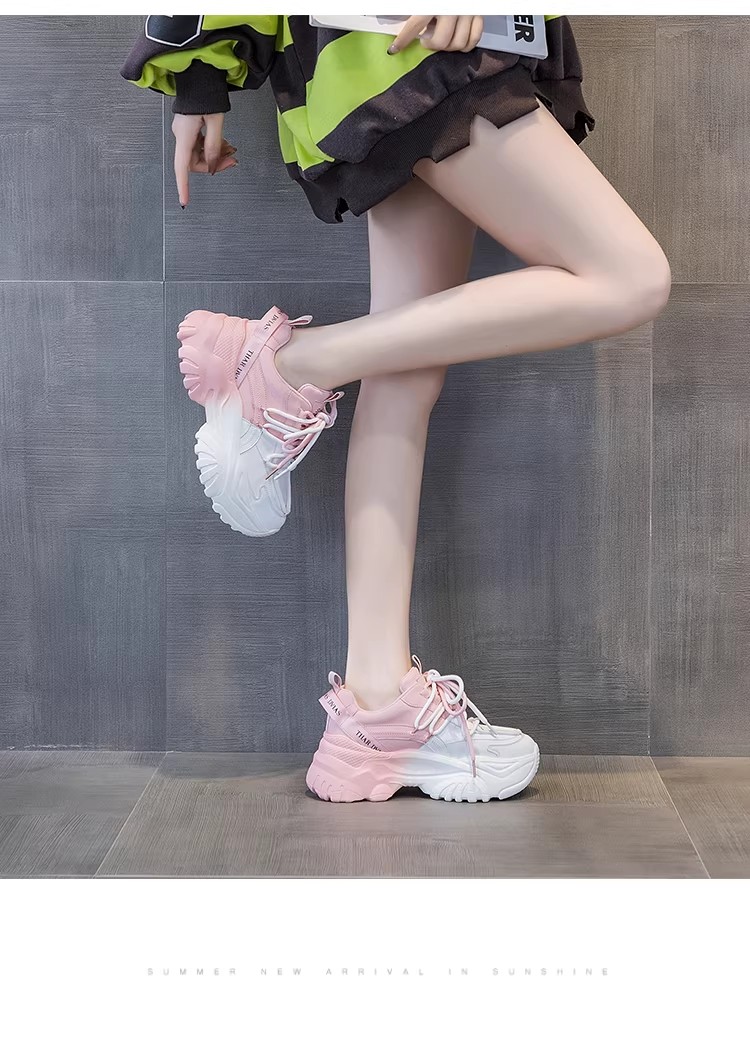
Where the collar lands on a 158cm frame and a 172cm frame
Take two women, same shoe, same size. On the 172cm frame, a low-collar pink sneaker with 6cm of bare ankle above it reads as sporty and light. On the 158cm frame, that same 6cm of ankle becomes a visual break in the middle of the leg, and the eye reads two short sections instead of one long line.
That’s not a rule about short women needing different shoes. It’s a rule about where the break happens. A break at the narrowest part of your ankle hurts you more than a break higher up the calf, because the contrast between narrow ankle and wider calf exaggerates the change in width.
The practical adjustment is small. On a shorter frame, either drop the hem to cover the collar entirely, or lift it well above the ankle bone so the break is deliberate rather than accidental. What doesn’t work is the middle: hem ending exactly at the ankle bone with 2 to 3cm of shoe showing.
Try it in a mirror with a pair of cropped jeans. Roll the cuff down so it sits over the collar, look, then roll it up 4cm, look again. Most people prefer the second version on a taller frame and the first on a shorter one. It takes ninety seconds and it tells you more than any styling article.
Height isn’t the only variable, either. Calf shape matters just as much. A straight calf with a defined ankle can carry a lower collar and a bigger gap. A fuller calf makes the same gap look wider than it is, because the contrast is doing more work. Two women at 162cm can need completely different hems for that reason alone.
If you’re unsure which group you’re in, take a photo from hip height rather than looking down at your own feet. Looking down foreshortens everything and makes every shoe look like it sits lower than it does.
There’s also the question of what’s above. A pale shoe against bare skin reads soft. The same shoe with black tights reads sharp, and the ankle break becomes almost invisible because there’s no colour change at all. If you want the lengthening effect in winter, tights in a tone close to the shoe do the job that a longer hem does in summer.
Crop, cuff or cover: the hem changes the same shoe three ways
The three hems you’ll actually wear with light pink sneakers behave differently, and the difference is measurable.
- Full-length trouser, hem to the floor. Covers the collar. The shoe shows as a toe and a hint of pink at the side. This is the lengthening option and the one that makes a pale sneaker look adult rather than childish.
- Cropped at 5 to 7cm above the ankle bone. Shows the collar and a strip of skin. Works if you commit to the crop and it’s clearly intentional. Fails if the crop is accidental, which usually means the trousers are simply too short.
- Cuffed, rolled twice. The casual option. The rolled edge adds visual weight right where you least want it, so it works better on a longer leg and a slimmer shoe.
A straight-leg jean with a single clean hem and no cuff is the safest combination for a pale pink sneaker. It lets the shoe be the light point of the outfit without turning your ankle into a dividing line. And if you want to test the difference properly, wear the same jean twice in one week, once cuffed and once not, and see which photo you prefer.
One thing to watch: pale pink next to pale denim can blend into a single washed-out block. If your jeans are light and your sneakers are light, you need one darker element between them, whether that’s a sock, a longer hem, or a different trouser entirely.
Wide-leg trousers behave differently again. A wide hem that covers the collar makes the shoe look smaller than it is, which is usually flattering. The same hem over a very low-cut shoe swamps it, and you end up looking like you’re wearing slippers to the office. If your trousers are wide, keep the collar in view by a centimetre or two so the shoe reads as deliberate.
And if you live in leggings, ignore most of this. A legging that ends at the ankle already has a clean edge, so the shoe is the only structure in the lower half. That’s the one case where a very low pink sneaker genuinely flatters a shorter leg, because there’s no hem competing with it.
The 3cm that separate petite from stumpy
There’s a specific measurement worth knowing. It’s the distance between the bottom of your trouser hem and the top of the shoe collar. Under 3cm, and you get a squeezed look. Over 8cm, and the ankle break dominates. Between 3 and 8cm, the shoe reads as part of the outfit rather than an interruption.
This is why the same light pink sneakers can look great on one person and slightly off on another with no difference in taste or budget. The variable isn’t the shoe. It’s a couple of centimetres of fabric.
How to fix it without tailoring:
- Change the sock. A thin no-show sock adds visible ankle; a crew sock in a matching tone fills the gap and unifies the line.
- Change the shoe’s collar height. A slightly higher collar fills the 3cm gap that a very low one leaves open.
- Change the hem. Half a turn of a cuff is often exactly the adjustment needed, and it costs nothing.
If you’re buying online and can’t try the combination, measure the hem of the trousers you wear most and compare it to the collar height listed on the product page. It sounds fussy. It’s faster than two returns.
Worth saying plainly: this measurement is a tendency, not a law. Plenty of people break it and look fine, because posture, leg length ratio and the rest of the outfit all pull their own weight. If you have a long torso and short legs, the 3cm to 8cm rule matters more, not less. If you’re the opposite, you can get away with a wider range.
The one version that almost never works is a hem that ends halfway down the shoe, cutting through the laces. That’s not a proportion problem you can style around. It’s a hem that needs to move up or down by at least 4cm.
A quick sanity check before you leave the house: sit down, cross one leg, and look at the gap. Sitting changes the hem position by a couple of centimetres, and if the outfit falls apart seated, you’ll notice it every time you’re at a desk.
Hem the trousers, not the shoe
The instinct when a pale sneaker looks wrong is to blame the shoe and buy a different one. Usually you’re solving the wrong problem, and you end up with three pairs that all look slightly off for the same reason.
Altering a hem is cheap and reversible in a way that altering a shoe is not. Taking 2cm off a wide-leg trouser costs less than a takeaway and changes the whole silhouette. If you’re shortening, keep the original hem so you can let it back down, and ask for a blind stitch so the finish stays clean with a casual shoe.
What you shouldn’t do is try to raise a shoe’s apparent height with a thick insole. An insert lifts your heel but leaves the collar where it was, so the ankle line doesn’t move, and now the shoe fits badly as well. If you want the visual effect of a higher shoe, buy one with a thicker sole. On the pink side, our 6cm-soled dad sneakers do that job honestly, and the pink and white version sits well under a full-length hem.
Shortening a hem yourself is genuinely easy for a straight-leg jean, and slightly risky for anything with a flare. Cut 2cm longer than you think you need, press the fold, try it on, then commit. A hem that’s 1cm off is invisible. A hem that’s 3cm too short can’t be undone.
If you’re not handy with a needle, the tape-and-iron hem tape route works for a season and fails in the wash. Fine for a test, not fine for a pair of trousers you’ll wear every week.
One more cheap fix that isn’t tailoring: press the hem. A curled or wrinkled hem adds visual thickness exactly where you don’t want it, and five minutes with an iron changes the line more than most people expect.
Measure with the trousers you’ll actually wear
Do this once and you’ll stop guessing. Put on the trousers you wear most with sneakers, stand in front of a mirror, and mark with your finger where the hem falls relative to your ankle bone. Then put on the sneakers and see how much of the shoe is exposed.
If the answer is “about 3cm of shoe and a sliver of ankle”, you’ve found the awkward middle. If it’s “just the toe”, you’re in the lengthening zone. If it’s “half the shoe”, the outfit is now about the sneakers, which is fine as long as you know you’ve made that choice.
Two more numbers worth having. Your ankle bone sits roughly 5 to 7cm above the floor on most adults, and the structure of the ankle joint is why that specific spot reads as a visual break. There’s nothing mystical about it. It’s the narrowest point of the leg, and narrow points attract the eye.
That’s also why a sock can rescue an outfit that a hem can’t. A sock in roughly the same tone as the shoe or the trouser fills the narrow point without creating a new edge, so the leg reads continuous. A contrasting sock does the opposite, which is a choice, just not the lengthening one.
Take the photo. Phone camera, standing back, full length, no cropping at the ankle. Most people judge their outfit from the waist up in a mirror and never see what their legs are doing, which is exactly why the hem problem goes unnoticed for years.
One last practical note for pale shoes: the visual weight of a light sneaker is low, so it can look undersized next to heavy winter trousers. If the outfit feels off in January and fine in June, that’s usually why, and the fix is a heavier shoe rather than a longer hem.
If you want to see how much difference a collar makes, compare a soft mesh sneaker with a low collar to a higher-cut pair in front of the same mirror. Same trousers, same person, different result. The women’s pink sneaker range has both cuts side by side, and if you’re still deciding on shade, this four-month check on a white and pink pair covers how pale pink ages. The basic anatomy of a shoe is a useful refresher if collar height is a new term for you.
Short version for the mirror tomorrow: put on the pale pink pair with your most-worn trousers, then change only the hem. Cover the collar and look. Show 6cm of ankle and look. Pick the one where your leg looks like one line rather than two, and buy your next pair to match that hem rather than the other way round.
