

You’ve bought your usual size, walked to the station, and by the time you sit down at your desk the outer edge of your foot is pressing against something hard. By 4pm you’ve loosened the laces twice. By 6pm you’re carrying the shoes instead of wearing them.
That’s not a sizing mistake in the usual sense. Your length is fine. The width isn’t, and the size chart on the box never mentions it.
Wide women’s walking shoes are treated like a niche category when they’re closer to half the market. Most women don’t have narrow feet, most shoes are built on a medium last, and the gap between the two is where blisters, bunions and a drawer full of regret come from.
Why Your Usual Size Fails at 4pm, Not 8am
Your foot changes shape during the day. Blood pools, the arch flattens slightly under load, and the whole package spreads by a few millimetres. In a roomy shoe you’d never notice. In a shoe that’s already touching both sides of your forefoot at breakfast, those few millimetres become pressure.
Walking makes it worse. Each step loads roughly one and a half times your body weight through the ball of the foot, and the forefoot spreads under that load. That’s why the pinch shows up on the outside edge first, near the little toe joint, and why it feels fine when you try shoes on in a shop at 10am.
So the first rule is boring and it works. Shop in the late afternoon, after you’ve been on your feet. If you’re buying online, order two widths when the brand offers them and send one back.
There’s a second rule that catches people who already know the first. Judge the fit with the shoes on for ten minutes, not thirty seconds. Lace them properly, stand up, and walk to the far end of the shop. The pressure that matters shows up once the upper has warmed up and your foot has settled into the footbed.
If you’re shopping for women’s walking shoes in a wide fit and the shop only stocks medium, ask them to order both. Most will, and it saves you a second trip.
Start with the ball of the foot.
Length gets all the attention because that’s the number on the box. Width is where the fit actually happens, and you can measure it in about 90 seconds with a piece of paper and a pencil.
- Stand on the paper with your full weight on that foot.
- Mark the widest point on the inside and the outside of the ball of your foot, just behind the toes.
- Measure between the marks. That number, in millimetres, is your forefoot width.
Typical women’s measurements run from about 88mm (narrow) to 105mm (wide), with most people landing between 92mm and 98mm. A standard B width is usually built around 90 to 93mm. If you measure 97mm, you’re not imagining the pressure.
Compare that to the sole width on the product page. Many listings give it, many don’t. When it’s missing, look at a top-down photo and check how much sole sticks out past the upper. A wide-fitting shoe usually shows 4 to 6mm of visible platform at the ball.
Write your number down. It’s more useful than any letter grade, because a brand’s “D width” is not a standard unit.
What “Wide” Means Brand to Brand
This is the part that makes people give up and buy men’s shoes. “Wide” is not a regulated measurement. One label’s wide is another label’s regular, and a third label’s wide is a genuinely roomy forefoot with the same narrow heel.
Three patterns show up again and again.
- Volume wide. Same sole, taller upper. Helps a high instep, does nothing for a broad forefoot.
- True wide. A wider last, meaning more sole under the foot. This is what you want if your little toe bulges.
- Stretch wide. Knit or mesh uppers that give 3 to 4mm. Useful, but they relax further over a month and can end up sloppy.
Ask which one you’re getting before you pay. A customer service reply that says “our wide is generous” tells you it’s volume wide, not true wide.
EU, US and UK: The Conversion That Trips Everyone
Conversion charts are approximations, and they get less reliable as sizes go up. The general mapping is documented in the comparison of international shoe sizing systems, and one detail matters more than the rest: EU sizes are based on a Paris point of 6.67mm, while US women’s sizes step in roughly 8.5mm increments. Those two systems drift apart.
Practically, a EU 39 is usually a US 8 to 8.5 and a UK 6. A EU 41 lands around US 9.5 and UK 7.5. The half-size gaps don’t line up, so if you’re between sizes, take the larger one when the upper is leather and the smaller when it’s knit.
Foot length in centimetres is the only number that survives borders. Measure heel to longest toe, standing, and add 10mm of clearance. If that gives you 25.3cm, you’re looking at EU 40 in most walking shoes regardless of what the US conversion says.
The Toe Box Shape Nobody Puts on the Box
Two shoes can both measure 100mm across and feel completely different, because width isn’t the only variable. Shape matters just as much, and it’s almost never listed.
A tapered toe box narrows quickly from the ball, which suits a foot whose toes slope down in a line. A rounded or square toe box keeps width further forward, which is what you need if your second toe is longer than your big toe or if you’ve got a bunion developing.
Check this by looking at the shoe from above with the insole pulled out. Trace the outline of your foot onto paper, cut it out, and lay it on the insole. Anywhere the paper hangs over the edge is where you’ll get pressure. That test takes five minutes and catches more fit problems than any size chart.
Depth counts as well. A shallow toe box will press on the top of your toes even when the width is right, and that’s the ache people describe as “the shoe is too small” when it’s actually too flat.
Three Different Problems That All Get Called “Wide Feet”
Broad forefoot, high instep and bunion are three separate issues, and they need different fixes. Buying a wider shoe helps the first, sometimes helps the second, and can make the third worse if the upper is stiff.
Broad forefoot? You need more sole under the ball. Look at true wide lasts and give the shoe a twist test. If it flexes easily at the ball, it won’t fight your foot.
A high instep needs volume, not width. That means a taller upper, a gusseted tongue and laces that can be adjusted in two zones. If the top of your foot aches after an hour, you need depth.
A bunion needs space plus a soft upper over the joint. Stiff leather will rub it raw. Knit or soft nubuck with a wide toe box is the kinder combination, and the clinical overview of bunions is clear that footwear pressure is a major contributor to symptoms.
None of this is a diagnosis. It’s a shopping filter. Get the shape right and half the discomfort disappears without an insert.
One overlap worth knowing: a bunion on one foot often changes how you walk, which then loads the other foot differently. If both sides hurt, the shoe is probably the common factor. If only one does, look at the shoe’s shape on that side and at your own gait before blaming the pair.
When to Size Up, and When to Walk Away
Sizing up is the internet’s answer to everything and it’s often wrong. If the length is short, size up. If the width is tight and the length is right, sizing up gives you a longer shoe with the same narrow sole, and your heel will slip.
Walk away when three things happen at once: your little toe touches the upper, the widest part of your foot sits behind the widest part of the shoe, and the heel slips when you size up. That combination means the last is wrong for your foot, and no amount of breaking in fixes a last.
Also walk away from any pair described as “runs small, size up two.” A shoe that needs two sizes up is a shoe with a fit problem the brand hasn’t solved.
If you’re between two pairs, take the one that feels roomy at 10am. The pair that feels snug in the morning is the pair you’ll resent by afternoon. This is why cheap walking shoes that fit badly cost more per wear than a full-price pair you actually wear.
Breaking In a Wide Pair Without Blisters
Wide shoes break in differently from narrow ones. The upper relaxes at the flex point, which is usually across the base of the toes, and the heel counter softens at the top edge. Do too much too soon and you’ll get hot spots exactly where the shoe is still stiff.
Start with two 30-minute walks on consecutive days, then a 5km day, then a normal day. Wear the socks you’ll actually use, because a thin sock changes the fit by about 2mm and that’s enough to matter.
If a spot starts rubbing, don’t wait for a blister. A small piece of moleskin over the hot spot, plus a heel-lock lace pattern, usually solves it. If the rubbing continues after three walks, the shoe is the problem, not your foot.
Machine washing is fine for mesh uppers on a cold cycle, but air dry them. A tumble dryer will shrink the upper and undo the width you paid for.
Before you return a pair, try two cheap fixes. They solve a surprising share of width complaints, and both take less time than a trip to the post office.
Lacing first. Most shoes leave the factory in a criss-cross pattern, which pulls the two sides of the upper together evenly and squeezes the widest part of your foot. Re-lace the middle section straight across, leaving the top two eyelets criss-crossed for heel hold. That single change takes pressure off the ball while keeping the ankle locked.
Socks second. A thick cotton sock can add 2 to 3mm of volume, which is the difference between snug and painful. If you’re testing wide women’s walking shoes in summer, test them with the thin socks you’ll really wear. If you plan to wear wool in winter, test with wool.
There’s a third trick for a high instep: skip the top eyelet entirely. It looks wrong and feels better, and nobody will notice from across the room.
Wide Fits on Plane Days and Long Station Platforms
Travel is where a wide fit earns its money. Cabin pressure and sitting for hours push blood into your feet, and most people land half a size bigger than they boarded. If your walking shoes are already snug at the gate, the last hour of the flight will be miserable.
Wear the roomiest pair on the plane and keep the laces loose for the first hour. Compression socks help more than people expect, especially on flights over six hours. Then walk the terminal rather than sitting at the gate, because ten minutes of movement does more for swollen feet than any shoe feature.
Station platforms are the other weak spot. You’re standing still on concrete for 15 minutes, then walking fast with a bag. A wide shoe with a soft heel counter will let your heel lift when you hurry, which is how people end up with a blister on the back of the ankle before the trip even starts. A heel-lock lacing pattern fixes it.
If you’re packing two pairs for a week, make one of them the wide everyday pair and the other something narrower for evenings. Two wide pairs is more weight and no extra benefit.
One honest limitation: no wide fit will make a stiff leather shoe comfortable on day one. If you’re leaving in three days, buy mesh.
Three Pairs Worth Looking At in a Wide Fit
Mesh uppers are the friendliest starting point for a broad forefoot, because they give where a leather upper won’t. These soft-soled mesh walking shoes for women have a rounded toe box and a flexible ball, which suits a foot that spreads under load. The trade-off is support: the upper is soft enough that a heavy overpronator will want an insert.
If you want something with more structure under the arch, a dad-style pair with a 6cm platform gives you a wider base without the shoe looking clinical. This white platform dad shoe with a roomy forefoot runs about half a size large, so try your normal size first. The thick sole also helps on gravel and uneven pavements, though it does make the shoe heavier at around 340g.
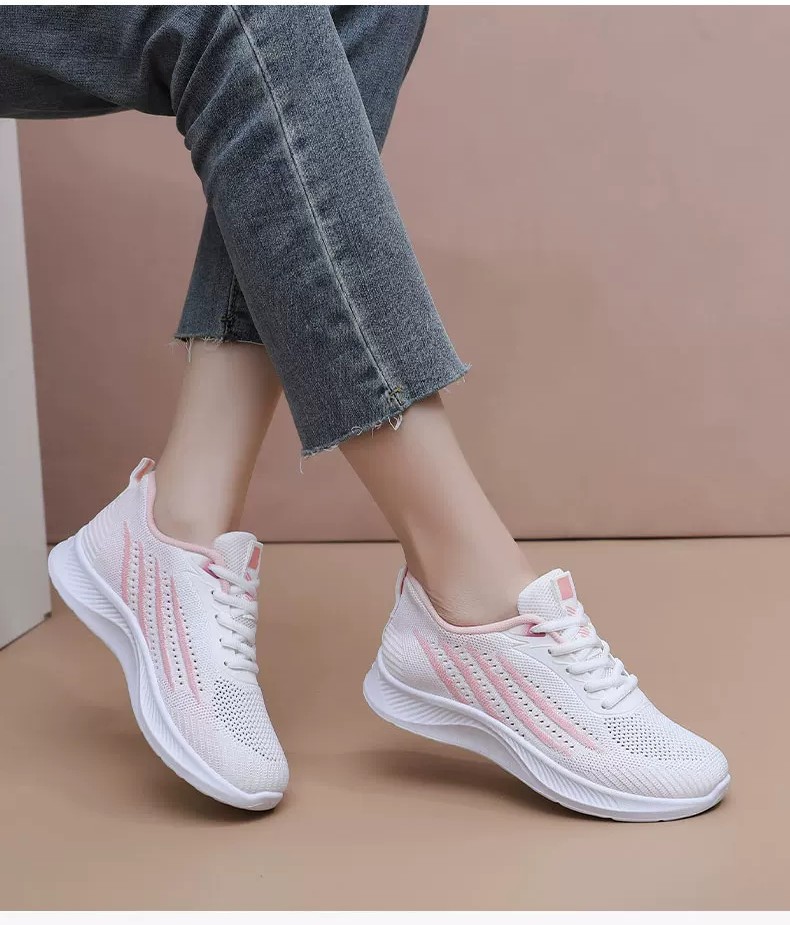
For something you can wear to work, a leather sports shoe with a soft heel counter is the middle ground. This leather everyday walking trainer has a slightly tapered toe, so it suits a broad forefoot better than a pointed toe but won’t work if your second toe is unusually long.
All three sit in the walking shoes collection alongside narrower options, which is worth browsing if you want to compare shapes side by side.

How to Read a Product Page Like a Fitter
Most listings give you four useful signals if you know where to look. None of them is the star rating.
- A photo of the sole from below. No tread shot usually means a smooth fashion sole, which is the wrong tool for long walks.
- A top-down photo. Compare the upper to the sole at the ball. Visible platform means a wider base under your foot.
- The size run. A brand that offers EU 34 to 42 on the same last is thinking about fit. One that stops at 40 is not.
- Review language. Search the reviews for the word “narrow” before you read the five-star ones. What people complain about is usually more useful than what they praise.
One more signal: whether the brand publishes a measuring guide at all. A page that tells you to trace your foot and measure the ball has been written by someone who understands the problem. A page that says “order your usual size” has not.
It’s also worth checking what the shoe weighs, because wide fits often add material. Anything above 360g per shoe will feel heavy after 10km, and wide women’s walking shoes are not exempt from that arithmetic.
You don’t need a fitting expert. You need a pencil, a piece of paper and five honest minutes.
Trace both feet, because most people are half a size different left to right and it’s usually the foot you don’t think about that causes trouble. Measure the ball width on each tracing. Then compare the wider foot to the shoe.
If the numbers don’t work, send them back. A return costs you a week. A pair that presses on your little toe costs you every walk for the next year.
