

You’ve got a pair of beige heels in the wardrobe that you wear maybe four times a year. A wedding, an interview, one dinner, then back in the box. That’s a lousy return on 120 euros, and the reason isn’t the colour. It’s that you’ve filed them under “dressy” and never tried them anywhere else.
Try this instead. Pick one beige pair and give it three outings in a single week: a garden wedding in the afternoon, a normal Tuesday at the office, and a dinner where you’ll be standing for two hours. Change nothing about the shoes. Change four things around them, and the same pair reads three different ways.
Here’s what those four swaps are, which one fails, and what to look for if you’re buying the pair rather than rescuing one you own.
One pair, three occasions: what changes and what doesn’t
The shoes stay. What moves is hem length, the bag, whether there’s a jacket, and how much of your leg is visible. Those four variables do all the work, because beige sits close to skin tone and stops competing with whatever else you’re wearing.
That’s also the catch. Beige is only neutral if it’s the right beige. A cool grey-beige next to warm skin looks grey, and a warm apricot-beige next to cool skin looks pink. This is the same shade problem that makes tan heels so hard to buy online, and it gets worse in photographs because the phone camera white-balances the whole frame.
So before the three outings, do one test at home. Hold the shoe against the inside of your forearm in daylight, near a window, not under a lamp. If the shoe disappears into the skin tone, you’ve got the right beige. If it reads as a separate object, that’s fine too, but plan around it, because it’ll look deliberate rather than neutral.
There’s a mechanical reason this matters so much with pale shoes. A heeled shoe shifts roughly 60% of your body weight onto the forefoot at 70mm, and any colour mismatch pulls the eye straight down to the place where the load is. Get the shade right and people see a leg line. Get it wrong and they see a shoe doing a job.
What each occasion actually asks of the shoe:
- Garden wedding: grip on grass, a heel that doesn’t sink, and no strap that catches on gravel.
- Office Tuesday: quiet on a hard floor, closed enough to look like work, and comfortable for 6,000 steps.
- Dinner, standing: stability after an hour, and a toe box that hasn’t compressed by dessert.
Three different demands. One pair can meet all three, but only if the heel is between 60mm and 75mm and the sole has some thickness under the ball. Below 60mm you lose the line that makes a beige heel worth wearing. Above 75mm you lose the grass, the standing, and probably your patience.
Keep the shoe itself unchanged across the three, though. If you swap the shoes too, you’ll never learn whether the problem was the pair or the outfit, and you’ll keep blaming a pair that’s actually fine.
Occasion one: a garden wedding at 3 p.m.
Grass is the enemy, and it’s not the heel height that betrays you. It’s the surface area of the tip. A 9mm stiletto tip on soft lawn sinks about 20mm per step, which means you walk on your toes and your calf does the work of a 5km hike by the time the cake comes out.
The fix is a wider tip, not a lower heel. A 12mm to 14mm tip spreads the load enough to stay on top of damp grass. If your pair has 9mm tips, a cobbler can fit wider ones for about 15 euros, and they don’t change the look from any normal viewing distance.
Then there’s the gravel path between the ceremony and the marquee. Thin straps collect small stones, and once one is lodged between the strap and your skin you’ll feel it every step until you take the shoe off. Two minutes with a fingernail before you go in solves it. So does choosing a style with fewer, wider bands.
Leather quality decides how the afternoon ends, too. A chrome-tanned upper with a coated finish wipes clean after a splash of Prosecco, while an unfinished nubuck drinks it. If you want to know what the finish on your pair actually is, the OEKO-TEX labelling standard for leather and textiles explains what the tags mean, and it’s a more reliable guide than the word “premium” on a box.
For the outfit, the swap that works is a midi hem that stops 5cm above the ankle, worn with a shoe in the same temperature as your skin. Not matching exactly. Close enough that the eye reads one continuous line from hem to floor. Add a small bag in a darker shade, and the outfit looks planned rather than accidentally beige.
The pair below is the closest thing to this brief in the range: a fine heel with a slim profile, cut in a shade the site calls champagne, from EU 33 to 40. It’s 216 euros, which is the top of the range, and you’ll see why that matters in the last section.
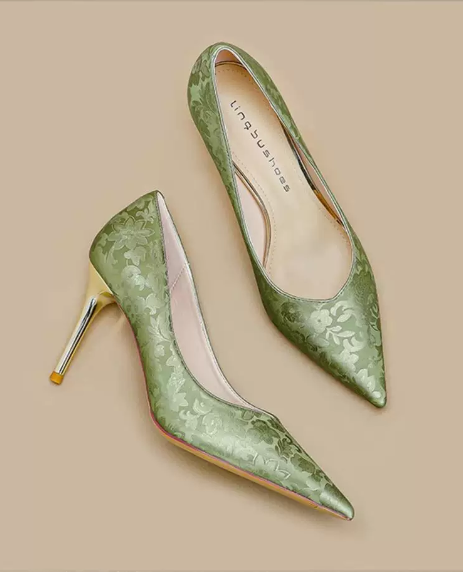
That’s the champagne slim-heel pump with the higher price tag. Worth it if you’ll wear them ten times. Not worth it if this is a one-wedding purchase, and I’d rather you bought the 119-euro pair and spent the difference on wider heel tips.
Occasion two: the office on a Tuesday
An open-shank or slingback beige heel can pass in most offices, and it will pass better than a black pump in summer because it doesn’t look like you’re dressed for a funeral. The issue is noise. A thin heel on a hard floor announces every trip to the printer, and in a quiet office that’s social pressure you don’t need.
Test it at home on tile before you wear them to work. If the click is sharp, a rubber heel cap costs 8 euros and kills about 80% of the sound. That’s the single most useful five-minute fix for office heels, and almost nobody does it.
The outfit swap here is a straight-leg trouser that breaks just at the top of the foot, plus a blazer that ends at the hip. The hem covering the instep is what makes an open shoe read as office-appropriate, because you only see the toe and 20mm of shoe. Same pair, completely different register.
Comfort for a workday comes down to one number: how much of your weight lands on the ball of the foot. At 70mm with a 10mm platform, you can do 6,000 steps with a gel pad and finish the day standing. At 90mm, you’ll be sitting more by 3 p.m. and you’ll notice it in your lower back before your feet.
One warning about mesh and woven finishes, which are common in beige heels. They look light and they breathe, but the mesh snags on the edge of a desk drawer and on the zip of a bag. Check the toe after every wear. A single pulled thread in a nude mesh is visible from a metre away, and no repair hides it.
The office also decides how much of the shoe you’ll actually see, which is why the hem matters more than the finish. Sit at your desk, cross your legs, and look down. If you can see the whole shoe, the trouser is too short for the room you work in. If you see the toe and a sliver of instep, that’s the proportion that reads as workwear in almost every office I’ve seen, from a design studio to a bank.
Occasion three: dinner where you’ll stand for two hours
Standing is harder than walking, which surprises people. When you walk, your foot loads and unloads 100 times a minute and the tissue gets a break. When you stand, one spot takes continuous pressure for an hour, and that spot is almost always the ball of the foot or the outside edge of the heel.
The dinner test happens at the 70-minute mark. If you’re shifting weight from foot to foot by then, the shoe is 10mm too high or the insole is 2mm too thin. Both are fixable. A 3mm leather insole costs 10 euros and buys you an hour. Raising the front by a cobbler costs 25 and buys you the whole evening, though it changes the angle enough that the shoe feels different.
For the outfit, the swap is a longer hem and a bigger bag. A column skirt that covers the knee, a bag you can hold in one hand, and no jacket. Beige heels with a long hem look expensive. Beige heels with a short hem and bare legs look like a summer office outfit, which is a different thing entirely.
Stability is the other half of standing comfort. A heel with a shank you can feel when you twist the shoe will keep your ankle upright on a polished floor; a heel with no shank rolls outward and your ankle does the correcting. Test it in the shop by holding the heel and the toe and twisting gently. Some give is fine. A shoe that folds like a sock is a shoe for sitting down.
The pair worth considering here is at the other end of the price range. Diamond mesh in a nude shade, 139 euros, EU 35 to 40. The mesh gives a little where leather doesn’t, which helps if your feet swell after 8 p.m., and the open texture keeps the shoe from looking heavy next to a long skirt.
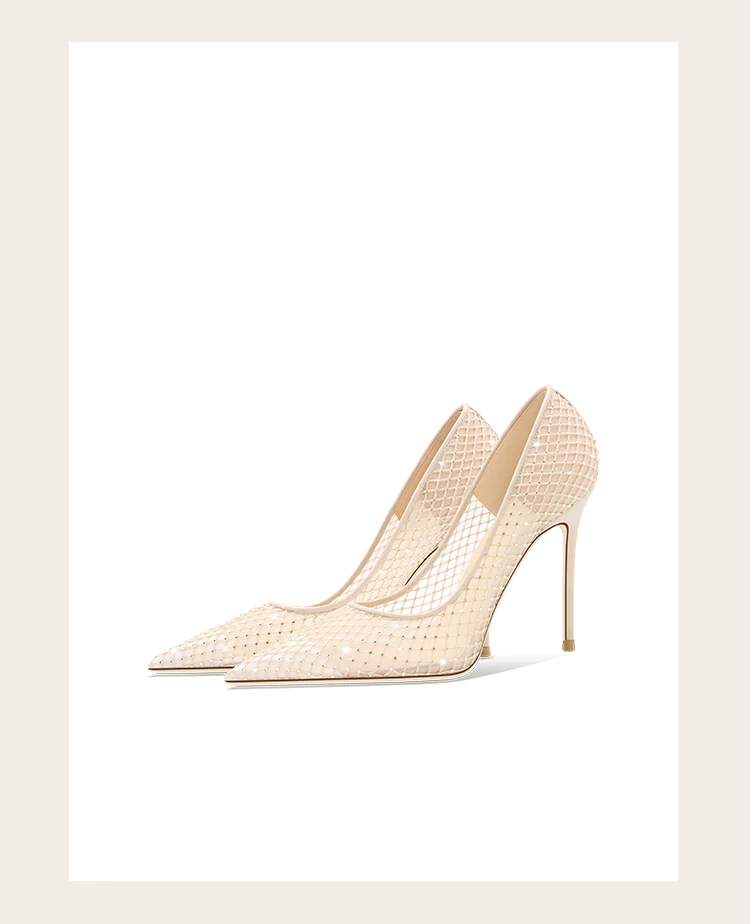
Those are the nude diamond-mesh heels with the softer upper. The trade is durability: mesh scuffs faster than leather at the toe, so keep them for evenings and don’t wear them to a conference with a wheely bag.
The four swaps, ranked, and the one that fails
Ranked by how much difference they make to the same pair of shoes:
- Hem length. Biggest effect by far. Same shoe reads formal at midi and casual at mini, and the change costs nothing.
- Heel tip width. Decides whether grass, gravel and wooden decks are usable. 15 euros at a cobbler.
- The bag. A structured bag pulls the outfit up; a soft tote pulls it down. No effect on comfort, big effect on register.
- A jacket or no jacket. Smallest effect of the four, and the one people overthink.
The swap that fails is changing the colour of your tights. Nude tights under a beige shoe create a second skin tone 20cm above the first, and the seam line at the ankle is visible in every photograph. If it’s cold enough for tights, wear a darker shoe and let the beige pair wait for a warmer day. That’s the honest answer, and it’s why so many beige heels sit in boxes from October to April.
Price deserves a straight word too. The 119-euro pair and the 216-euro pair differ in the upper, the lining and how the heel is attached, and you can feel all three by hand in a shop. What they don’t differ in is whether the colour suits you. A cheap pair in the right beige beats an expensive pair in the wrong one, every time, and no amount of styling rescues a shade that fights your skin.
If you want a second pair in a different height for the same three outings, the heels section sorted by style is where the champagne and nude options sit together. Two pairs at different heights cover more occasions than one expensive pair, and the second pair is the one you’ll wear on a Tuesday.
If you’re starting from nothing, the women’s shoe collection index is the faster way in than scrolling by colour. Filter by heel height first, then look at the shade in the photos, then check the size range. Sizes stop at 40 on many beige styles, and if you’re a 41 that’s the constraint that decides the purchase before anything else does.
Give the pair three outings in one week. If it survives a lawn, a Tuesday and a two-hour dinner, you’ll stop thinking of it as occasionwear and start reaching for it on ordinary mornings. That’s when a beige heel earns its shelf space.
