

It’s 8:10 on a Tuesday, the forecast says 32°C by two o’clock, and the pair of women’s open-toed heels you wore to a wedding in May is sitting by the door. You remember them as comfortable. By 11:40 you’ll remember them differently, because the strap that felt soft in an air-conditioned shop turns into a thin blade once your feet swell.
So here’s the short version, before the details. Most open-toe heel pain in hot weather comes from three places: a toe strap that’s too narrow, an ankle strap that sits above the bone instead of below it, and a heel height above 75mm on pavement that’s radiating heat. Fix the first two and the third stops mattering as much.
What follows is how to judge a pair in the shop, in about 90 seconds, and what to do with the pair you already own. No brand names, no guessing. You can check every point yourself with your own hand and your own twenty steps.
Your feet are roughly half a size bigger at 4 p.m. than at 8 a.m.
Heat does two things to a foot. Blood vessels near the skin widen, and the tissue between the bones holds more fluid, which is the same mild fluid retention that shows up as swelling in warm weather. In practice, on a warm day with 6,000 steps behind you, the foot can spread 3mm to 6mm across the ball and lengthen slightly. That’s most of a half size, which is why the pair you tried at 10 a.m. on a cool morning feels tight by late afternoon.
If you buy open-toed heels in the morning in summer, size for the evening. If you can only shop in the morning, try them on after walking for ten minutes, not straight off the stool.
There’s a second reason the toe box matters more in an open-toe shoe than in a closed one., the upper holds the foot and the toe box has walls to push against. In an open-toe sandal, the front edge of the shoe does the work, and your toes hang over it or they don’t. Nothing else is holding them back.
Two quick checks, both free:
- The paper test. Stand on a sheet of paper in the afternoon, weight on the foot you’re fitting. Trace the outline. Measure from the heel to the longest toe. Add 6mm. That’s your inside length for a sandal with a closed heel cup.
- The edge test. In the shop, push your foot forward until the heel sits against the back. If your big toe touches the front edge, the pair is a half size short. Open-toe styles don’t stretch lengthwise, and no cobbler can add it.
There’s one more pattern worth knowing. If your two feet measure differently, and most people’s do by 2mm to 4mm, fit the larger one. Open-toe styles can’t be stretched lengthwise, and a toe hanging over the front edge looks worse than a heel that sits 3mm forward inside the cup.
If the sizing chart on the page disagrees with your measurement, trust the tape measure. We wrote about the half-size problem in strappy sandals separately, and it’s the same issue: charts list foot length, shoes list last length, and the gap between them is where returns come from.
Width matters as much as length, and it’s the number nobody measures. Put your foot on the paper again and measure across the widest part of the ball. If you’re above 100mm, a strap that looks generous in the photo will still cut, because the strap length is fixed and the buckle only gives you 20mm of adjustment. Wide feet and open-toe heels aren’t enemies. They just need a strap that’s cut long enough, and you find that out by buckling it, not by reading a size guide.
High insteps cause a different problem. The instep pushes up against the front band, which lifts the heel out of the cup at the back. If you have a high arch and the shoe feels tight on top, the pair is too small, even if the length is right.
Three straps do the work, and usually one of them ruins the day
An open-toe heel holds your foot with a toe strap, an ankle strap, and whatever happens at the heel, either a closed counter or a sling. Each one carries load differently, and each fails in its own way.
The toe strap stops your foot sliding forward. It should sit across the ball of the foot, roughly 15mm behind the joints, not across the toes themselves. A strap that crosses the toes gets pushed by every step and starts to cut. Test it by pressing your thumb on the strap edge. If the edge feels like a folded card, it will rub. If it rolls under your thumb with a bit of give, it’s likely fine.
Ankle strap placement is the second trap. It should cross below the ankle bone, close to the narrowest part of the ankle, or well above it as a higher wrap. Right on the bone means pressure on a spot with no padding at all. Put the shoe on, then flex your foot up and down ten times. If you feel the strap catch on the bone, that’s the pair that will leave a red mark by noon.
The heel decides whether the shoe stays on when you walk. A slingback with a fixed buckle holds better than an elastic sling. A closed counter in thin leather can be comfortable from day one, but only if the top edge is finished with a soft roll rather than a raw cut. Run a fingernail along that edge. Sharp means blisters on the Achilles.
For a pair that gets worn to work rather than to dinner, the belted style matters more than the strap count. You can see the difference on these European-style belted heeled sandals with a thin heel: one adjustable band across the instep, one ankle strap, and nothing else competing for space on the foot.
Why the toe post feels fine in the shop and cuts by lunch
A thong-style open toe concentrates force on a 12mm strip of skin between the first and second toe. In the shop you take fifteen steps, the strap is soft, and nothing hurts. Then you walk 4,000 steps on hot pavement and the skin between the toes, which is thin and has almost no fat under it, gets abraded at the same spot thousands of times. Repeated friction like that is how a friction blister forms in the first place.
The first hour is fine. The third hour is when people start walking on the outside of the foot to avoid the rub, and that changes your gait enough to make your knee complain by evening.
Two things help, and one doesn’t. What helps: a toe post made of rolled leather or suede rather than a flat strap, and a post that’s set slightly forward so it sits in the gap rather than pressing the side of the toe. What doesn’t help: breaking them in around the house in socks. The strap softens, but the geometry stays, and the rub comes back the moment you add distance.
There’s a cheap way to test this before you buy. Put the shoe on and stand on a hard floor for two minutes without walking, then take it off and look at the skin between your toes. If there’s already a pink line from standing still, walking will double it. If the skin looks unchanged, the post is sitting in the right place.
If you want the open front without the post, a toe-cap or wide-band sandal is the safer build for a long day. The pair below has a closed front band that spreads pressure across the whole ball of the foot instead of one strip of skin, and it comes in black or pink from EU 34 to 40.
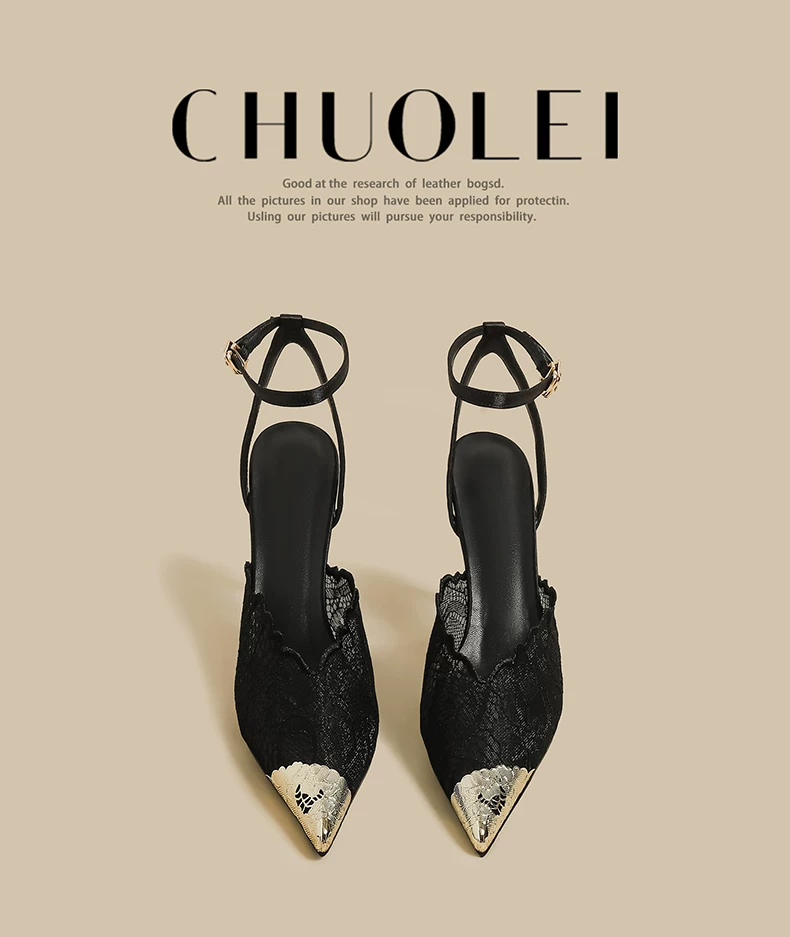
That’s the heeled sandal with a closed toe cap for long days, and the front band is the reason it survives an afternoon better than a thong. It won’t look as bare as a strappy pair. That’s the trade.
The 75mm ceiling once the pavement is 40°C
Heel height gets blamed for everything, and height alone isn’t the problem. Angle is. At 75mm with no platform, the foot sits at roughly 20 degrees of plantar flexion, and most of your weight moves to the ball of the foot. Add heat, add swelling, and the ball of the foot becomes the hottest, most compressed part of your body by mid-afternoon.
A platform changes the math without changing the look. A 90mm heel with a 20mm front platform gives the same visual height as a 90mm stiletto but only 70mm of actual drop. The idea behind a platform sole is older than most people assume, and it has always solved the same problem: height without the ankle angle.
Your ankle works less, your forefoot takes less load, and the shoe photographs identically.
Practical ceilings for a day that involves real walking:
- Up to 50mm: fine for 8,000 steps if the toe strap is right.
- 50 to 75mm: fine for 4,000 to 6,000 steps, better with a 10mm platform.
- 75 to 95mm: plans of 2,000 steps or fewer, or a seated event.
- Above 95mm: doorway to car to chair. Nothing more.
The platform point is worth repeating because it’s where most people misjudge a pair from a photo. Two shoes can look like the same height on a shelf and behave completely differently on a pavement, and the difference is 15mm of sole under the toes. Check the side profile, not the number in the product name.
One more number that surprises people: heel tips wear faster in heat. A 10mm tip on hot asphalt can lose 2mm in a season of daily wear, and once the tip is worn through, the heel pin starts chewing the leather above it. Replace tips at 7mm, not when you can see metal. Our full heels range lists heel heights in the product names, so you can filter by the number instead of guessing from photos.
If you want the height with a broader front, this pointed-toe sandal with a slim heel and a wider front band is the shape to compare against a bare thong. Same 155-dollar bracket as most mid-range pairs, sizes 33 to 38, so it’s a real option if you have a small foot.
A 90-second check in the shop, in this order
You can’t test a shoe for four hours in four minutes. You can find the four things that will fail first, and that’s enough to decide.
First, the edge test, about 20 seconds. Run a thumb along both edges of the toe strap and the top edge of the heel counter. Any hard, sharp or glued-and-unfinished edge is a blister in waiting. Soft, rolled or stitched edges pass.
Then the buckle. Fasten the ankle strap on the hole you’d actually use, not the loosest one. If you’re on the last hole and it’s still tight, the strap is cut short for your ankle. If you’re on the first hole and there’s 40mm of strap flapping, that’s a fit problem too, just a fixable one with a punch.
Next, twenty steps on a hard floor. Not carpet. Carpet hides a loose heel and a slipping sole. Listen for the heel tip clicking unevenly and feel whether your heel lifts out of the cup at each step. If it does, the shoe is too long or the strap is doing nothing.
Last, the push test. Stand still and press down through the ball of your foot as if you’re about to step. Watch the toe strap. If it bulges outward and the front edge lifts off the floor, the sole is too flexible for the height and your toes will do the work of holding the shoe together. That pair will feel great for ten minutes and awful by hour three.
Height isn’t the only number worth checking on the sole. Squeeze the shoe between your thumb and fingers at the arch. A sole that twists easily under a 90mm heel will roll outward on uneven pavement, and that’s how ankles go over. For a heel above 60mm, you want very little twist and a shank you can feel through the midsole.
Do this in the afternoon if you can. If you can only shop at 10 a.m., do the twenty steps twice with a lap of the shop in between, and buy the size that fits at the end of that lap.
Fixes that buy you three hours, and two that don’t
You already own the pair. Here’s what actually extends the wear window, ranked by how much difference it makes per euro spent.
- Gel ball-of-foot pads, 3 to 6 euros. The single best return. They move 3mm of cushioning under the metatarsals, which is where the heat and load concentrate. Get the thin fabric-covered ones, not the thick silicone domes that push your heel out of the cup.
- Anti-friction balm or stick, 8 to 12 euros. Apply to the skin where the strap crosses, not to the strap. Ten seconds per foot before you leave, and the same spot stops complaining for a whole evening.
- Suede heel grips, 5 euros. Useful only if the sling is slipping. They won’t fix a shoe that’s a half size long, and they’ll make a tight pair worse.
- A cobbler stretching the toe strap, 10 to 20 euros. Works on leather, does nothing on PU or patent. Ask for a 2mm stretch, not “as much as it’ll go”.
If you’re wearing the pair for a wedding or a long dinner, plan the tape before you plan the outfit. A strip of soft paper tape over the spot where the strap crosses the ankle bone costs about two euros and prevents the one blister that makes you take your shoes off at the table. Put it on clean, dry skin twenty minutes before you leave, and it’ll survive a whole evening.
Cost per wear changes the maths here too. A 12-euro balm and a 6-euro pad set used across three pairs is 6 euros per pair. Compare that with a 40-euro cab home because your feet gave out at ten, and the pads pay for themselves the first night.
What doesn’t work: talcum powder inside an open shoe. It feels cool for twenty minutes, then turns into a paste against sweat and increases friction. Same story with thin no-show socks under a strappy sandal. The sock edge adds a second rubbing line right where the strap already sits.
Conditioner is the other cheap fix. Straps on leather sandals dry out in heat and sun, and dry leather rubs harder. A neutral leather balm worked into the inside of the strap every two weeks keeps the surface soft enough to slide instead of grab. Skip it on patent and on anything with a metallic finish, because those surfaces are coated and the balm just sits on top.
One honest exception. If your feet sweat heavily, a spray antiperspirant on the sole of the foot in the morning does more than anything you can put in the shoe. It’s not glamorous advice, and it works. Do it the night before as well as the morning of, because it takes a few hours to plug the ducts that produce sweat.
Walk away when the toe box is narrow, not when the price is high
Price tells you almost nothing about whether an open-toe heel will work for you. Construction does, and you can see most of it in the shop.
Walk away when the front edge of the sole curves up sharply under the toes. That shape looks elegant on a shelf and forces your toes to curl to stay inside. Walk away when the toe strap has no adjustment at all and the fit is “close”. Walk away when the ankle strap sits dead centre on the bone and there’s no second hole to move it. And walk away when the leather feels like plastic film with a shine: PU doesn’t stretch, so a tight pair stays tight forever.
Buy when the strap edges roll under your thumb, the ankle strap crosses below the bone, and you can walk twenty steps on tile without your heel lifting. Heel height is the last decision, not the first, because a 70mm pair that fits beats a 50mm pair that doesn’t.
If you’re shopping for a specific occasion rather than a number, start with the wider women’s shoe collection and filter by the toe shape you want, then check strap placement in the photos. It’s faster than scrolling heels by colour. And if you’re deciding between two pairs at different prices, wear the cheaper one for a full afternoon at home with the tags on before you commit to the expensive one. Sometimes the 79-dollar pair fits your foot better, and there’s no shame in that.
One last thing about the heat. Shoes that survive a hot summer are the ones you rotate. Two pairs worn alternately last three times as long as one pair worn daily, because the leather dries between wears and the straps recover their shape. Give yesterday’s pair a night on a shelf with newspaper inside and they’ll be ready again by Thursday.
