

The forecast says 8°C and the invitation says smart. You have black heels at three inches, a pair of 80-denier tights and about ninety seconds to decide whether that combination works or whether you’ll be cold and uncomfortable by 10am.
Short answer: it works, and the cold isn’t the part that usually fails. What fails is fit. Tights change the volume inside the shoe by roughly a third of a size, and a three-inch heel is unforgiving about that change because the foot slides forward into the toe box as the heel lifts.
Below are the four things that decide whether a pair of black 3-inch heels is a cold-weather shoe or a summer shoe, in the order they matter. Then the practical detail: which tights, where the wind gets in, and what to check before you pay.
Four things decide it, and fit comes first
Ignore insulation for a moment. A pump is never warm. What you’re actually managing is fit, grip, and the visible line between the shoe and your leg.
- Volume: tights add material, so a shoe that fits bare will be tight with 80 denier and tighter again with wool.
- Heel height against the surface: 76mm on wet paving is a different proposition from 76mm on carpet.
- Hem position: a hem that clears the ankle keeps the leg line continuous, and it also keeps the wind off.
- Sole grip: the outsole on a dress heel is usually smooth leather or a thin rubber patch, and both are poor on cold, damp ground.
Everything else is decoration. A pair that fits well in tights and has a rubberised sole will be comfortable at 8°C. A pair that’s half a size small will hurt whether it’s November or June, and the cold just makes you notice sooner.
The order matters because people fix the wrong problem. If your feet hurt after an hour in the cold, the instinct is to blame the temperature. Nine times out of ten it’s the toe box, and the tights turned a snug fit into a tight one.
One clarification about temperature. At 8°C, a pump with tights is genuinely wearable for a normal day of walking between buildings. At 2°C, with wind, the same shoe becomes a 20-minute shoe, meaning it’s fine for the walk from the car to the door and nothing longer. That’s not a failure of the shoe. It’s just the honest limit of a shoe with no upper coverage, and knowing the limit saves you from buying a pair you’ll resent.
There’s also a question of what you’re comparing against. Black 3-inch heels in winter compete with boots, and boots will always win on warmth. They don’t win on everything else. A pair of heels under a wool trouser looks sharper than a boot, takes less space under a desk, and works for an evening without a change of clothes. If that’s the trade you want, the four points below tell you how to make it work rather than whether to attempt it.
What three inches actually measures
Three inches is 76mm, measured at the back of the heel. That’s the number to work from, because heel heights in shops get rounded up and down in ways that make “mid heel” meaningless.
Where the measurement lands depends on the shoe. A 76mm heel with no platform puts your foot at roughly a 30-degree angle. A 76mm heel with a 10mm platform under the toe reduces the effective angle to about 25 degrees, which is noticeably easier to walk in. Same stated height, different shoe.
The practical consequence for cold weather is that a platform pair keeps your forefoot further from the ground, and cold comes up through the sole. A 10mm platform is worth more than a thicker sock on a wet pavement. It’s not elegant, but it’s the difference between numb toes and comfortable ones after twenty minutes outside.
For reference, the mechanics of load distribution at different heel heights are covered in the standard reference on heeled footwear, and the short version is that anything above 60mm shifts a meaningful share of your weight to the ball of the foot. At 76mm, you feel the surface you’re standing on much more directly than you would in a flat.
That last point explains why a 76mm black heel can feel fine on an office carpet and punishing on a station concourse. The shoe hasn’t changed. The amount of force going through a small area of your forefoot has, and cold ground makes the same force feel sharper because the tissue under your foot is less pliable when it’s cold.
Check the platform before anything else when you’re buying black 3-inch heels for winter. Turn the shoe over and look at the gap between the sole under the toe and the ground. If there’s a visible slab, you’ve got 8mm to 12mm of separation from the cold and a shallower walking angle. If the sole meets the ground in a thin line, the height is doing all the work and your toes will feel the pavement.
Tights change the fit more than the temperature
This is the part that decides whether the outfit works, and it’s almost never discussed.
Denier measures yarn weight, not warmth directly, but the two track closely enough to use as a rule.
- 40 denier: sheer, adds about 0.2mm of thickness. Fit change is negligible; warmth is negligible too.
- 80 denier: opaque, adds roughly 0.4mm. This is the sweet spot for 8°C to 12°C and the level most black heels are designed around.
- 120 denier and up: adds 0.6mm or more, and now you’re into half-size territory. Feet also slide less, which helps, but the toe box gets tight.
The numbers are small and the effect isn’t. An extra 0.4mm around the forefoot is roughly a third of a size in volume. On a shoe with a pointed toe, that’s the difference between comfortable and pinching after forty minutes.
If you know you’ll wear 120 denier or wool tights, buy the pair half a size up and add a heel grip. If you’re between sizes and plan to wear 80 denier, take the larger size. That single decision prevents most of the cold-weather complaints people blame on the shoe.

One more effect worth knowing: tights reduce friction, so the heel slips more inside the shoe. That’s why a pair that gripped bare skin in September starts clicking loose in November. A heel grip costs very little and solves it entirely.
Wool tights are a separate case. They’re warmer, but they’re also thicker at the heel and toe, and the toe seam is the detail that ruins an otherwise good fit. If the seam sits across the top of your toes and you can feel it through the shoe, the pair is too short for wool. Test that before you commit to a winter wardrobe around one pair of shoes.
Here’s the version that surprises people: 80 denier is usually the best match for black 3-inch heels, not the heaviest tight you can find. Heavier tights change the fit, reduce the slide that lets your foot settle, and make the shoe feel smaller than it is. If you want warmth without volume, add an insole rather than going up a denier step.
Where the wind actually gets in
A closed pump is warmer than it looks, and the heat loss happens in two specific places.
The first is the topline, where the shoe meets the top of your foot. On a low-cut pump, that opening is the whole surface area of your instep, and wind across it pulls heat out continuously. A higher-cut vamp covers more and is measurably warmer, which is why court shoes with a deeper throat feel better in winter than a low-cut d’Orsay style.
The second is the sole. Leather soles conduct cold from the pavement straight into the foot, and there’s nothing between you and the ground but 6mm of leather. A rubber sole or a thin felt insole changes the experience more than a heavier tight does.
What doesn’t help much: thicker socks. Once the volume is used up, a thicker sock makes the shoe tighter, which restricts circulation, which makes your feet colder. That’s the counterintuitive bit. Loose and dry beats thick and tight every time.
Ankle exposure is the third factor and the most visible. A hem that stops 3cm above the ankle leaves a strip of tight-covered skin exposed, and that strip is where you’ll feel the wind at a bus stop. It won’t make your feet cold, but it will make the outfit feel wrong.
The exposure maths is simple enough to plan around. Ten minutes of standing at 8°C with a 4cm gap above the ankle is noticeable but fine. Twenty-five minutes at a windy platform is not, and no amount of thermal tight compensates for air moving across a thin layer of nylon. If your commute involves a wait outdoors, that’s the argument for the trouser option, and it’s the only argument you really need.
Cut matters here more than fabric. A d’Orsay pump, the kind with the sides cut away, is effectively an open shoe with a closed toe, and it behaves like a sandal in wind. A court shoe with a full quarter keeps the sides of your foot covered and is noticeably warmer at the same heel height, which is why the closed shape is the one to look for if winter wear is the plan.
The hem gap rule for a 76mm heel
Three-inch heels change the proportion of a hem, so the length that worked with flats will look different.
The working rule: a hem should end either well above the ankle or below the calf, never right at the ankle. On a 76mm heel, a midi that ends at the narrowest part of the ankle makes the leg look shorter and the shoe look heavy. The same midi, 4cm shorter, reads completely differently.
Three combinations that work reliably.
- Midi, ending mid-calf: the safest option with black heels and opaque tights, and warm enough for 8°C.
- Above the knee with dark tights: works if the shoe is plain. Avoid with straps or hardware, which makes the whole outfit busy.
- Trouser, breaking just above the shoe: the warmest option by a distance, and the one that hides a scuffed toe.
The trouser option deserves more attention than it gets. A wide-leg wool trouser that grazes the top of the shoe keeps the ankle covered and makes a 76mm heel do its proportion work without exposing any skin. On a cold day, that’s the difference between walking to the venue and taking a taxi for 400 metres.
If you’re working with a skirt, measure rather than guess. Put the skirt on with tights and the heels, stand in front of a mirror, and note where the hem falls relative to the top of the shoe. Anything within 5cm of the topline is the danger zone, because it draws the eye to the join and cuts the leg line at its narrowest point. Shorter than that, or longer than that, and the proportion works.
Colour is the other half of the rule. Black tights with black 3-inch heels create one continuous block from hem to floor, which lengthens the leg and hides the shoe almost entirely. Sheer or navy tights break that block at the ankle and make the shoe read as a separate object. Neither is wrong, but the effect is very different, and it’s worth choosing deliberately rather than by habit.
The layer people forget
Nearly everyone thinks about tights and nobody thinks about the insole.
A felt or wool-felt insole, cut to shape and dropped in, adds maybe 3mm of insulation and takes the cold edge off a leather sole. It also absorbs a little moisture, which matters because cold feet sweat too, and damp feet get cold faster than dry ones.
Cost is trivial, and it’s removable, so the same pair goes back to being a summer shoe in April. That’s a better investment than buying a separate winter pair unless you’re outside for hours at a time.
Second forgotten layer: the top of the foot. A pump leaves the instep exposed, and a thin ankle sock under the tight covers about 4cm of it without changing the visible line. Sounds fussy until the first really cold morning, and then it’s the difference between comfortable and distracted.
Third: keep a spare pair of tights at work. Not for warmth. For the moment a nail catches and a run appears at 9am, which is a different kind of cold-weather disaster and much harder to solve without a spare.
Insole choice is worth two minutes of thought. Felt is warm and cheap and compresses within a season. Wool felt lasts longer and handles moisture better. A thin foam insole adds cushioning but almost no insulation, so it’s the wrong pick if cold is the problem. Whichever you choose, trim it to the original insole rather than to the shoe, and check that it doesn’t push your heel up out of the counter, because that reintroduces the slip you spent money to fix.
One combination that works better than expected: a felt insole plus a thin ankle sock under the tight. Together they add around 4mm and cover the instep without changing how the shoe looks. On a cold morning that’s the difference between arriving at a meeting with cold feet and arriving without thinking about them at all.
Grip, salt and wet pavement
Cold weather means wet ground, and wet ground is where a dress heel stops being a shoe and becomes a balancing act.
Two things to check before you wear a pair outside in November.
- The sole material: smooth leather on wet stone has almost no grip. A thin rubber or TPU sole, or a rubber patch at the heel, is safer by a wide margin.
- The heel tip: a worn tip has a bigger contact area and less bite. If the tip is more than 2mm worn down, replace it before winter rather than after.
Grit and salt are the other problem. Road salt is abrasive and mildly alkaline, and it sits in the seams of leather. Wipe the shoes with a damp cloth at the end of the day rather than the end of the week. Left for a week, salt leaves a pale tide line that’s hard to remove from black leather without dulling the finish.
There’s a cheap upgrade worth knowing about: adhesive sole grips, the textured pads you stick to the forefoot. They cost less than a coffee, they’re invisible, and they turn a slippery pair into something you can walk in on wet paving. I’d fit them before the first cold wear rather than after the first slip.
Walking technique matters too, and it’s free. On wet or icy ground, shorten your stride and put the heel down almost flat rather than striking the tip first. Most slips on a 76mm heel happen because the tip lands on a wet joint in the paving and skids forward. A shorter stride keeps the tip under your body weight instead of ahead of it.
Genuinely icy pavement changes the answer: no pair of black 3-inch heels is the right shoe, and it’s worth saying plainly. Grit helps for a few metres. Walking on the road-side of the kerb where salt has been spread helps more. But a smooth sole on ice is a fall waiting to happen, and one bad landing costs more than a pair of winter boots.
What to check in the shop, in five minutes
If you’re buying a pair specifically for cold weather, the checks are different from a summer purchase.
- Try them on with the tights you’ll actually wear. Bring a pair of 80 denier. Bare-foot fitting is the single most common reason a winter pair ends up unworn.
- Press the insole at the arch. It should resist and spring back. A spongy board softens further in damp weather and the shoe loses shape.
- Look at the sole edge. A stitched or cemented rubber layer is what you want. Bare leather is fine for indoors and poor outside.
- Check the heel tip diameter. A 9mm to 11mm tip at 76mm is stable. Anything under 8mm is a summer tip and will feel precarious on wet ground.
- Walk 20 steps on a hard floor. Listen for the heel. A click that changes pitch means the tip is loose.
Passing all five means the pair will handle an 8°C day without drama. If it fails the first, walk away, because everything else follows from the fit.
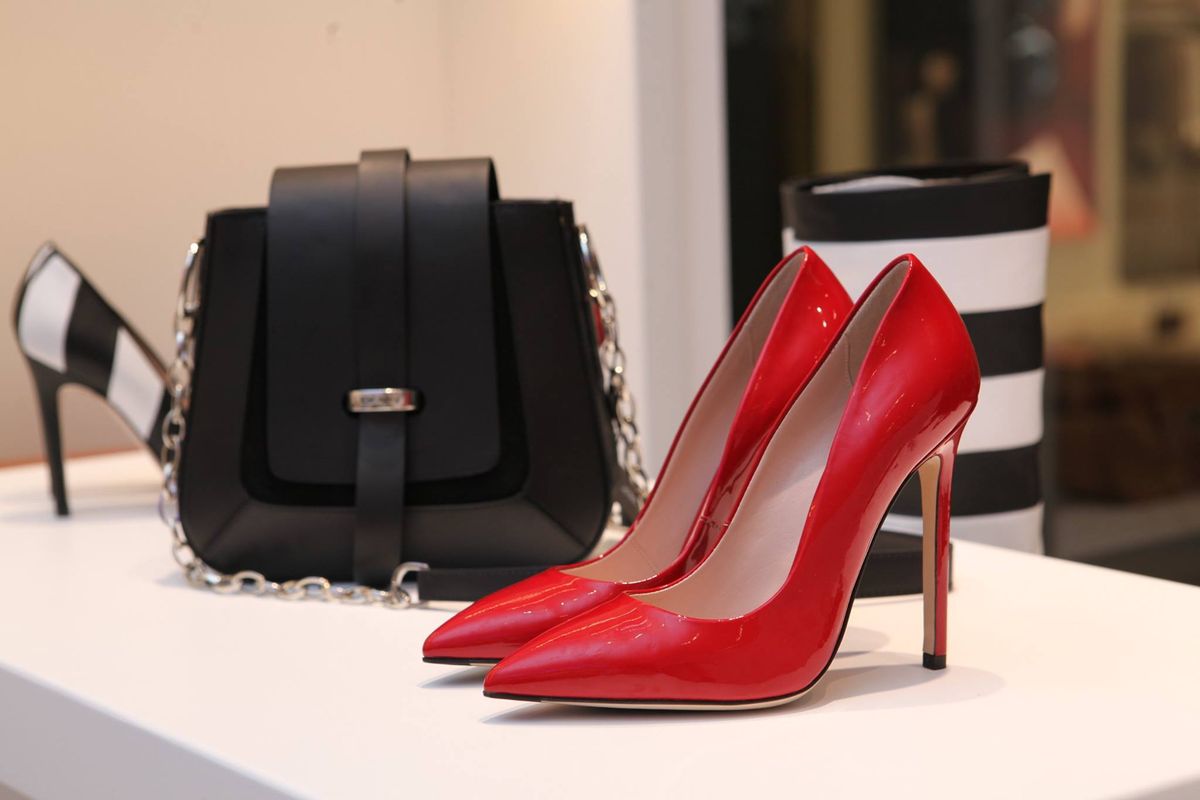
Two pairs worth considering if you want a black heel that works from October to March. The satin black heels with a covered platform keep the forefoot off the cold ground and take tights without pinching. The black lace heels with side cut-outs are a warmer-weather shape, so treat them as a September and April pair rather than a January one.
For the general question of how a heel behaves over a long day, the notes on the two-hour sit test for heeled sandals apply to pumps as well. If you’re weighing up strap styles for winter, the foot-width notes explain the measurement that predicts most fit problems. Tights sizing and denier are covered in more detail in the reference entry on tights. More winter-appropriate styles sit in our heels collection.
So: black 3-inch heels at 8°C are fine, provided the shoe was bought with tights in mind and the sole isn’t bare leather. The cold is manageable. The half size you didn’t account for is not, and that’s the thing to fix before the weather does it for you.
