

Your black sneakers are the pair you reach for on the way out the door. That part works. The problem is what they look like once you’re out there. Most black pairs on a shelf were built for a run, and they read that way from ten feet: a bright midsole stripe, mesh panels catching the light, a heel counter shaped like a spoiler.
You wanted something that passes at a desk and on a train. You got something that looks like you’re about to do lunges in a car park.
The gap between a gym shoe and a city shoe is smaller than the shops make it look. It comes down to sole thickness, tread depth, and how much of the upper is mesh instead of leather. None of those are style opinions. They’re things you can measure in the shop before you hand over a card, which is the whole point of what follows.
So here’s the order I’d work in. Sole first, because it carries most of the visual signal. Upper second, because it decides how the pair ages. Outfit third, and only third. Most people do it backwards, buy the shape they like, then spend a year trying to build outfits that hide it.
The sole decides more than your outfit does
Stand a gym shoe and a city shoe side by side and look at the sidewall. That’s the strip of material between the upper and the ground, and it’s the first thing anyone’s eye lands on.
Running shoes usually sit at 30mm to 40mm of stack height at the heel, with a rubber outsole that wraps up around the toe. The wrap is there so your foot doesn’t blow out on a trail. On a pavement it just signals sport. City pairs run lower, often 15mm to 25mm, and the sidewall is cut flat instead of sculpted.
Flat sidewall, low stack, shallow tread. That’s your checklist, and it takes three seconds at the shelf.
Rubber soles themselves have been on shoes since the 1800s, when the vulcanised rubber sole moved from plimsolls into everyday wear. The silhouette has been through a lot since then. The signal hasn’t changed much: thick and grippy means sport, thin and quiet means street.
Colour matters as much as shape. A black upper on a black outsole reads as one continuous dark shape, which is why those pairs look dressier than the same shoe with a white or gum sole. If you want one pair to do office days and weekends, the all-black build gives you more room to move.
One caveat before you go hunting for the thinnest sole you can find. Under 10mm of rubber between you and the pavement, an eight-hour day on tile will find your heel by hour four. If you’re on your feet at a till or a hospital corridor, you want the 20mm to 25mm range with a firm heel, not a pancake.
Check the flex, too. Hold the shoe by the heel and push the toe into the floor. It should bend at roughly a third of the way along, where your toes actually hinge. A sole that folds in the middle, under your arch, will leave you rubbing the instep by mid-afternoon.
What people actually clock at a glance
Nobody studies your shoes. They get a half-second look at the silhouette, and the brain sorts it into a category. Four things push that sorting toward gym:
- Contrast lining. A pale grey or neon inner lining showing at the collar. Black outside, highlighter inside, and the whole shoe reads athletic.
- Mesh side panels. Even black mesh goes slightly grey in daylight because it reflects light off the weave. Leather doesn’t.
- Logo placement. Anything wider than about 3cm sitting mid-quarter, right where the eye lands.
- Foam texture. The moulded EVA midsole with visible mould lines. It’s a dead giveaway, and it also yellows.
Flip the shoe over. Look at the outsole. A running shoe has deep lugs and a rocker curve at the toe. A city shoe has a fairly flat outsole with shallow grooves, sometimes a stitched leather sole, sometimes just smooth rubber.
Then look at the collar height. A low collar with a thin padded rim looks like a plimsoll. A high, padded collar with a pull tab at the back looks like a trainer, every time, regardless of what else the designer did.
Laces are the last signal. Flat cotton laces in the same colour as the upper read calm. Round laces with metal aglets, or anything reflective, read sport. Swapping laces is the cheapest fix in this whole article, and it changes the read of a pair more than most people expect. Ten minutes and a couple of pounds, and the pair you already own may start working.
Now the honest bit. Some of the pairs that pass this test are not comfortable for long walks. Flat outsoles with no flex at the ball of the foot will fight you after 6,000 steps. You’re trading cushioning for looks, and you should know that going in rather than finding out at a station platform.
Leather, suede, or knit, picked by how you scuff things
Pick the upper by your own habits, not by the product photo.
Leather creases across the toe box in a line that shows up within a week. That crease is normal and it looks fine on a smooth full-grain hide. It looks cheap on corrected-grain leather with a plastic coating, where the crease turns white at the fold. Leather also takes polish, which means a scuff on Tuesday is gone by Friday. For anyone who works near desks, chairs, and car doors, that repairability is worth more than a softer upper.
Suede is the better-looking option in the first month and the worse one after rain. Wet pavement, a puddle at a kerb, and you get a dark tide line that never fully lifts. If you live somewhere with 120 rainy days a year, factor that in. A suede brush and a protector spray get you most of the way back, but not all of it.
Knit hugs the foot, which feels great and photographs badly. It also shows the shape of your toes, and toe outline is the single strongest athletic signal a shoe can send. If your goal is “not a gym shoe”, knit is the hardest upper to make work. It’s also the upper that stretches, so a pair that felt snug in March may feel loose by August.
There’s a fourth option worth knowing about: coated canvas. Cheaper, wipes clean, and holds a shape better than knit. The downside is that it cracks at the flex point after a couple of seasons rather than creasing gracefully.
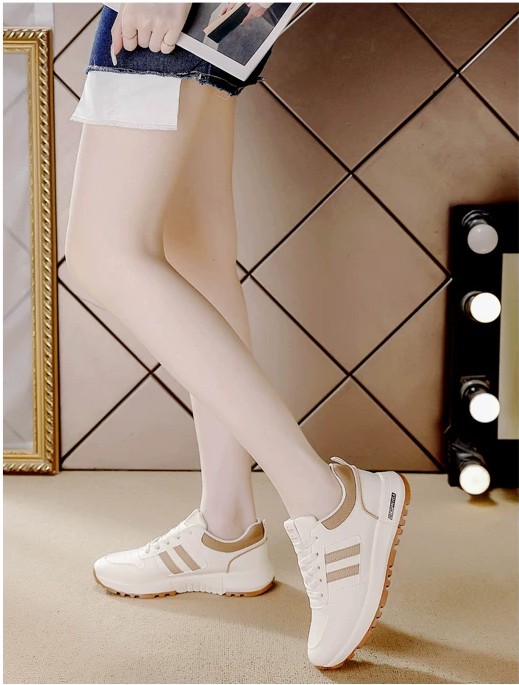
A pair like these leather sports shoes with a soft, already-broken-in feel sits in the middle. Leather upper, sporty sole, so they read casual rather than formal. That’s a fair trade for most days. Just don’t expect them to pass a dress code that mentions leather shoes and a heel.
If you have narrow heels that slip out of everything, leather is the upper that adapts least. Suede grips better at the collar. Try those first before you go down a half size and end up crushing your toes to fix a heel problem.
Four outfits that work, and two that don’t
Black sneakers are forgiving, which is why people over-trust them. Here’s what actually holds up:
- Straight-leg denim, full length. The hem covers the collar and half the laces. Only the toe and the sidewall show, which is exactly the part that reads clean.
- Cropped wool trousers. Ankle on show, no sock or a sock the same colour as the trouser. The break between trouser and shoe stays sharp.
- A black midi skirt. One colour from waist to floor, with the shoe as the only dark note at the bottom. Add a crew sock in cold weather and it still works.
- Tailored shorts, mid-thigh. This is where a low-profile pair earns its money. A chunky sole would make your legs look shorter than they are.
Now the two that go wrong. A pleated mini with ankle socks turns the whole thing into school PE, and no amount of black fixes it. And floor-length wide-leg linen will drag on the outsole and fray the hem within a fortnight, because there’s no heel to hold the fabric up.
There’s a middle path that works in spring: a midi skirt with a slightly heavier drape, like a wool blend or a ponte, plus the sneaker and a plain sock. The fabric weight does the work that a heel would normally do. Lightweight viscose won’t behave the same way and will cling to your legs on the walk.
Proportion is the thing to watch. A low-profile black sneaker adds almost nothing to your height, so if you’re used to a 40mm heel, your trousers will suddenly sit 4cm too long. Get them shortened by that much and the whole outfit settles.
If you’re building around one pair, the women’s shoes in the wider catalogue are worth a slow scroll before you commit to a shape. Look at the side profile of each pair at thumbnail size, from a metre away. That’s the honest test.
Office days: the 12-foot rule
Walk twelve feet away from a mirror and look back at yourself. That’s the distance your colleagues actually see you from, and at twelve feet the details disappear. What’s left is silhouette, sole colour, and how the shoe meets the hem of your trousers.
This is why a black leather sneaker with a black outsole can pass in a relaxed office while a black mesh trainer with a white midsole cannot, even though both are “black sneakers”.
Most written dress codes at work are vaguer than people assume, and “smart casual” usually means no athletic footwear rather than no sneakers. Read your own handbook before you spend money solving a problem that doesn’t exist.
Where it gets tight: client meetings in finance or law, anything with a dress code that specifies closed leather shoes, and weddings where the invitation says formal. In those rooms, a sneaker is a statement you probably didn’t mean to make.
Practical middle ground for the in-between days: keep a pair of black leather sneakers in the office drawer and wear something else on the commute. Sounds excessive until the first time you’re asked to sit in on a client call at short notice. It also saves the walk to the station from wrecking a good pair in the rain.
One small habit that helps more than it should: match the sock to the trouser, not to the shoe. A black trouser with a black sock makes the leg one line and the sneaker reads as the end of it. A white sock in the same outfit cuts you in half at the ankle, and people will notice that before they notice anything about the shoe itself.
I learned the boundary the hard way, and wrote up what nine days in one pair of black leather sneakers actually felt like. The shoes were fine. My assumption about where they’d be acceptable was not.
Where this stops working
Three situations where you should buy something else.
If you stand for eight hours on a hard floor, a low-profile fashion sneaker will leave your arches sore by the end of the week. You need a removable insole and a firm heel counter, and most of the pairs that look right in a photo don’t have either.
If your winters involve slush and salt, black leather will develop a grey bloom along the welt that needs wiping after every wear. Suede is out entirely.
And if your feet are wide across the ball, a pointed or tapered toe box will pinch no matter how good the sole is. That’s not a break-in problem. It’s a shape problem, and no amount of wearing them in will fix it.
Worth saying plainly too: black sneakers photograph flatter than they look in person. If you’re buying for a specific event with a photographer, a pair with some texture in the leather will hold up better on camera than a smooth matte one, which tends to go to a dark grey blob under flash.
One more honest limitation. If you need arch support and you like a thin sole, those two wants fight each other. Thin-plus-supportive exists, but it costs more than the average pair, and the shops that stock it are few. Budget for it or accept the compromise.
And if you drive a lot, a stiff flat outsole is genuinely worse than a soft one. You feel every pedal through the sole, and the shoe doesn’t roll with your ankle. Not a dealbreaker, but worth a test in the car park before you commit to wearing them on a long drive.
None of these are reasons to avoid the shape. They’re reasons to be specific about which pair you buy and what you expect it to do.
Five checks before you pay
Do these in the shop, in this order. It takes six minutes.
- Heel slip. Walk ten steps. More than about 5mm of lift at the heel and you’ll get a blister on the first long day.
- Toe clearance. A thumb’s width, roughly 10mm, between your longest toe and the end. Feet swell by up to half a size over a day.
- Flex point. Bend the shoe where your toes bend, not in the middle. A sole that folds mid-arch will fight your foot all day.
- Removable insole. Pull it out. If you can swap it, you can fix the arch support later instead of buying again.
- Weight. Over 350g per shoe and you’ll notice it at hour six. Under 300g and it starts to feel flimsy.
Sizing runs inconsistent across brands, so ignore the label and trust the two measurements above. A 39 in one pair can be a 40 in another with no warning, especially between European and Chinese sizing conventions.
One more thing that saves money: check the inside heel lining. If it’s fabric rather than leather, it will wear through in a season if you slip the shoes on without untying. If you’re a slip-on person, either pick a pair with a leather-lined heel or get a shoe horn. Sounds fussy until you’ve replaced a pair for that reason alone.
If you want the everyday-comfort version rather than the sharpest silhouette, these soft-soled mesh sports shoes for women and the 2026 sports and leisure styles cover the other end of the range. Softer, more casual, less likely to pass a strict office. That’s the trade, and it’s a reasonable one if your days involve 9,000 steps and no meeting rooms.
For a straight comparison of how a single pair survives a working week, this write-up on five workdays in one pair of black-soled sneakers is a useful reality check before you decide.
Here’s the sequence I’d follow. Decide the sole thickness first, because that fixes most of the look. Then pick the upper by your weather and your scuff habits. Then check the five fit points. Skip any step and you’ll end up with a second pair of shoes that live by the door and never get worn past the corner shop.
And if you already own a pair that reads too sporty for the office, try them with a full-length trouser before you replace them. Half the time, the shoe was never the problem.
