

Gold strappy heels come back to the shop in a specific way. Not scuffed at the toe, not worn at the sole. They come back with the plating gone at the buckle, one strap stretched, and a note that says “only worn twice”.
That’s the whole story of this category in one return. The shoe was never really worn standing up. It was worn sitting down, at a table, for four hours, and the damage happened exactly where the body presses hardest when you’re not moving.
If you’re buying a pair this season, the useful question isn’t how they look in the box. It’s what happens to a thin gold strap after four hours in a chair, and which parts of the shoe are built to survive that.
Gold is a coating, and the coating has a clock
Almost nothing in the gold strappy heel market is solid gold, obviously. What you’re buying is a base material with a gold-coloured layer on top, and that layer has a thickness measured in microns. The thickness decides the lifespan, far more than the price does.
Electroplated finishes sit somewhere between 0.3 and 3 microns. At the thin end, the layer is decorative and wears through at contact points within a dozen wears. At the thicker end, it lasts years if you don’t scrape it. Physical vapour deposition, which is what the better mid-market shoes use, lays down a harder film that bonds at a molecular level rather than sitting on top (the process explained is worth reading before you spend $150, and gold plating thickness is the number that actually predicts wear).
You can’t measure microns in a shop. You can do two things instead. Look at the edges of the straps where the material was cut, because a thin coating shows a pale line there immediately. Then press a fingernail into the surface, gently, on an inconspicuous part. A thick finish resists and springs back. A thin one marks, and that mark is a preview of month three.
There’s also the honest trade-off nobody puts on the box: the shinier the gold, the thinner the coating usually is. Mirror-bright finishes need a very smooth base and a very thin top layer, so they look expensive in the shop and go patchy fastest. A satin or brushed gold has a thicker, more forgiving layer and hides wear for much longer.
The buckle is the first thing to go
In this trade you learn to look at the hardware before the upper, because the buckle is where a cheap shoe announces itself. It takes the most friction, it’s the smallest part, and it’s the part buyers never inspect.
Three things fail there. The plating rubs off the prong within a month, leaving a grey dot in the middle of a gold strap. The prong itself bends if it’s cast rather than stamped. And the hole in the strap stretches, so the buckle no longer holds the setting you chose and the strap creeps looser through an evening.
None of it is visible in product photography, because buckles are shot from the front with the strap lying flat. Turn the shoe over in your hand and look at the back of the buckle. A stamped steel buckle with a rolled edge will outlast a cast zinc one by years. You can feel the difference in weight in about two seconds.
The other hardware question is whether the buckle is functional or decorative. Plenty of strappy heels have a buckle that doesn’t actually open, with the strap closing on a hidden elastic or a velcro tab. That’s not a fault. It’s a cost decision, and it means the strap can’t be adjusted, which matters more than you’d think once your feet swell.
Four hours in a chair: what straps do when you’re not walking
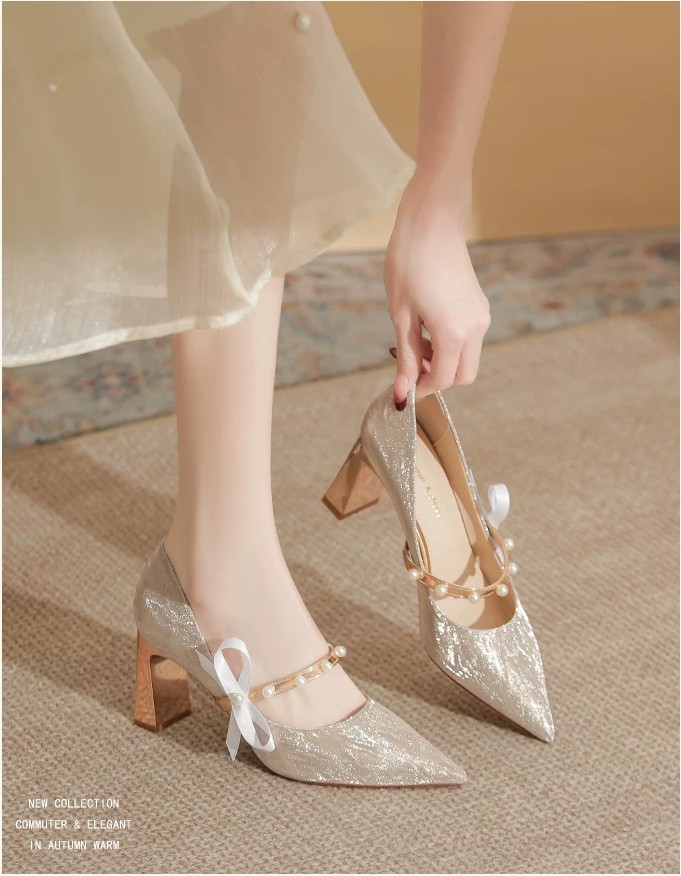
Walking distributes pressure. Sitting concentrates it. A thin strap across the instep that feels fine while you’re moving becomes a line of pressure the moment you sit down and cross your legs, because the foot changes shape and the strap doesn’t.
The pattern repeats across almost every strappy pair, gold or otherwise:
- Instep strap. Digs in when you sit with your feet flat and your knees together. The strap has nowhere to move and the skin takes the load.
- Ankle strap. Rides up over the ankle bone when you cross your legs, then settles back in the wrong place.
- Toe post or thong strap. The only part that gets worse when you’re still, because your toes curl slightly against it without the distraction of walking.
- Heel counter. Nearly irrelevant when seated, which is why so many people buy a pair that doesn’t grip and only discover it on the walk to the taxi.
The sitting test is easy and almost nobody does it. Put the pair on at home, sit in a dining chair for twenty minutes with your legs crossed, then stand up and walk. Any strap that left a red line you can still see after two minutes will leave a mark you can feel after four hours.
A wider strap spreads the same pressure over more skin, and a double strap at the instep is usually more comfortable than a single one at the same tension. That’s counterintuitive until you try it. Two thin straps at moderate tension beat one thin strap pulled tight.
Swelling, and why the strap you fitted at 10am lies by 4pm
Feet swell by up to half a size over a day, and more in heat, on a plane, or after a long lunch with salt in it. A strappy heel has no give in the upper, so all of that swelling goes into the buckle holes and the skin under the straps.
The practical consequence: fit the pair in the afternoon, or fit it loose in the morning knowing it’ll be right by evening. The second option works better for evening shoes, which is what most gold strappy heels are.
There’s a second-order effect that catches people out at weddings. Standing for a ceremony, sitting for a meal, standing for photographs, sitting again. The foot goes up and down in volume four or five times in six hours, and each time the strap needs a different hole. A buckle with three holes at 8mm spacing is genuinely more useful than one with a single fixed setting, and that’s a specification worth checking before you buy.
Gold makes this worse in one specific way. A metallic finish doesn’t breathe at all, so the skin under the strap stays damp, softens, and blisters faster than it would under leather or suede. On a hot day, a gold synthetic strap and a leather strap of identical width will produce completely different outcomes by hour three.
Strap count versus strap width, from the trade side
Six thin straps and two wide ones cover the same foot and behave nothing alike. The six-strap version photographs better, sells faster, and comes back more often. The two-strap version looks plainer on a shelf and gets worn for years.
Every season the same conversation happens on both sides of the counter. Buyers want the version that looks like the picture, which is the multi-strap one, and the picture is taken on a foot that isn’t going to walk anywhere. Sellers know the return rate is higher on multi-strap styles and stock them anyway, because that’s what sells in the first place.
What actually matters for comfort is total strap width in contact with skin, and how much of it crosses a joint. A 12mm strap over the instep does real work. Three 5mm straps over the same area do less, because each one presses on a smaller area and the skin between them takes the shear. If you want the look of many straps with the behaviour of one, look for a pair where the straps are joined at the sides rather than floating free.
Then there’s the strap-end problem. Thin straps with cut ends and sealed edges crack at the fold within a season, and once the edge seal goes, the strap starts to fray from the inside. A folded and stitched strap end costs more to make and lasts three times as long. You can see which one you’re getting by looking at where the strap meets the buckle: a raw cut edge that’s been painted is the cheap version.
Heel height decides which strap carries the load
A 60mm strappy heel and a 100mm one can share the same upper pattern and feel nothing alike, because the angle of the foot changes what the straps are being asked to do. At 60mm the foot is almost flat inside the shoe and the ankle strap does most of the retention work. At 100mm the foot is wedged forward, the instep strap becomes structural, and the ankle strap turns into decoration.
That’s why a high strappy sandal that fits beautifully at the ankle can still slide forward and crush your toes. The strap isn’t the problem. It’s holding the wrong end of the foot.
There’s a rule of thumb in the trade: above 90mm, count the straps that cross the instep or the vamp. If there’s only one, and it’s thin, the shoe will require your toes to do the gripping. Under 70mm, count the ankle strap instead, because that’s what keeps the shoe on when you walk.
Platform versions break the rule on purpose. A 100mm heel with a 20mm platform has an effective pitch of 80mm, so it behaves like a much lower shoe while keeping the height in photographs. If you want the look without the toe grip, that’s the version to look for, and it usually costs the same.
What a cobbler can rescue, and what’s gone for good
Knowing the repair ceiling changes what you’re willing to spend. Most people assume a shoe is repairable until it isn’t, and by then they’ve paid twice for the same problem.
A cobbler can replace a heel top piece in twenty minutes and it costs about as much as a coffee. That’s the single most worthwhile repair on any heel, plated or not, because a worn top piece changes how you walk and how the whole shoe wears. They can also re-stitch a strap that’s come away at the seam, and add a rubber forepart for grip on smooth floors.
What they can’t do is re-plate a strap. Replating requires stripping the whole component, which means taking the shoe apart, and the labour exceeds the value of the pair below about $300. A leather or suede upper can be re-dyed because the colour sits in the material. A metallic coating sits on top of it, and once it’s breached there’s nothing underneath to work with.
So the honest arithmetic: buy the plated pair knowing it has one life, and spend the repair money on the heel top piece and the grip, which are the two things that keep that life from ending early. Skip the touch-up pens and the spray-on metallic restorers. They look acceptable for an evening and they make the next proper repair impossible.
Where the finish fails first, and what to do about it
Gold finishes fail in a predictable order. Buckle, then the strap edge that rubs against the buckle, then the inner side of the heel where the other foot knocks it, then the toe. The toe is last, which surprises people, because that’s the part they inspect.
Inspection tells you where to protect. A dab of clear nail polish on the buckle edge slows the rub, and it’s the single cheapest intervention available. Keeping the pair in the dust bag rather than loose in a cupboard stops the cross-foot scuffing that kills the heel counter. And wiping the straps with a dry cloth after a summer evening removes the salt and sweat that accelerate tarnish.
What you can’t fix is a worn-through patch. Once the base material shows, no polish matches, because the base is a different colour and a different reflectance. Touch-up pens exist and they work for about an evening. That’s the honest ceiling.
The care routines that work on patent leather heels mostly don’t transfer here. Patent is a coating you can polish back to a shine. Thin gold plating is a coating you can only slow down. Same category of problem, opposite solution.
What buyers ask for, and what they actually wear
The gap between the question at the counter and the shoe that ends up in the rotation is where most of the money gets wasted. People ask for the tallest, brightest, most strapped version of the shoe they saw in a photograph. They wear the pair that goes on in nine seconds and doesn’t need adjusting.
Nine seconds is roughly the threshold. If a pair takes longer than that to buckle, it gets worn to events and nothing else. If it slips on and the strap fastens in one motion, it starts appearing on ordinary Fridays. That’s not a fashion observation, it’s a friction observation, and it predicts wear counts better than price does.
Gold strappy heels have one legitimate everyday use that people underrate: they finish an outfit that’s otherwise all neutral. Jeans, a plain white shirt, and a gold strap sandal is a complete look, and it doesn’t need a party to justify itself. The pair that gets worn eight times a summer is usually the plain two-strap version, not the architectural one.
There’s a version of this shoe that survives: satin or brushed gold, two straps, stamped buckle, thicker coating, folded strap ends. It’s rarely the best-looking pair on the shelf. It is, almost always, the pair still intact in September.
If you’re weighing materials more broadly, the finish test used for silver heels before you spend applies to gold without changes. Metallics all fail the same way, just at different speeds.
Buying a pair that survives three summers
Five checks, in the order that matters. Thickness of the coating at a cut edge. Type and weight of the buckle. Whether the straps are joined or floating. Width of the instep strap. And whether the strap ends are folded and stitched rather than cut and painted.
Then a sixth, which isn’t about the shoe: count the outfits you’d wear it with this month. If the number is under three, the durability doesn’t matter, because the pair won’t get enough wears to fail.
A pair that costs $90 and gets worn thirty times is a better buy than a $40 pair worn four times, and that maths holds even if the $90 pair only lasts two summers. The crystal-trimmed champagne pair and the plain thin-heeled strappy sandal sit at opposite ends of that calculation, and both can be the right answer depending on your calendar.
Buy the satin finish if you want it to last. Buy the mirror finish if you want it for one specific night and you’re honest about that. The mistake is buying the mirror finish and expecting the satin lifespan, and that mistake is what fills the returns bin every January.
Before you commit, sit down in them. Not the shop stool, a real chair, for twenty minutes, with your legs crossed. If the strap leaves a mark you can still feel, you’ve already answered the question.
