

You bought a pair of beige heels online because the photo looked like the answer to everything. Then they arrived, you put them next to your favorite cream trousers, and the whole thing went flat. The shoes turned pink. Or grey. Or they looked like medical footwear under your office lights.
Beige is the hardest color in the shoe shop to get right, and almost nobody warns you about it. There are hundreds of shades hiding under one word, and they behave differently next to your skin, your hems, and the fluorescent tube above your desk.
So here’s the short version before anything else: match the undertone of the shoe to the undertone of your skin, not to the color of your outfit. That single rule fixes about 80% of beige shoe mistakes. Everything below is how to apply it, plus the heel heights that survive a real day and the places where beige heels will let you down.
Beige has three undertones and only one of them is neutral
Pull six beige shoes off a shelf and put them side by side. What you’ll see is not one color family but three: yellow-based sand tones, pink-based blush tones, and grey-based taupe tones. The industry calls a lot of this “nude”, which is a useless word because it describes almost nobody’s actual skin.
Warm beige leans yellow or peach. Camel, sand, biscuit, and honey all sit here. Cool beige leans pink or grey, so you get oatmeal, mushroom, and taupe. True neutral beige is rare and usually looks slightly dusty, like the color of a paper bag in shadow.
Under natural daylight, warm and cool beige can look nearly identical. Under 4000K office lighting they split apart fast. That’s why the pair you loved in the shop window at noon looked wrong at your desk by 10am.
One more thing worth knowing: color naming in footwear is loose. Two brands can both print “beige” on the box and be four shades apart. Beige as a color term covers a wide band of pale yellowish greys, which is exactly why you can’t buy it by name alone.
Look at the shoe against a white sheet of paper in daylight. If it reads yellow against the paper, it’s warm. If it reads greyish, it’s cool. If it nearly disappears, you found a neutral.
Match the shoe to your skin, then worry about the outfit
Here’s the test that actually works, and it takes about ten seconds. Hold the shoe next to the inside of your wrist. Warm beige will pick up the yellow in your skin and look continuous, like an extension of your leg. Cool beige on warm skin creates a visible edge, and that edge is what makes legs look shorter.
If you have olive or deep skin, most mass-market “nude” shoes are too light and too pink. A caramel or cognac-leaning beige will blend far better than anything labeled nude. If you have very fair, cool skin, mushroom and greige tend to vanish in a good way.
This matters more with heels than with flats. A heel lifts the arch and puts the top of your foot on display, so the shoe reads as part of your leg line rather than a separate object. Get the undertone wrong and the shoe announces itself. Get it right and people notice your legs, not your footwear.
What about the outfit? After the skin match, beige is genuinely easy. Warm beige heels work with denim, cream, rust, olive, and chocolate brown. Cool beige heels work with white, navy, grey, black, and dusty pink. Both handle a monochrome look, which is the fastest way to look taller.
If you only own one pair, pick the one that matches your wrist, then build outfits around it. Buying the shoe that matches your favorite dress is how people end up with five pairs of beige heels and nothing to wear.
70mm is the height most people can actually walk in

Beige heels have a reputation problem: they’re sold as the “safe” pair, so brands put them on a 100mm stiletto and expect you to manage. You won’t, not for six hours, and certainly not on pavement.
A 70mm heel with a slightly forward-set heel tip is the practical ceiling for most women who aren’t used to heels. At that height the pitch of your foot stays under about 30 degrees, which is the point where your toes stop taking the load. Above 85mm, the ball of your foot carries most of your body weight, and beige patent at that height will feel like standing on a coin by hour three.
Width of the heel matters as much as the height. A 9mm stiletto tip sinks into grass, gets caught in paving joints, and wobbles on tile. A 25mm to 35mm block or Cuban heel at the same 70mm height is dramatically more stable and, honestly, looks more current than a thin stiletto right now.
Platform changes the math. A shoe with a 70mm heel and a 20mm platform has an effective pitch of only 50mm, which is close to a walking shoe. If you want height without the burn, that’s the shape to look for.
Heeled footwear has been shifting load onto the forefoot for centuries, and the physics hasn’t changed. What changed is the padding. A 4mm memory foam insole is not enough. Look for a 6mm to 8mm latex or cork layer under the ball of the foot, and check that the insole isn’t glued down flat with zero give.
Here’s my honest ranking of heel heights for daily wear:
- 50mm to 60mm: all-day safe, works with trousers
- 70mm: the sweet spot for dresses and events
- 85mm: two hours, then sit down
- 100mm and up: photographs well, hurts by the second drink
None of this is a moral judgment about heel height. Wear the 100mm pair if you love them. Just don’t expect them to be the pair you keep by the door.
The shapes that make beige look expensive
Color does a lot of work here, and the wrong shape can make a beautiful beige look cheap. The culprits are usually a very round toe combined with a low, thick heel, which reads as a uniform shoe, and a squared-off block heel with a fat ankle strap, which reads as a 2010s office shoe.
Pointed toes elongate and look sharpest in a smooth leather or a fine suede. Almond toes are more forgiving on wide feet and still read as polished. If your toes need room, an rounded toe box with a 70mm heel solves both problems at once, and it doesn’t look dated if the leather is smooth.
Straps are where beige gets tricky. A single slim ankle strap in the same color as the shoe keeps the leg line intact. A thick contrast strap cuts the ankle at the widest point. If you have short legs, skip the ankle strap entirely and go for a slingback or a slip-on pump.
Material changes the shade, too. The same beige in suede reads warmer and softer than in patent, which bounces light and can look almost white at the toe. Nubuck sits in between and scuffs the least visibly. Patent beige is the one to avoid if you’re hard on your shoes, because every scuff shows as a grey line.
Open toes and peep toes are a gamble in beige. The moment your polish chips, the neutral shoe draws the eye straight to it. If you like the shape, plan on a pedicure schedule you can actually keep.
Where beige heels genuinely let you down
I like beige heels. I also think the internet oversells them, so here’s the other side.
They show dirt. A beige suede toe box picks up pavement grime and bus-floor dust faster than any other color, and the first scuff on a pale shoe looks worse than the tenth scuff on a black one. You’ll be brushing them weekly if you wear them outdoors.
They’re unforgiving on fit. Black leather hides a slightly loose heel cup. Beige does not. If the shoe runs large and your heel lifts with each step, you’ll see a gap open at the back and the whole thing looks broken. Always size for the heel, not the toe.
They can wash out pale skin in photos. If you’re very fair, an unbroken beige from shoe to bare leg disappears entirely, and in a group photo you look like you’re floating. A slightly deeper caramel or a visible ankle strap fixes it.
And the big one: beige heels are not neutral in every context. Next to a warm ivory dress they can look grey. Next to a cool white dress they can look yellow. Test the shoe against the actual garment in daylight before you commit, and don’t trust the shop mirror.
There’s also a seasonal issue nobody mentions. Summer beige is lighter and sandier. Winter beige on the same shelf leans brown. Buying a summer shade in February is how you end up with a pair that only works three months a year.
Care: what a scuff actually needs
Suede and nubuck need a brush and a rubber eraser, not polish. Brush in one direction with a brass or nylon brush to lift the nap, then work the eraser over dry scuffs. For oil marks, cornstarch left on overnight pulls a surprising amount out. Don’t wet suede. Water leaves a tide line that never fully goes away.
Smooth leather beige needs a cream polish in the closest shade you can find, applied in thin layers. Beige cream polish is hard to source, so most people use a neutral cream and accept slightly less coverage. That works for maintenance, not for repair.
Patent beige needs nothing but a damp microfiber cloth and a check for color transfer. Denim is the enemy. Indigo transfers onto pale patent within a couple of wears and once it’s in, it’s in.
Store them stuffed with tissue so the toe box holds shape, and keep them out of direct sun. Pale leather oxidizes and yellows when it sits in a bright window for a season. I learned this the expensive way with a pair of cream slingbacks that spent a summer on a shelf.
For anything you wear weekly, budget for a cobbler visit once a year. New heel tips cost very little and prevent the worn-down metal click that makes a good shoe sound cheap.
The 15-minute at-home fit check
Before you cut the tags off, do this. It saves you from discovering the problem in a car park.
- Stand up and press your thumb into the space behind your heel. You want 3mm to 5mm of slip, no more.
- Walk on tile for two minutes and listen. A slapping sound means the shoe is too long.
- Press the ball of your foot area with your thumb. If it bottoms out against hard board, there’s no padding.
- Check the toe box width against your widest toe while standing, feet spread. Sitting hides width problems.
- Look at the color next to your wrist under daylight. If you see a hard edge, the undertone is wrong.
If two or more of those fail, return them. Beige heels are too visible a shoe to live with a compromise.
When the fit is right, the color is right, and the heel is under 75mm, a beige pair becomes the shoe you reach for without thinking. It works with the navy suit, the cream midi, the straight-leg jeans. That’s the whole point of the color. It’s supposed to disappear into your wardrobe, not compete with it.
Start with one pair in the undertone that matches your wrist, in a shape you can walk in for an hour. Then decide whether you need a second shade. Most people don’t. They need a better first pair.
If you want to see how the rest of the silhouette family compares before you buy, our guide to the twelve main shoe shapes is a decent place to start, and the full heel collection is where the actual color decisions get made.
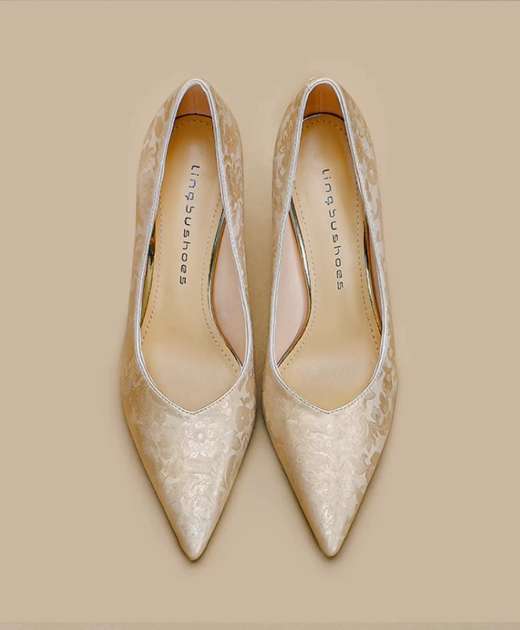
Two pairs worth looking at in beige specifically: the genuine leather beige high heels if you want a warm sand tone, and the champagne slim heel if your skin leans cool and true beige keeps going pink on you.
And if you’re someone who already knows a thin heel won’t survive your commute, the thick-heel version does the same job on a wider base. Check the heel height on the listing before you order. Half the returns on beige heels happen because nobody looked.
