

Most of us own one pair we reach for without thinking: the flat-sole pair by the door that survives the school run, the grocery trip, and the odd dash for a train. That pair is usually a lace-up, and it is usually the hardest working thing in the closet. Casual lace up shoes for women sit in an awkward middle ground — dressy enough for the office on a Friday, plain enough for a weekend walk, sturdy enough to survive a wet pavement. Finding that balance is less about brand and more about construction, and the details that decide whether a pair lasts two seasons or two years are rarely printed on the box.
Part of the confusion is the word itself. A lace-up is a fastening system, not a shoe type, and the same lacing can sit on a canvas plimsoll, a leather derby, or a knit runner. Athletic brands have spent decades convincing shoppers that laces equal performance, which is why so many women end up in a cushioned trainer for a day spent mostly at a desk. The reverse mistake is just as common: buying a stiff leather pair because it photographs well, then discovering after four blocks that the heel counter chews through socks. Neither shoe is wrong. They are simply answering different questions, and the first step is working out which question you are actually asking. For a broader look at the category, the women’s shoes range sets out the full spread from flats to heeled styles, which helps put lace-ups in context.
What “Casual” Actually Means in a Lace-Up Shoe
Casual, in footwear terms, describes the social register rather than the shape. A shoe reads casual when it can be worn with denim without looking borrowed from a suit, and when its materials are expected to show wear instead of being polished back to new. That rules out patent finishes, razor-thin soles, and anything with a heel tall enough to change your gait. It leaves a wide field: canvas low-tops, suede trainers, soft leather derbies, moccasin-stitched slip-ons with laces purely decorative, and the whole family of knit walking shoes that has taken over commuter wardrobes.
The sneaker is the obvious reference point, and its history explains the shape. Rubber-soled canvas shoes were being sold in the late nineteenth century, and the American nickname came from how quietly the rubber sole let a wearer move. Comfort, in other words, was the original selling point — not sport. Modern casual lace ups inherit that logic. What separates a good everyday pair from a gym shoe is the last: the mould the shoe is built around. Athletic lasts are narrow through the midfoot and generous at the toe for push-off; casual lasts tend to be roomier through the instep and less curved, because most of us spend the day standing, sitting, and walking on flat surfaces rather than sprinting. If you have ever wondered why a running shoe feels unstable while waiting in a queue, that is the last doing its job for a sport you are not playing. Casual lace up shoes for women are built on a different set of assumptions, and once you know that, the wall of near-identical options in a shop starts to sort itself out. A useful shortcut is to look at the heel counter and the toe box first, because those two areas reveal what the designer expected you to do in the shoe: stand, walk, or perform.
Getting the Fit Right Without Guesswork
Lace-up shoes forgive a lot, but they cannot fix a length that is wrong. The single most useful measurement is not your shoe size but the distance from heel to the ball of your foot, because that is where the shoe flexes and where your toes need clearance. Measure at the end of the day, when feet are at their largest, standing up with weight on both feet. Add roughly a thumb’s width — about half an inch — beyond the longest toe. If a pair passes that test and still feels tight, the problem is almost always width or volume rather than length, and sizing up will only make you trip over the toe.
Width matters more for women than most size charts admit. Feet widen across the ball under load, and a lace-up that is snug at 9 a.m. will be painful by four in the afternoon. Look for removable insoles: pulling the factory insole out gives you a surprisingly accurate view of the footbed shape, and it tells you whether there is room for an orthotic later. Heel slip is the other thing to check before you commit. A small amount — a few millimetres — settles once the heel counter softens, but anything more means the last is too long or too wide at the back, and no amount of extra lacing will hold it. The proper test is to walk on a hard floor, not carpet, and to do it in the socks you actually wear. Try the pair late in the day, and if you are between sizes, trust the larger one only when the heel stays put. It is a slow way to shop for casual lace up shoes for women, but it is the only method that reliably works without being able to return them after a week of wear.
Materials That Decide How Long They Last
Upper material drives almost everything: breathability, how the shoe ages, and whether it can be cleaned at all. Canvas is the cheapest and the most honest. It breathes well, takes colour badly after a few washes, and will eventually crack where the toe creases. That is fine for a summer pair you expect to replace, less fine if you want something to wear from April to November. Leather — particularly full-grain or a decent nubuck — costs more, moulds to the foot over a couple of weeks, and can be revived with cream and a brush for years. The catch is weight and break-in: a stiff leather lace-up will blister a heel in the first week if you wear it for a long walk straight away.
Knit and engineered mesh sit between the two. They are light, dry fast, and need almost no break-in, which is why commuters like them. The trade-off is structure. A knit upper relies on the sole and the heel counter for support, so a cheap knit shoe can feel like a sock on a slab. Suede is the material most people regret buying and then love: it scuffs visibly, stains in rain, and looks better for it once you stop treating it like a dress shoe. Whichever you choose, check the lining. A textile lining dries quickly and is comfortable against bare skin; a synthetic leather lining traps heat but holds shape. Neither is automatically better, but a shoe with a padded collar and a soft lining will be the one you keep by the door, and that is the whole point. Weight is the other number worth checking, and it is rarely listed. Anything over about 350 grams per shoe starts to feel like effort on a long walk, especially once a sole has picked up grit and the upper has absorbed a little moisture. The best casual lace up shoes for women tend to be unremarkable in the hand and obvious on the foot: nothing flashy, everything in the right place.
Laces, Eyelets, and the Small Details That Matter
Laces are the cheapest component and the first to fail. Flat cotton laces hold a bow well and suit canvas and leather; round laces stay tied on smooth leather but tend to loosen on knit uppers; elastic laces turn any lace-up into a slip-on and are genuinely useful if you are carrying a child or a coffee. The eyelet count changes the fit more than most shoppers realise. Five pairs of eyelets give a fairly fixed fit; seven or eight let you tighten the midfoot independently of the ankle, which is why walking and hiking styles run longer up the throat. If a shoe gapes at the top of the foot but fits everywhere else, you have a lacing problem, not a size problem. The fix is usually to skip the lowest eyelet pair and thread straight up the sides, which pulls the quarters together without strangling the instep. A heel that lifts can often be settled by tying a runner’s loop through the top eyelets — a small change that costs nothing and saves a pair you would otherwise return.
The difference between open and closed lacing is worth knowing before you buy a leather pair. Closed lacing, as on an Oxford, has the quarters stitched under the vamp, so the two sides meet in a V that closes as the shoe breaks in. Open lacing, as on a Derby, has the quarters stitched on top, which lets the throat open wider — kinder to a high instep and easier to get on. For a casual shoe you intend to wear with thick socks in winter, open lacing is almost always the more forgiving choice. Also look at how the tongue is attached. A gusseted tongue keeps grit and rain out and is a mark of a shoe built for actual walking rather than display. Then run a finger around the inside seam near the toe. Any ridge you can feel will find the joint of your big toe within a month, and no sock thickness will protect it for long.
Sole Shape, Heel Height, and All-Day Standing
The sole is where casual shoes quietly differ from trainers, and it is the part you cannot change later. A thin vulcanised rubber sole gives ground feel and a flat, planted stance; it is lovely for driving and terrible for a concrete floor. A compression-moulded EVA midsole is light and soft but packs down within a year of daily wear. Rubber outsoles with a defined tread last longer and grip better on wet paving, at the cost of weight. What matters for all-day comfort is the drop — the height difference between heel and toe. Anything close to zero keeps the calf and Achilles in a neutral position and suits people who stand for hours. A 6-8mm drop feels more familiar if you are coming from conventional trainers.
Heel height in a lace-up is usually modest, and that is the point. A 10-15mm heel is enough to stop the foot rolling inward on hard floors without changing posture. Anything above 25mm starts to push weight forward onto the ball of the foot, which is exactly what a lace-up is supposed to avoid. Check the flex point too: bend the shoe where your toes bend, not in the middle of the arch. A shoe that folds in half at the shank will feel unstable within an hour. Finally, press a thumb into the footbed under the heel. If it is unyielding, the shoe will be fine for short trips and punishing after a long day at a museum. Many women solve this with a thin aftermarket insole, but you need volume in the shoe to fit one — another reason to buy with the insole removed. On paper, casual lace up shoes for women look like a simple category; underfoot, they are anything but. Weather matters too. A deep tread in a soft compound grips beautifully on wet leaves and wears down fast on pavement, so if most of your walking happens in a city, a harder rubber with a shallower pattern will outlast the grippier option.
Building Outfits Around One Pair
The practical advantage of a plain lace-up is that it stops an outfit from looking costumed. Wide-leg trousers, a straight midi skirt, tailored shorts, and dark denim all sit comfortably beside a low-profile pair in white, cream, black, or tan. The trick is proportion: a chunky sole balances a cropped trouser and makes an ankle look narrower, while a slim sole keeps a long skirt from looking heavy. Keep the hem in mind as well. A shoe that stops well below the ankle makes a cropped trouser look intentional, while a high-top or a padded collar shortens the leg line and works better with a straight, full-length cut. Socks are the quiet variable: a visible white crew sock pushes an outfit towards sport, a hidden liner keeps it neutral, and a thin wool sock in a matching tone makes a mesh shoe look considerably smarter than it is. Weather decides the rest. In a wet climate, dark uppers and a rubber sole age more gracefully than pale suede, however good the suede looks in the shop window.
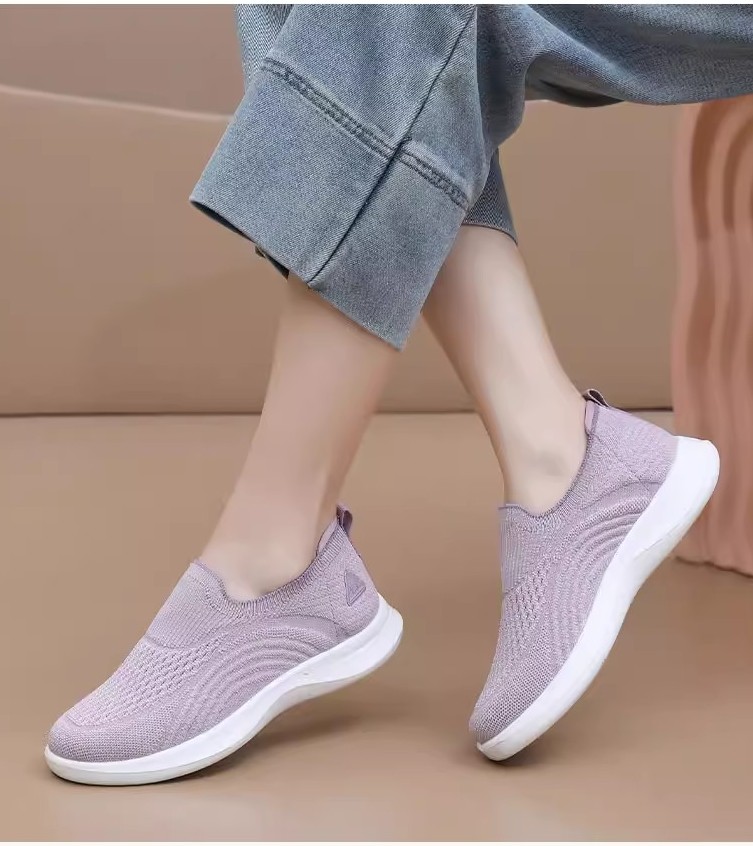
For commuting, a breathable mesh pair earns its place in a way a leather sneaker cannot in July. Something like these breathable mesh casual walking shoes works with linen trousers and a tote without asking to be noticed, and the open mesh dries overnight after a rainy walk. At the smarter end, a leather Derby in dark brown or black does the work of a loafer with better grip, and pairs with wool trousers in a way that a running shoe never will. If you want to see how the sportier end of the range is styled, the sneakers section is a decent reference; for the flatter, more walking-oriented shapes, the walking shoes collection covers the practical end.
Keeping Them Looking New
Care routines fail when they are complicated, so keep it short. Brush dry dirt off canvas and suede before it works into the weave, and never machine-wash a shoe with a glued sole — the heat and tumbling will separate it. A soft brush, lukewarm water, and a drop of mild soap handle most marks on canvas. Leather wants the opposite treatment: wipe with a damp cloth, let it dry away from radiators, then work in a small amount of cream and buff. Suede needs a suede brush once dry and a protective spray before the first wear, applied outdoors and left overnight.
Two small habits make the biggest difference. Untie before you pull a shoe off — heel collapse is the fastest way to destroy a counter — and stuff newspaper or cedar trees into damp shoes so they dry from the inside without creasing. Rotate between two pairs if you can. Shoes, like most things, last longer when they get a day off, because foam and leather both need time to recover. Laces are the one part worth replacing early: a fresh set costs very little and makes a scuffed pair look deliberate again. Keep a spare pair in a drawer and swap them the moment the aglets fray, before the lace snaps somewhere inconvenient. Storage matters more than most people expect, too. Shoes stacked on top of each other lose their shape at the heel, and a pair left in a hot car through a summer will yellow at the glue line long before the upper gives out.
None of this requires spending more. It requires knowing which questions to ask in the shop: how the last fits your instep, whether the sole flexes where your foot does, whether the lining will survive a summer without socks. Get those right and a pair of casual lace up shoes for women becomes the one you stop thinking about — which is, honestly, the highest compliment footwear can earn.
