

You pick up a shoe in the shop, and it’s so light you almost drop it. That’s the moment most people buy. It feels like the answer to every complaint they’ve ever had about heavy feet, tired legs, and the pair that got left in the hall.
Sometimes it is the answer. Sometimes you spend 90 pounds on something that feels like a slipper, then discover three weeks later that your heels ache on pavement and your arches are doing work they shouldn’t.
Light sneakers for women are one of the few categories where the number on the box actually predicts how the shoe will feel, so it’s worth learning a few of them before you buy. Under 200g per shoe is genuinely different from 280g. The difference isn’t just comfort. It changes how you walk.
Light is a number, so ask for one
Weight is the most honest spec in footwear, and almost nobody asks for it. A women’s sneaker in a size 38 usually lands between 210g and 290g per shoe. Anything under 220g is light. Anything under 190g is very light, and you should start asking what was removed to get there.
Note the word shoe. Some listings quote the pair, which doubles the number and makes an average shoe look heavy. If the figure is 400-something, it’s the pair. If it’s 200-something, it’s one shoe. Get this wrong and you’ll compare two completely different things.
Weigh them yourself if you can. A kitchen scale is more accurate than any product page, and it settles the question in ten seconds. Weigh one shoe, not the pair, and do it before you wear them outside so you can still return them.
Here’s a rough map of what the numbers mean in practice.
- 170g to 200g. Racing-flat territory. Very little structure, thin outsole, and a midsole that compresses fast. Fine for short walks and gym floors, harsh on concrete.
- 200g to 240g. The sweet spot for most people. Light enough to feel quick, structured enough to walk 8,000 steps without thinking about it.
- 240g to 290g. Standard everyday sneaker. More cushioning, more rubber, longer life. You’ll notice the weight on stairs, not on flat ground.
- Over 300g. Chunky soles and leather uppers. Built for durability and looks, not for distance.
If you’re shopping for light sneakers for women and the listing has no weight at all, ask the seller. A brand that can’t tell you what one shoe weighs either doesn’t know or doesn’t want you to compare, and both are reasons to look elsewhere.
One caution about the very light end. A shoe at 175g has to lose weight somewhere, and it’s nearly always the outsole rubber and the midsole density. That’s fine if you’re walking 20 minutes to the station. It’s not fine if you’re on your feet for a nine-hour shift on a hard floor.
Where the weight comes from
Roughly 55% of a sneaker’s weight sits in the sole unit, split between the midsole foam and the rubber outsole. The other 45% is the upper, the lining, and the insole. That split tells you where a light shoe has saved weight and where it hasn’t.
The EVA foam in the midsole is the easiest place to save weight, because a lower-density foam is simply lighter for the same volume. That’s mostly good, since modern foams are lighter and bouncier than the EVA of ten years ago. The catch is durability. Low-density foam packs out faster, so a 190g shoe often feels flat at month six while a 270g shoe still has life at month eighteen.
Outsole rubber is the second place. Thin rubber saves a lot of weight and wears through quickly at the heel, especially if you walk with a heavy heel strike. If the outsole on a light shoe is under 3mm at the heel, expect a hole within a year of daily wear.
The upper is the third. Sneaker uppers built from engineered mesh, knit, and thin synthetic suede all weigh very little. Leather and thick canvas don’t. That’s why almost every genuinely light sneaker is some form of mesh, and why the leather version of the same shoe is always 60g to 90g heavier.
There’s one more hidden weight source: the insole. A thick, dense insole can add 30g to 40g per shoe, and swapping it for a thin one is the cheapest way to lighten a pair you already own. It changes the fit slightly, so try it at home before a long day out.
What you should not accept is a light shoe with no structure at all. Press the midfoot from the side. A shoe with no shank and no torsional rigidity folds in half easily, and for anyone with a neutral or flat arch that means the foot does all the stabilising work. A little stiffness through the middle is a feature, not a compromise.

Two hours in: what light shoes do to your feet
The first hour is great. That’s the trap. Light shoes feel wonderful while your feet are fresh, and the problems show up in hour two or three, when the cushioning has compressed and your arches start to notice.
Here’s what typically happens on a long day in a very light pair. Your heel strike gets heavier because there’s less foam to absorb it, so the impact travels up through the ankle. Your toes work harder to push off because a thin sole gives less rebound. By late afternoon your feet feel bruised rather than tired, and that’s a cushioning problem, not a fitness problem.
There’s also a fit effect nobody talks about. Lightweight uppers are thin, and thin uppers have less padding at the collar and the tongue. On a 20-minute walk that’s fine. On a two-hour walk, the lace pressure across the top of your foot becomes noticeable, and the collar can rub your Achilles if the heel counter is soft.
Here’s a test you can run at home without buying anything. Wear your light sneakers for a normal day and note the hour your feet first feel tired. If it’s before 3pm, the shoe is too light for the amount you walk. If you only notice at 7pm, it’s matched to your week, and there’s nothing to fix.
My rule: 220g to 240g is the lightest I’d go for a shoe I plan to wear all day. Below that, I want a second pair in the rotation so the light ones only do short trips.
This isn’t a knock on light shoes. It’s a question of matching the shoe to the day. If you know you’ll be sitting at a desk and walking 3,000 steps, take the light pair every time. If you’re sightseeing in a city and will hit 15,000 steps on stone, take the heavier, cushioned one and accept the extra 80g.
When light is the wrong choice
There are four situations where I’d steer you away from the lightest option on the shelf, even though it feels best in the shop.
Long days on concrete or stone. City pavements and shopping-centre floors are unforgiving, because they don’t deform at all. All the shock goes into your foot. A thicker, softer midsole is worth 60g here.
Heavier walkers. If you’re over about 75kg, a low-density foam compresses much faster under you, and a 190g shoe can feel dead within four months. The weight saving is real. The lifespan isn’t.
Anyone with plantar fasciitis, heel pain, or a history of arch trouble. Very light shoes usually have thin, flexible soles and minimal arch support. That combination is exactly wrong for a sore arch, which needs cushioning and a bit of rigidity rather than more flexibility.
And standing jobs. If you’re on your feet for eight hours without walking much, weight matters far less than cushioning. Standing is a compression problem, not a movement problem, so a heavier, thicker sole is the better tool. Something like a cushioned walking pair makes more sense than the lightest trainer in the range.
There’s also a seasonal version of this. Very light shoes with thin mesh uppers are brilliant in July and miserable in February, because there’s no insulation and no water resistance. If you want one pair to cover the year, light sneakers for women work best from about 240g upward, where the uppers tend to be a bit more substantial.
None of this means light shoes are overrated. It means weight is one variable out of three, and the other two are cushioning and structure. A light shoe with good foam beats a heavy shoe with bad foam every time. A light shoe with no foam at all just moves the problem to your joints.
The maths of 10,000 steps
Here’s where the weight argument gets interesting, because the effect multiplies.
Research on running economy suggests every 100g added per shoe raises the energy cost of running by roughly 1%. Walking is less sensitive, closer to 0.3% to 0.5% per 100g, but you also take more steps. A 5km walk is around 6,500 steps. Ten thousand steps a day is 3.65 million steps a year.
At that volume, 80g per shoe is not a rounding error. It’s the difference between finishing a day with heavy legs and finishing it fine, especially if you’re walking on top of a job, a commute, and a school run.
The other half of the maths is where the weight sits. Weight at the far end of the shoe costs more than weight near your ankle, because your leg has to swing it through a longer arc. A 20g chunk of rubber on the toe is worse than 20g of padding at the collar. This is why some heavy-looking shoes feel lighter in motion than the scale suggests.
One caveat on that figure: the research is about running, and walking is a different gait. Don’t take the percentages literally for a shopping trip. Take the direction, which is that weight costs you more the more steps you take, and the more steps you take, the more the light pair earns its price.
Try it yourself. Put one light shoe on one foot and a heavier shoe on the other, and walk 50 steps. The difference is obvious, and it’s obvious in a way a spec sheet never is. Shops rarely mind, and it’s the fastest test there is.
For a mesh pair around the 220g mark, the soft-soled mesh sports shoe sits in that range with a flexible sole, and our notes on when a leather running shoe is the wrong tool cover the heavier end of the same trade-off.
How to buy light without buying flimsy
Six checks, all of them quick, none of them requiring any knowledge of foam chemistry.
Twist the shoe. Hold the heel and the toe and twist gently. It should resist a little and return straight. If it twists like a tea towel, there’s no structure and your foot will do the work.
Press the heel. Thumb inside the heel counter, press outward. It should barely move. A soft heel counter on a light shoe is the fastest route to heel slip, and heel slip is how you get blisters on the back of your ankle.
Look at the outsole thickness at the heel. Under 3mm and you’re buying a shoe with a short life on pavement.
Feel the insole. Removable insoles are a good sign, because you can replace them when they pack out. Glued-in thin insoles mean the shoe’s comfort has a fixed expiry date.
Weigh one shoe. Under 190g, ask what the midsole density is and expect a short lifespan. Over 300g, ask yourself whether you need that much shoe for your actual week.
And check the collar padding with your fingers. Light uppers often skip it. If the collar is a single layer of thin mesh with no foam, that edge will rub your ankle within a month of daily wear.
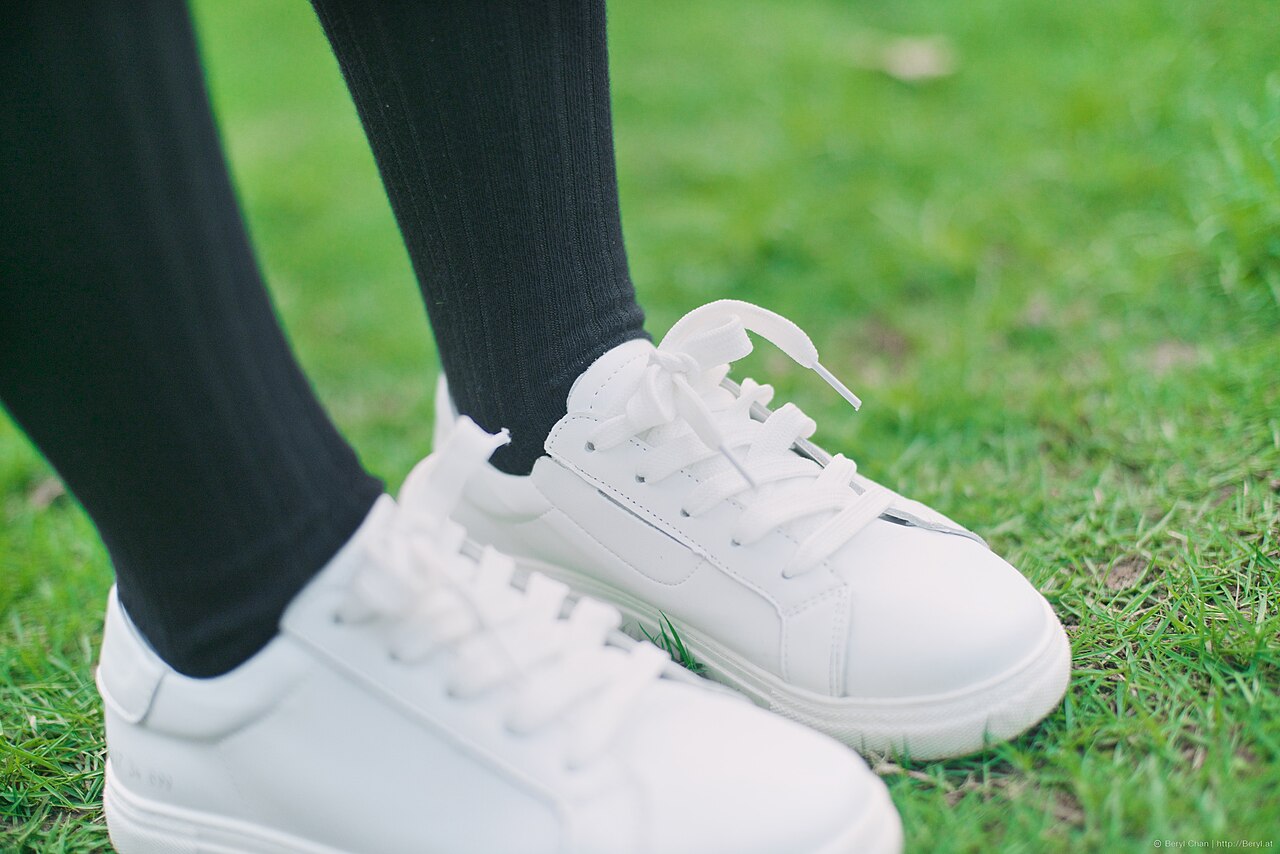
One last thing worth doing: try the pair with the socks you actually wear. A thin sock makes a light shoe feel roomier than it will with a wool one, and light uppers don’t stretch enough to make up the difference. Ten seconds in the shop saves a month of annoyance. If you want to see how a similar flexible pair works in a different colour, our piece on navy slip-ons and the heel test uses the same checks from another angle, and the full sneaker range is where to compare weights side by side.
If you walk 5,000 to 8,000 steps a day and want one light pair, aim for 220g to 240g with a removable insole and at least 4mm of rubber at the heel. That combination covers the commute, the school run, and a Saturday in town without leaving you sore.
Walking further than that? Buy the light pair anyway, but keep a cushioned one for the long days. Two pairs rotated will outlast three pairs worn one at a time, and your feet will last longer too.
If you only take one thing from this, take the scale. Light sneakers for women are worth the money when the weight matches your week, and the only way to know is to weigh a shoe and count your steps for a day.
And if a 180g shoe is what you want, buy it for what it’s good at: short trips, warm weather, and the days you want to feel like you’re wearing nothing. Just don’t ask it to do a nine-hour shift. That’s not what it was built for, and no amount of lightness makes up for a sole that’s flat by lunchtime.
