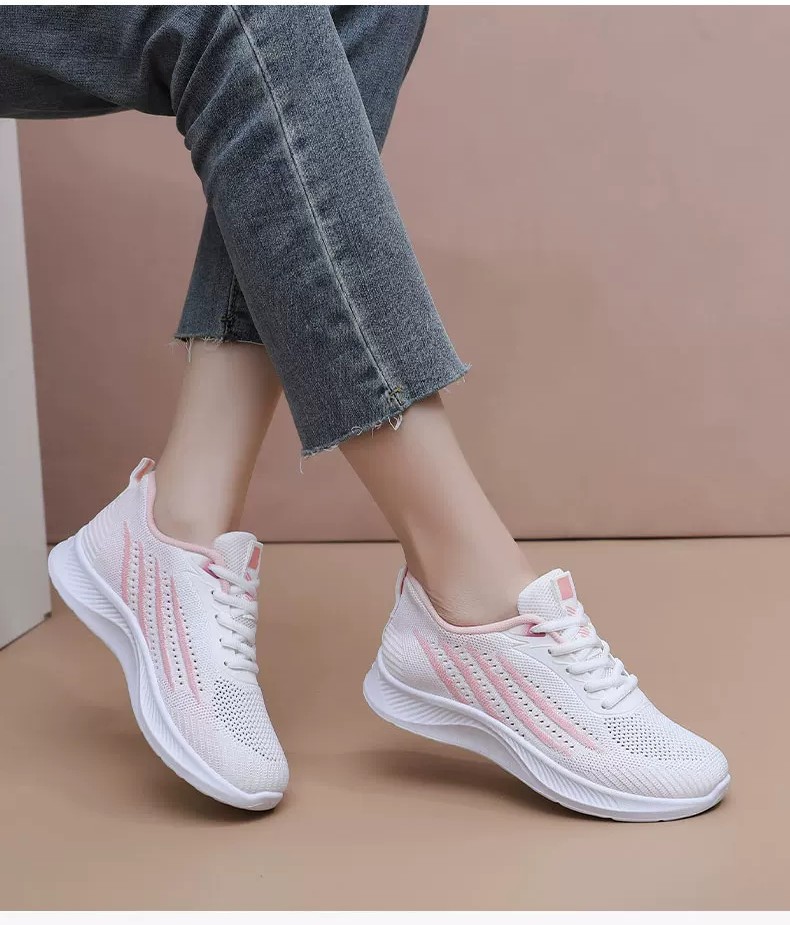
It’s 6pm, you’ve done maybe 9,000 steps, and your feet feel like they’ve been carrying something. They have. A pair of shoes at 400g each means you’ve lifted about 7 tonnes of shoe today, one step at a time.
That’s the entire argument for light sneakers, and it’s why people who switch tend to describe it the same way. Not “these are comfortable”. More like “I forgot I had them on”.
Women’s light sneakers have quietly taken over the daily-wear slot in most wardrobes. Half of that is weight, and half is that the category finally stopped looking like gym kit. Runway styling at Vogue has been pairing slim trainers with tailoring for a few seasons now, and the shops followed.
Light isn’t automatically better, though. Some of the lightest pairs on the shelf are also the ones that fall apart in a season or leave your arches aching by Thursday. Here’s how to tell the good ones from the ones that just weigh nothing.
You notice weight at hour four, not hour one
Try on a heavy pair in a shop and they feel fine. Walk to the till, drive home, wear them to lunch. Everything’s normal. Then you spend a full day on your feet and the shoes start to feel like a decision you made earlier and now regret.
That delayed reaction is why shoe weight is such a common buying mistake. Runners have a rule of thumb that each 100g on your feet costs roughly the same energy as 500g on your back. The exact number gets argued over, but the direction is not in doubt. Feet swing, so weight at the end of your leg costs more than weight in a backpack.
For a normal day of walking, the difference between a 400g shoe and a 220g shoe is about 3kg of perceived load by evening. You won’t feel it at 10am. You’ll feel it on the escalator at 6pm and you’ll blame your legs.
Light sneakers also change how you walk. A heavy shoe encourages a flat, slapping gait because lifting the foot costs effort. A light one lets you roll through the step, which uses your calf and ankle the way they’re built to be used. People often report their knees feeling better after switching, and the mechanism is usually this rather than anything in the cushioning.
There’s a limit, obviously. Below about 150g per shoe you’re in racing flat territory, and those things exist to be worn for 90 minutes by someone with strong feet. For daily wear, light means 200 to 260g per shoe in a women’s size 38. That’s the band where you get the weight benefit without giving up the sole, and it’s where most women’s light sneakers worth buying actually sit.
One quick comparison to make the numbers tangible. A 400g pair worn for 8,000 steps works out to roughly 3.2 tonnes of shoe lifted in a day. At 220g the same day costs 1.8 tonnes. Same walk, same you, one tonne and a half of difference.
What 200 to 260 grams per shoe buys you
Numbers on a spec sheet are only useful if you know what they mean in practice. Here’s the practical version, using a women’s size 38 as the reference.
- Under 200g. Barely there. Great for travel and hot days, thin underfoot, usually no shank. Fine for 5,000 steps, rough after 12,000.
- 200 to 260g. The sweet spot for most people. Enough foam to absorb pavement, light enough to forget. This is where a daily pair should sit.
- 260 to 320g. Noticeably sturdy. Better for standing all day than walking all day, and the extra weight buys structure rather than cushioning.
- Over 320g. Chunky, platform, or leather-lined. You’re buying a look, and your feet will send an invoice.
You can check the weight of any pair you already own on a kitchen scale. Weigh one shoe, not the pair, and compare with what you’re about to buy. Most people are surprised. A pair that feels light in the hand can be 340g because the weight sits in the sole, where your foot does the most work.
Distribution matters as much as total. A 240g shoe with a heavy rubber outsole and a papery upper feels worse than a 260g shoe with weight spread evenly. Pick the shoe up by the heel and hold it sideways. If the toe drops like a hammer, the sole is doing all the weighing, and your forefoot will feel it.
One more number worth knowing. Heel-to-toe drop changes perceived weight too. A 4mm drop puts your calf under more load, which reads as heaviness even when the scale disagrees. If you’re coming from a 10mm shoe, don’t jump straight to zero.
And the shoe you’re replacing is the real benchmark. Women’s light sneakers bought to replace a 380g leather pair will feel transformative in week one and normal by week three. That’s fine. The point is the whole day, not the first ten minutes.
The materials doing the actual saving
Light sneakers aren’t magic. They’re a set of trade-offs, and most of them happen in three places.
The upper is the big one. Engineered mesh weighs roughly half what a comparable leather upper does, and it breathes, which keeps your foot from swelling in heat. Knit uppers go lighter still and stretch across the forefoot, which is why they suit wide feet so well. The cost is structure: a knit upper does very little to hold your foot over the arch, so the sole has to do that job alone.
The midsole is where the engineering money goes. Modern EVA blends and supercritical foams are dramatically lighter than the dense rubber used a decade ago, and they return more energy per gram. A pair like these ultra-light running shoes with shock absorption gets its low weight from foam density rather than from removing material, which is the good version of light.
Outsoles are the sneaky line item. Full rubber coverage adds 60 to 90g and lasts longer. Blown rubber or exposed foam saves that weight and wears through in about 500km of pavement. If you walk 8,000 steps a day, that’s under a year.
Hardware adds up quietly. Metal eyelets, leather heel counters, thick laces and padded collars can add 40g to a shoe that looked light on paper. None of it is visible in a product photo.
Trade press covers this lurch towards lighter builds every season, and the tone has shifted from performance to daily wear. Footwear News coverage keeps returning to the same point: the weight number sells the shoe, the outsole decides whether you keep wearing it.
If you want the lightest possible option with a soft sole, something in the mesh sports range with a soft sole is about as far as you can go before the shoe stops protecting you. Below that line, you’re wearing a sock with ambitions.
Where light sneakers let you down
Honest section. Light has costs, and pretending otherwise is how people end up disappointed.
Thin means less underfoot. A 20mm stack of foam transmits more of the pavement into your foot, and if you have plantar pain or a heel spur, that’s the opposite of what you need. Light shoes are for people whose feet already behave, not for people rehabbing them.
They wear out faster. Less material means less material to wear through. Expect 500 to 800km from a light daily pair, against 1,000 to 1,200km from something heavier and better built. On a cost-per-walk basis the heavy shoe sometimes wins.
They’re worse in rain. Mesh drains fast and dries fast, which sounds good until you realise it also lets water in within seconds. A light sneaker in a downpour is a wet sock by the second block.
And they’re not great for standing still. Cushioning is designed for impact, and standing doesn’t produce impact. If your day is 10 hours behind a counter rather than 10,000 steps, a slightly heavier shoe with a firmer sole will feel better by mid-afternoon.
One more: light uppers show creases and scuffs faster, and pale colours on thin mesh are almost impossible to clean back to new. If you want a pair that still looks presentable in month eight, buy darker.
There’s also the question of how they age. A heavy leather sneaker looks better in year two than year one, scuffed and soft. A light mesh sneaker looks worse every single month after the first, because there’s nothing to develop a patina on. If you like the worn-in look, this is the wrong category for you.
So women’s light sneakers are a use-case purchase, not a lifetime one. Buy them for the 10,000-step days and the carry-on bag. Keep something heavier for the days when you’re on your feet but not moving, and for anything involving weather.
The 60-second test in the shop
You can’t weigh a shoe accurately by feel, and you shouldn’t trust the number in the listing. Do these four things instead.
- Twist the shoe lengthways. It should bend at the ball of the foot and resist at the middle. Bending in half like a sock means no shank.
- Press the heel counter from both sides. If it collapses easily, your heel will roll and the shoe will feel unstable on uneven ground.
- Drop the shoe from 30cm onto a hard floor. A dull thud is fine. A sharp slap means hard rubber and a rough ride.
- Weigh it if the shop has a scale. If not, compare it in your hand with a pair you already own and trust.
Then walk. Not around the shop, which is carpet and 20 metres. Ask to walk outside for two minutes if you can, and pay attention to the transition from heel to toe. Light shoes that fit well feel like nothing at that point. Light shoes that don’t fit feel like they’re sliding forward.
Ignore the “lightweight technology” language on the box. Every brand says it. The scale and your own heel strike are the only two sources that don’t lie.
Then do the stairs. Walk up one flight and down again. Going up tells you nothing. Coming down is where a thin sole and a soft heel counter show themselves, because that’s when your foot slides forward into the toe box. If your toes touch the front on the way down, the shoe is too short, whatever the size label says.
Last check: take them off and look at your socks. A red mark across the top of the toes means the toe box is too shallow. A mark around the heel means the collar is too high for your ankle bone. Neither problem gets better with wear.
Packing them, and the personal-item test
Light sneakers earn their money in a carry-on. A 220g pair saves roughly 400g against a normal pair, which is a paperback and a charger, or one extra jumper you’ll actually wear.
They also pack flat. Thin soles roll into a corner of a bag in a way that chunky ones never will, and mesh uppers don’t hold creases from being squashed for six hours. If you’re doing a week with one bag, this matters more than the weight.
What they don’t do well is multi-purpose duty. One light pair can handle a city break, a museum day and a casual dinner. It can’t handle a hike, a formal dinner, or a rainy week in a place with cobblestones. Pack a second pair if the trip includes any of those.
For the flight itself, wear them rather than pack them. Security is easier, and a light shoe is the closest thing to barefoot you can get away with on a plane. There’s a longer take on this in what women should actually pack for travel, including the two-pair rule that saves most people’s trips.
One packing detail people miss: light sneakers with mesh uppers pick up smells faster than leather, because the foam inside holds moisture. Air them out every night rather than stuffing them back in the bag. A dryer sheet in each shoe works for about three days and then stops working, which is the honest version of that tip.
Weight in the bag is not the only reason to buy light for travel. They also dry overnight in a hotel bathroom, which means one pair can cover a five-day trip if the weather behaves. A heavier leather pair will still be damp on day three, and damp shoes in a small bag is a smell you can’t undo.
Sizing and socks when the upper is thin
Thin uppers change sizing behaviour. There’s less material to stretch, so the shoe fits closer to how it feels on day one for the whole first month, then gives maybe 2mm across the forefoot and stops.
That means you should buy for the fit you want immediately, not the fit you hope to break into. If the toe box pinches at all in the shop, size up. There’s no stretch coming.
Socks become part of the sizing decision. A thin no-show sock takes up about 2mm. A cushioned crew sock takes 5mm or more. If you plan to wear these with thicker socks in winter, try them on with a thick pair, or accept that they’re summer shoes.
The heel is where thin uppers cause trouble. With no padding to grip, a low-cut shoe can slip at the heel even when the length is right. A heel lock lacing pattern fixes this in about 30 seconds and costs nothing. Look it up once and you’ll use it on every pair you own.
For anyone with a wide forefoot, mesh is the material to look for, and knit second. Leather light sneakers exist but they’re an oxymoron; leather is heavy, and thin leather splits. If your feet are wide and you want low weight, the answer is mesh with a wide toe box, not a smaller size in leather.
Check the insole too. Many light sneakers ship with a 3mm foam insole that flattens in a month. Replacing it with a 5mm one adds 25g and makes the shoe feel considerably better. That’s the cheapest upgrade in footwear.
Finally, rotate. Two light pairs worn alternately last roughly twice as long as one, because foam needs about 24 hours to recover after a long day. It’s the least exciting advice here and the one that saves the most money. Have a look at the rest of the sneaker collection by style and weight if you want a second pair that isn’t a copy of the first, and this piece on women’s black sneakers with black soles covers the heavier end of the same decision.
Weigh your current pair tonight. Whatever the number is, you’ll spend the next month noticing it. If you’re starting from zero, look for women’s light sneakers in the 200 to 260g range, try them on late in the afternoon when your feet are at their largest, and give yourself a week before you decide they’re the answer to everything. They’re not. They’re the answer to the days when you’re actually moving, which for most of us is most days.