

The first time you put on a chunky pair, you notice two things in this order. The height, which is fun. Then the weight, which is less fun.
Chunky sneakers for women sit in an awkward spot. They solve a proportion problem for some outfits and create one for others. They add 4cm to your height and 200g to each foot. Whether that trade is worth it depends on three numbers and one habit, and none of them appear in the product description.
Here’s what to check before you spend money on a pair you’ll wear twice.
What “chunky” means in millimetres
There’s no industry definition, so let’s use measurements. A standard casual sneaker has a 20mm to 25mm stack under the heel. Chunky starts around 35mm and runs to 55mm before it becomes a platform shoe with a sneaker upper.
The width of the sole matters more than the height. A 45mm sole that’s 110mm wide at the ball feels stable. A 45mm sole that’s 85mm wide feels like standing on a plank. The visual bulk people react to is mostly width, and the stability comes from the same place.
Ask for two numbers when you’re shopping: stack height at the heel, and sole width at the widest point. If a brand won’t tell you, that tells you something too. A reasonable chunky pair runs 32mm to 45mm of stack with a sole 10% to 20% wider than a standard sneaker of the same size.
Anything above 50mm starts to change how you walk. Your ankle has to work harder to keep you upright on uneven ground, and your calf stays slightly contracted all day. That’s fine for a two-hour outing and tiring for a nine-hour one.
The sole itself is usually EVA foam, sometimes with a rubber outsole bonded underneath. Thick EVA looks impressive and compresses over time, so a 45mm sole becomes a 40mm sole after about a year of regular wear. Thick rubber weighs more but keeps its shape.
The trouser problem, and how to solve it
This is where most chunky sneakers get abandoned. You buy them, you wear them with your usual jeans, and something looks off. The leg looks short and the foot looks like a boat.
The cause is hem width. A chunky sole needs a hem that’s either clearly wider than the shoe or clearly shorter than the ankle. Anything in between creates a visual pile-up at the ankle that makes your legs read about 5cm shorter than they are.
Three combinations that work:
- Wide-leg trousers with a hem that covers two-thirds of the shoe. The volume above balances the volume below.
- Cropped straight jeans ending 4cm above the ankle. You see the whole shoe and a bit of ankle, which keeps the line clean.
- Midi skirt with a hem between mid-calf and just above the ankle. The shoe grounds the skirt instead of fighting it.
What doesn’t work: skinny jeans bunched at the ankle, a long coat that stops right at the shoe, and any hem that sits exactly on top of the collar. All three make the shoe look heavier than it is.
Colour helps here. A sole in the same tonal family as your trousers shortens the visual block at the bottom of the outfit. A bright white sole on a black trouser draws a hard line at the ankle and cuts your leg length in half.
If you want the height without the visual weight, a lower-profile chunky pair like these thick-soled casual sports shoes do the job. The rise happens inside the shoe, so the outside stays closer to a normal silhouette.
Weight: the number nobody lists
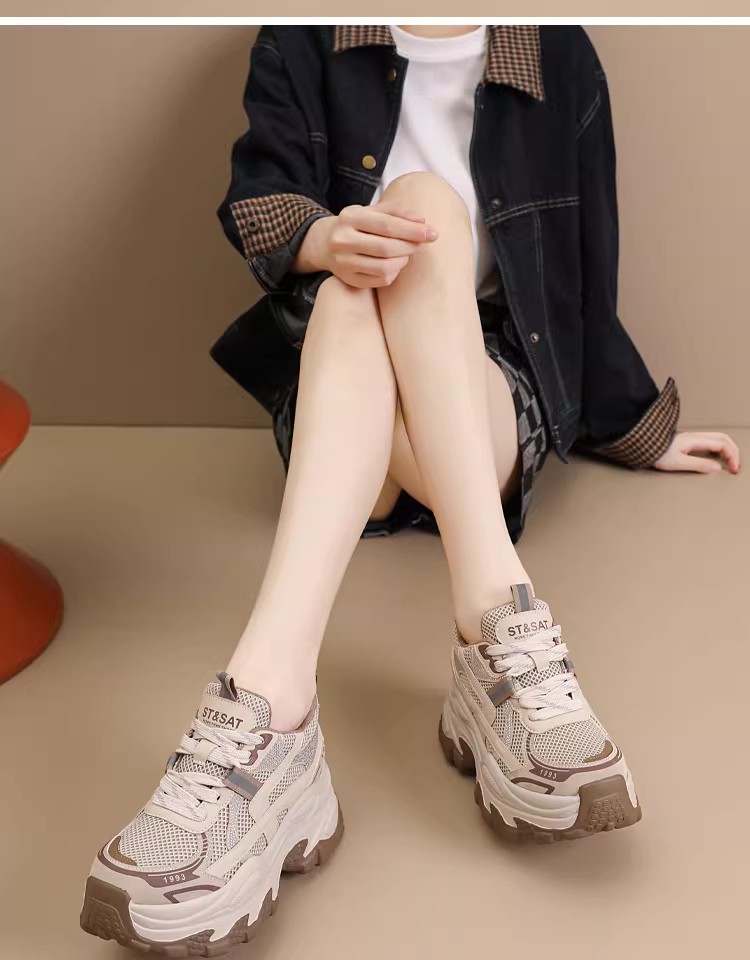
A standard women’s sneaker weighs 220g to 280g per shoe. A chunky pair weighs 380g to 550g. That difference is roughly a bag of sugar strapped to each foot, and you will feel it at about step 6,000.
Weight affects walking more than cushioning does. Every extra 100g per shoe adds measurable effort to each step, and over a day that adds up to the kind of tiredness you’d normally blame on the shoes being uncomfortable. They’re not uncomfortable. They’re heavy.
If you’re choosing between two pairs with the same look, weigh them. Stand on a kitchen scale with one shoe, then without. Under 400g is comfortable for a full day. Over 500g is a shoe for sitting in, not striding in.
The upper contributes less than you’d think. Leather adds maybe 40g per shoe over canvas. The sole is where the weight lives, and a hollow or honeycombed midsole can cut 80g without changing how the shoe looks. That’s the single most useful spec a brand can publish, and almost none of them do.
Picking them up in the shop is a rough test. If the pair feels surprisingly light for its size, someone thought about the midsole. If it feels like a brick, it is one.
Ankle roll: the real risk, and it isn’t the height
People worry about rolling an ankle in chunky shoes. The height matters less than the collar and the heel counter.
A low-cut chunky sneaker leaves your ankle free to move, which sounds dangerous but isn’t, because your foot can also correct itself. A mid-cut chunky shoe that ends just below the ankle bone is the awkward one. It restricts sideways movement without supporting it, so your foot pivots against a stiff edge.
What actually stabilises you is the heel counter, the stiff cup at the back, and a sole that flares slightly outward at the base. Squeeze the heel counter in the shop. If it folds flat with light pressure, your foot will roll inward and the shoe will lean after a few months.
Try this before you buy: stand on one foot, then the other, with your eyes closed for five seconds. A stable chunky shoe lets you hold it. A tippy one has you grabbing for the wall. It looks strange in a shop and takes eight seconds.
If you have flat feet or already roll inward when you walk, a chunky sole exaggerates the movement. You can compensate with a firmer insole, but the simpler answer is a lower stack. There’s a useful piece on low-cut sneakers and the ankle question if you want to stay closer to the ground.
Height, and who it actually suits
The honest answer is that chunky sneakers add height to everyone and flatter some silhouettes more than others.
If you’re 5’2″ and wear wide-leg trousers, a 40mm chunky shoe is the easiest way to stop the hem swallowing you. Same for long skirts and maxi dresses. The extra volume at the base gives the outfit a foundation it otherwise lacks.
If you’re 5’10”, the same shoe can push an outfit from relaxed to clumsy, but only with certain hems. With cropped trousers and a fitted top, it reads deliberate. With anything flowing, it starts to look like you borrowed someone else’s shoes.
Body proportions matter more than raw height. A long torso and short legs benefit from the visual weight at the bottom. Long legs and a short torso already have enough going on down there.
And there’s the practical side: 40mm of extra height does change how you sit, get in and out of cars, and reach top shelves. Most people adapt in a week. Some people find the raised centre of gravity odd for a month, especially on stairs.
Care: foam, mesh, and glue lines
Chunky shoes collect dirt in places other shoes don’t. The deep midsole groove, the gap between sole layers, and the mesh panels all trap grit that acts like sandpaper against the material.
Brush the midsole weekly with a dry brush. A soft toothbrush works for the grooves. Water and a cloth for the upper, nothing more aggressive than that on mesh.
Don’t submerge a chunky shoe. The layered sole holds water between the EVA and the rubber outsole, and that moisture sits there. A pair that’s been soaked takes 48 hours to dry properly and often starts to smell in the midsole where you can’t reach.
Watch the glue line between midsole and outsole. On cheaper pairs it starts to separate at the flex point after six months. A dab of shoe glue and 24 hours clamped will hold it another season. Ignore it and the gap widens until the layers peel apart at the toe.
If the upper is suede, keep it away from water entirely. If it’s mesh, a water-repellent spray helps but doesn’t make it waterproof. If it’s leather, condition it every couple of months, and pay attention to the crease where your toes bend. That’s where leather cracks first, and it’s the one part no repair can fix. For a rundown of what decent suede care looks like, the guide to picking a grey shade that survives covers cleaning without wrecking the finish.
Where they belong in your week
Chunky sneakers are a commuting shoe and a weekend shoe. They’re not an airport shoe if you’ll be running for a connection, and they’re not a museum shoe if you’ll be standing on marble for four hours.
The place they genuinely earn their keep: a wet-weather commute where you want height above the puddles. A 40mm sole keeps your socks dry on a pavement with standing water, which no flat canvas shoe manages. That’s a practical argument you won’t find in a styling article, and it’s the reason a lot of people in rainy cities own a pair.
They also work for long days on your feet on hard floors, as long as the midsole is decent. A wide, 40mm EVA sole absorbs more impact than a 20mm one, and the drop from a chunky sole tends to be flatter, which some people find easier on their lower back. If you spend all day on concrete, that matters more than how the shoe looks.
Where they don’t work: anything requiring you to be quiet, elegant, or quick on stairs. And driving. A 45mm sole changes the angle of your foot on the pedal enough that I’d change shoes before getting in the car.
For a softer, lower version of the same idea, these thick-soled breathable board shoes keep the wide base but drop the height, which is a better bet if you’re on your feet for nine hours rather than three. You can compare the full spread of silhouettes in the women’s shoe collection before you commit to a height.
One last practical note. Chunky pairs take up more room in a bag and more space by the door. If you’re short on storage, that’s a real cost, and it’s the reason my own pair lives in the hallway rather than the cupboard.
What I wouldn’t buy
Three types of chunky sneaker I’d walk past, and the reasons are specific.
First, anything with a sole taller than 50mm and a soft, squishy midsole. The combination is unstable: you’re high up and the base gives way. These are the pairs people roll an ankle in, and it’s not the height on its own that does it.
Second, a pair with a decorative sole panel glued onto the side. It’s there to add visual bulk cheaply, and it will peel within a year, usually starting at the toe where you scuff it. Once it lifts there’s no clean fix.
Third, a fully white chunky pair in a city with rain. The sole scuffs at the edges within a week, and white EVA can’t be restored to its original colour. If you want white, get a pair with a rubber toe bumper so at least the scuffs land somewhere designed for them.
What about the ones that cost three times as much? Sometimes they’re better. Often they’re the same shoe with a different logo and a slightly denser midsole. Compare the weight and the sole width before you decide the price means quality. OEKO-TEX certification is a more useful marker than a designer name, at least for what’s touching your skin.
How to break a pair in without regret
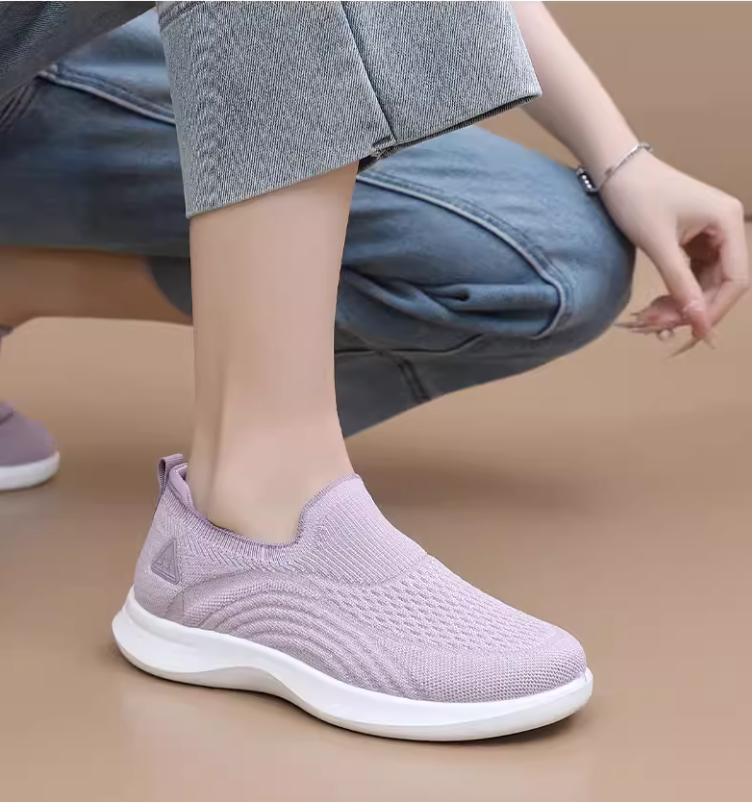
Wear them for two hours at home first. Not to soften them up, but to find the pressure points while you’re near a chair.
Then a short outdoor walk, 20 minutes, on flat ground. Then a normal day. Skip this sequence and the first long walk becomes the test, which is how people end up with blisters on the arch from a seam they never noticed.
Chunky shoes don’t need much breaking in. The upper is usually soft already, and the sole doesn’t mould to your foot. What you’re testing is whether your foot and the shoe agree about where your weight should sit.
If the shoe feels fine for 20 minutes and then your arch aches, the insole is wrong, not the shoe. Swap it for something with more structure before you give up on the pair.
The pair worth keeping is the one you forget about by lunchtime. If you’re still thinking about your feet at 4pm, the height wasn’t worth it, and no amount of styling will fix a shoe that makes you want to sit down.
