

The first pair of slingbacks I bought were a half size too long, and I did not notice for three weeks. They felt fine standing still. It was only on the walk from the train to the office — maybe six hundred metres of pavement — that the strap started sliding down under my heel bone, and I began doing that small, undignified shuffle where you curl your toes to keep a shoe attached. The problem was not the size on the box. It was where the strap sat.
That is the thing about heels with an open back: almost every complaint people have about them — slipping, rubbing, that clacking sound when the shoe leaves your foot mid-step — traces back to a strap that is in the wrong place or under the wrong tension. Get that one detail right and a slingback becomes one of the easiest heels in a wardrobe. Get it wrong and no amount of heel grips will save the pair. This guide works through the mechanics, the history, the material differences that only show up after eight hours, and the specific tests worth doing before you hand over a card.
The Open Counter Is the Entire Point
A conventional pump holds your foot with a closed heel counter — a stiff cup of leather or thermoplastic that wraps the back of the heel and stops it from travelling backwards. Remove that cup and you remove most of the shoe’s grip on your foot. Everything a slingback does, it does by tension: the strap pulls diagonally across the back of the heel and forward into the vamp, and the whole arrangement stays put only because those two forces balance.
This is why slingbacks behave so differently from pumps of the same size. A pump that is slightly too long will still stay on, because the counter catches the heel. The same foot in the same length of slingback will step straight out of the shoe. The counter is not just structure; it is a tolerance for error, and an open back gives you almost none.
The upside is real, though, and it explains why the style has never gone out of production. An open back means no rigid edge pressing on the Achilles tendon, which is the single most common site of blistering in new heels. It also means the shoe accommodates a wider range of heel widths, because nothing is clamping the sides. Women with a narrow heel and a wide forefoot — a very common combination and a nightmare for pumps — often find that sling back heels women can wear comfortably for a full day are the ones built on a last that is narrow at the heel and generous across the ball, with the strap doing the work a counter cannot.
There is a trade-off in the other direction too: less structure means less support in the arch, so the sole and shank matter more than they do in a pump. A slingback built on a flimsy sole will feel fine in the shop and collapse underfoot by mid-afternoon. More on that in the section on materials.
It is worth saying plainly that sling back heels women discard quickly are almost never discarded for their height. They are discarded because one of those three fit variables was wrong from the first wear and never got better.
A Short History of the Slingback
The idea of fastening a shoe behind the heel rather than over it is old — the ancient Greek krepis and Roman sandals both used rear straps — but the modern slingback as a dress shoe is a mid-century invention, and it is usually traced to Paris. Roger Vivier, who designed shoes for Christian Dior from the early 1950s and is credited with the needle-thin aiguille heel, worked extensively with open-backed and rear-fastened shapes in that period. His interest was structural: an open back let him move the heel further forward under the arch, which changed the whole balance of a high shoe.
The configuration most people picture — a low, slender heel, a pointed or almond toe, a thin strap with a small buckle — arrived properly in 1957, when Chanel released the two-tone slingback: beige body to lengthen the leg, black cap toe to hide scuffing, and an elasticised back so the strap held without a fastener. It was designed to be worn in daylight, which was unusual for a heel at the time, and it has barely changed in sixty-odd years. That longevity is a useful signal. A shoe that survives that long is not a novelty; it is a solved problem.
What followed was a series of reinventions rather than improvements. The 1990s brought the kitten heel back and made the slingback a work shoe. The 2000s pushed it into square toes and platforms. The 2010s briefly turned it into a sculptural object with block heels and architectural straps. The Bata Shoe Museum collection shows how consistently the construction stayed the same through all of it — the strap, the buckle or elastic insert, the open counter — while toe shape, heel profile, and material cycled through fashion. If you are buying today, you are buying a shape that has been refined by roughly seventy years of trial and error, and the differences between a good and a bad pair are almost entirely in the details rather than the silhouette.
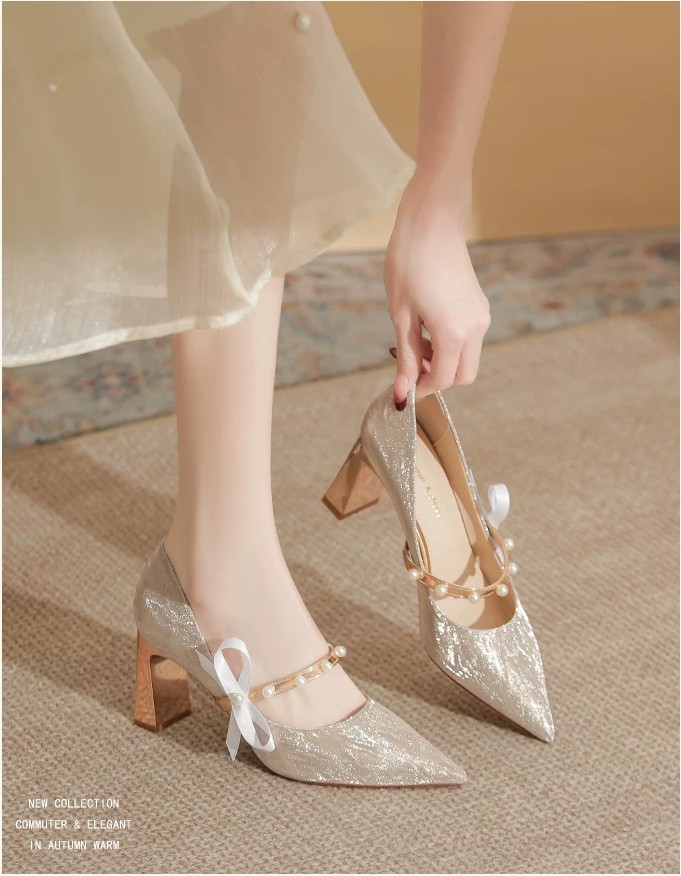
Strap Placement: Three Fit Zones That Decide Everything
When a slingback fits, three separate things are correct at once. When it does not, usually only one of them is wrong, and identifying which one saves a lot of pointless returns.
Zone one is strap height. The strap should sit in the hollow just below the bony point of your heel, not on it and not below it. Too high and it presses on the bone with every step, which is where those narrow red lines come from. Too low and there is nothing for it to catch against, so the shoe slides forward and your toes take the load. A useful check: with the shoe on and your weight on the ball, the strap should rest in that dip with light contact, not a grip and not a gap.
Zone two is vamp depth. The vamp is the part covering the top of your foot, and in a slingback it is doing half the retaining work. If it is cut too shallow — a low-cut throat with a lot of toe cleavage — there is not enough surface area to hold the forefoot, and the shoe will feel loose no matter how tight the strap is. If it is cut too deep, it presses on the instep and cuts circulation. The right depth covers the base of the toes and the first knuckle, and it should feel snug but not tight when your foot is at its largest, which for most people is late afternoon.
Zone three is strap tension and length. This is where cheap and expensive pairs separate most visibly. A strap with a buckle gives you roughly a centimetre of adjustment, which is often not enough. An elasticised insert gives continuous tension and forgives daily swelling, which is why the Chanel original used one. The failure mode to watch for is a strap that is elasticised but under-powered — you can feel it stretch to its limit when you pull the shoe on, and it will not recover.
One more variable that almost nobody mentions: the lining. A smooth synthetic lining in an open-backed shoe is a slip hazard, because there is no counter to catch the heel once it starts moving. Look for a leather or suede-lined heel patch, or a silicone grip strip bonded into the strap. It is a two-dollar detail that determines whether the shoe survives a full working day.
Heel Height Measured in Millimetres
Descriptions like “mid” and “high” are useless, because a 70mm heel set forward under the arch feels nothing like a 70mm heel set back under the heel bone. Measure in millimetres and look at the pitch.
Under 45mm is the practical end of the range. At this height the ankle does not have to compensate much, and the shoe can be worn for a commute, a wedding, or a nine-hour day without a change. The trade-off is purely visual: a very low slingback reads casual, closer to a flat than to a heel, and it works best with cropped trousers and full midi skirts rather than anything body-conscious.
Between 55mm and 70mm is the sweet spot for most daily wear, and it is where the shape earns its reputation. For sling back heels women wear to an office five days a week, this is the band to stay inside until you know exactly how your feet handle an elevated heel over a long day. At this height the arch is lifted enough to change your posture but the ankle is not locked into a permanent point. Look at where the heel sits relative to the rest of the shoe: a heel placed slightly forward, under the middle of your heel bone rather than behind it, distributes load through the arch and feels dramatically more stable than the same height set further back.
Above 85mm, everything changes. The angle of the foot increases to the point where the strap is doing nearly all the retaining work, and the forefoot takes a load it was not designed for. A high slingback can absolutely work — but only with a sturdy strap, a well-shaped last, and a sole with some actual substance. A 95mm slingback on a thin leather sole is a shoe for sitting in. A 95mm slingback with a 10mm concealed platform and a rubber-tipped sole is a shoe you can walk in. The number on the box is the least informative part of the spec.
Materials: What They Do by Six in the Evening
Every slingback feels good at 10 a.m. The real differences show up after lunch, once your feet have expanded by up to half a size and the upper has been through a few hours of flexing — which is exactly when sling back heels women bought in a hurry reveal what the material is actually made of.
Box calf and polished calf are the most forgiving. They stretch very little lengthwise but soften considerably across the vamp, and they hold their shape between wears. If you buy a pair that is snug rather than tight, calf will meet you halfway within a fortnight.
Nappa and soft lambskin feel wonderful immediately and stretch more than you expect. This is the material most likely to produce a slingback that fits in the shop and is too loose by week three. If you go this route, buy the tighter of two sizes and accept a week of breaking in.
Suede has the best grip of any upper material, which matters enormously on an open-backed shoe, and slightly less stretch than nappa. Its weakness is weather and crush resistance — a suede slingback left in a hot car will never be the same shape.
Patent is the one to be careful with. It does not stretch, at all, and it does not breathe. In a closed pump that is manageable because the counter holds the shoe on. In a slingback, a non-stretching upper plus a rigid strap plus a hot day is a reliable recipe for a shoe that either rubs or slips, sometimes both on the same walk.
Satin and woven fabrics are occasion shoes, and should be bought as such. They mark, they crease permanently at the toe, and they offer no structural help whatsoever, which means the fit has to be perfect from day one because nothing is going to adapt.
The other half of the material story is underfoot. A leather sole looks correct and slides on smooth floors, which is why so many people add rubber pads. A thin rubber or TPU sole with a defined heel tip is far better for real pavement, and it also dampens the noise — that sharp clack of a hard sole on tile is a function of sole material, not elegance. Check the shank too, the stiffener running through the midfoot. Flex the shoe in your hands: it should bend at the ball and stay firm through the arch. If the whole shoe folds in half, walk away.

The Ten-Minute Sizing Test
Shopping for slingbacks in the morning is a mistake. Feet are at their smallest then, and the shoe that fits at 9 a.m. will be tight by 5 p.m. Try them on in the late afternoon if you can, and if you cannot, size for the larger foot rather than the smaller one.
Start by standing, not sitting. Almost every slingback problem hides when you are seated, because the foot slides back and the strap appears to fit. Standing loads the foot, spreads it, and pushes it forward into the vamp. Then walk. Not two steps in front of the mirror — twenty paces on a hard floor, ideally out of the carpeted area. Listen for the heel lifting off the sole; you will hear it before you feel it.
The strap test: with your weight on the ball, hook a finger under the strap. It should be snug enough that you cannot slide a finger in easily, but not so tight that the strap indents your skin. Then curl your toes hard, as if gripping. If the shoe stays on without the strap moving down, the tension is right. If the strap slides, the shoe is either too long or the strap sits too low, and no half size will fix the second problem.
The toe test: press the tip of the shoe with your thumb while standing. You want a few millimetres between your longest toe and the end of the shoe, roughly the width of a thumb. Less than that and every step will jam your toes into the front, which is the leading cause of the burning sensation people blame on heel height.
On the half-size question: for pumps, most fitters go up. For slingbacks, go with whichever size keeps the strap in the right place, because strap position is fixed by the shoe and cannot be adjusted by a sock. If the shoe is right lengthwise but the strap is loose, a cobbler can shorten it — a five-minute job and usually cheap. If the shoe is right lengthwise but the strap sits too high or too low, no alteration will help, because the whole heel curve is wrong for your foot. Walk away from that pair. There are hundreds of others.
Walking, Grip, and Repairs That Save a Pair
Technique matters more in an open-backed heel than in any other shoe, and it is the part nobody explains at the till. The gait that makes sling back heels women can genuinely walk in is not a delicate one; it is simply a shorter one. The instinct when a shoe feels loose is to reach forward with the toe, which pulls the heel out of the strap. Instead, shorten your stride by roughly a third and land a little flatter — midfoot rather than heel-first. It looks deliberate rather than careful, and it keeps the strap exactly where you put it.
If the pair is otherwise good and the strap still slips, the fixes are cheap and worth doing before you give up. A heel grip, the suede or foam kind rather than the gel kind, bonded to the inside of the strap adds friction without changing the fit. A thin leather insole takes up a little volume and pushes the foot back into the strap. If the strap is elasticised and has stretched out, a cobbler can replace the elastic for very little money, which effectively resets the shoe.
Two repairs are worth knowing about because they extend life significantly. First, heel tips: the small plastic cap at the bottom of the heel wears through fast on pavement, and once it is gone the heel itself starts grinding away. Replace tips before they reach the nail, not after. Second, sole protection — a thin rubber half-sole applied when the pair is new costs less than a single re-soling and prevents the leather from wearing through at the toe, which is where slingbacks always go first because the open back makes you place more weight forward.
Storage matters too. Slingbacks lose their shape when the strap is left stretched over the back of the shoe, so store them with the strap fastened loosely and the pair in a bag rather than loose in a wardrobe. If you have a pair in satin or suede, stuff the toe with tissue to hold the shape between wears.
What to Wear Them With
The slingback’s open back creates a horizontal line at the ankle, and once you notice that line you can dress around it deliberately. The most reliable pairing is a hem that stops above it: a midi skirt that ends mid-calf, a cropped straight-leg trouser, or a knee-length dress. Anything that falls to the exact height of the strap creates visual clutter and, worse, gets caught between the strap and the heel with every step.
Trousers need a little length management. A full-length wide-leg trouser over a pointed slingback looks excellent — the toe carries the line and the open back adds a break of skin. A slim ankle-length trouser works if the hem clears the strap by a couple of centimetres. What does not work is a straight-leg jean that lands exactly on the strap, because it will ride up and expose the back of the shoe at the wrong moment.
Colour logic is simpler than it looks. A nude or beige slingback, following the Chanel formula, visually extends the leg and is the most versatile choice with skirts and dresses. Black is the better option with trousers and tights, and it is more forgiving of scuffs at the toe. Metallic and satin versions are occasion pieces and read best with a single-colour outfit, because the shoe is already doing the decorative work.
Seasonally, the style is more flexible than its reputation suggests. In warm weather, wear them with bare legs and a light fabric — the open back is genuinely cooler than a pump. In cooler months, a suede or leather slingback works with opaque tights and a heavier skirt, and it reads less severe than a closed court shoe. If you are shopping for sling back heels women will still be wearing in three years, ignore the trend-led colours and buy the neutral. And if you are building a wardrobe around women’s shoes that actually get worn rather than admired, one pair in a neutral leather at 60 to 65mm will earn its place faster than any other heel.
The related detail worth reading up on is strap geometry more broadly — if you like the way a narrow strap changes the line of the foot, our guide to T-strap heels for women covers the same principle from a different angle.
None of this is complicated, but it is specific, and specificity is what separates a pair you wear twice from a pair you wear for years. Check the strap height standing up, buy the size that puts the strap in the right place rather than the size that matches your pumps, look at the sole before you look at the toe, and accept that the difference between a good slingback and a painful one is usually about eight millimetres of strap placement. Find that and the shoe disappears into your day, which is the highest compliment a heel can get.
