

Most sneakers ask for attention. They arrive with a white midsole, a gum sole, a flash of colour along the heel, and the whole shoe announces itself before anyone has looked at your face. An all-black pair does the opposite. When the upper and the sole sit in the same value of black, the eye stops separating the shoe into parts and starts reading it as one shape — a shape that happens to sit under your ankle and quietly finish the line of your leg. That is the reason women’s black sneakers with black soles have become the pair a lot of people reach for on the mornings when they cannot be bothered to style anything at all.
I have worn through enough pairs to be suspicious of any shoe that photographs better than it walks. This category is one of the few that holds up on both counts, but only if you pay attention to three things most shoppers ignore: how the black is applied to the material, how the sole unit is built, and whether the last was actually cut for a woman’s foot rather than shrunk down from a men’s mould. Get those right and a single pair can carry you through a working week. Get them wrong and you end up with a shoe that turns grey at the toe crease within a month and looks tired long before the rubber wears out.
Why a Black Sole Changes What the Shoe Looks Like on Your Foot
A white midsole is a horizontal stripe. It sits at the widest, lowest point of the shoe and cuts across the ankle at exactly the height where most people want continuity. That stripe is why a white-soled sneaker can make a cropped trouser look stumpy and why it reads so loudly against dark denim. Put the same shoe next to a black trouser and you get two hard edges competing: dark fabric, white stripe, dark shoe. The eye has to stop and restart.
Take the stripe away and the problem disappears. A black sole merges into a black upper, the shoe becomes a single dark mass, and the leg line runs from hem to floor without interruption. On a short frame this reads as length. On a wider foot it reads as restraint, because there is no bright band pulling attention outward. Photographers have known this for decades: dark on dark compresses, light on dark expands. The same principle that makes a black turtleneck slimming makes an all-black sneaker look smaller than the tape measure suggests.
There is a practical side too. Black midsoles are usually moulded from a rubber compound that has carbon black in it rather than a painted-on coating, which means scuffs are less visible and the sole does not develop the grey-yellow bloom that white EVA picks up after a few months of pavement. The trade-off is that a black sole can look flat and slightly heavy in photographs, especially in a flat, matte finish. A little sheen — a semi-gloss sidewall, a rubber that catches light along the edge — keeps the shoe from reading like a school plimsoll. The chemistry behind that rubber goes back a long way; the vulcanisation process that made rubber soles durable enough to walk on was patented in the 1840s and is still, more or less, how your sole is made today (Wikipedia).
One caveat worth stating plainly: all-black shoes can look severe with pale, summery clothing. If your wardrobe is mostly cream, oatmeal and washed linen, a black-on-black sneaker will feel like a punctuation mark rather than a neutral. It is a neutral, but a heavy one. Pair it with mid-tones — grey, denim, olive, camel — and it settles down.
Leather, Knit, Suede: How Each Material Handles Black
Black is not one colour. On smooth full-grain leather it is deep and slightly reflective, and it holds a polish, which is why a black leather sneaker reads closer to a loafer than to a gym shoe. On knit it is matte and light-absorbing, closer to charcoal than to true black, and it tends to go slightly ashy wherever the fabric stretches over the toes. On suede it is the deepest black of all — suede swallows light — but it also marks the fastest and does not enjoy rain.
This is the detail that separates a good pair from a disappointing one, and it is why women’s black sneakers with black soles can look wildly different from each other on a shelf where every box shows the same silhouette. If you want one pair that works for the office and the weekend, leather is the safer bet. Look at how the black sits on the leather rather than on top of it. Dyed-through, drum-dyed hides stay black even when the surface is scuffed, which matters enormously at the toe crease and along the collar where the shoe flexes thousands of times. Surface-coated or sprayed leather looks perfect in the box and then reveals a pale grey core the first time you catch it on a stair. Turn the shoe over, flex the vamp with your thumbs, and look at the crease. If it whitens immediately, walk away.
Coated synthetic uppers have improved a great deal, but they still fail in a specific way: the coating cracks rather than creases, and once a crack forms it cannot be conditioned back. They are also the least breathable option, which matters if you wear the shoes without socks in summer. Knit uppers are the opposite — light, breathable, forgiving across the instep — but a black knit sneaker almost always looks sportier, so it will not slide under tailored trousers the way leather will.
A mixed build is often the smart compromise: leather or suede across the vamp and heel, a knit or mesh tongue and collar, and a black rubber sole with a slightly textured sidewall. You get structure where the shoe needs to hold its shape and ventilation where your foot needs it. Whatever the material, check that the lining is also dark. A black upper over a white or cream lining will show at the collar every time you put the shoe on, and that single bright line undoes most of the visual work the all-black build was doing.
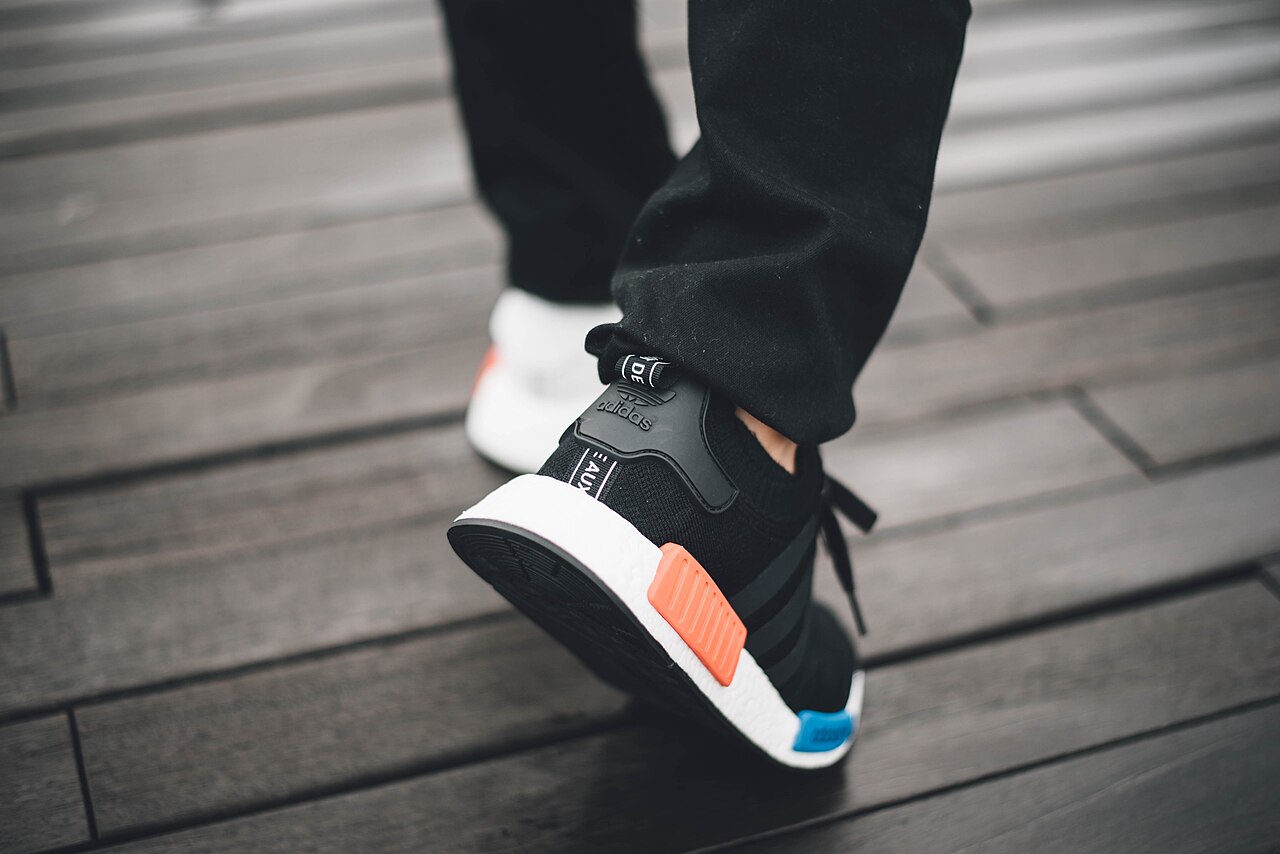
Fit: Toe Box, Heel Counter and Sole Stack
Fit is where most sneaker purchases go wrong, and an all-black pair hides the symptoms longer than a white one. Because there is no contrast to show where your toes end, a shoe that is half a size short can feel acceptable in the shop and be unbearable by three in the afternoon. Measure your foot late in the day, standing, with the socks you actually wear. Then check the shoe against three numbers: a thumb’s width between your longest toe and the front of the shoe, no more than about five millimetres of heel lift when you walk, and enough width at the ball that your foot does not spill over the welt.
The heel counter deserves a squeeze. A firm, structured counter holds the back of your foot steady and stops the shoe from collapsing inward as you walk; a soft, floppy one feels comfortable for ten minutes and then lets your ankle roll. The American Podiatric Medical Association’s general guidance on shoe selection puts the same points first — room in the toe box, a firm heel, and a sole that flexes where your foot flexes, not in the middle (APMA). None of that is exotic advice, but it is easy to forget when you are buying on looks.
Sole stack height is the other variable people underestimate. A low, flat sole of around 15 to 20 millimetres feels connected to the ground and suits long walking days on even pavement. A stack of 30 millimetres or more adds cushioning and a bit of height, but it also changes your gait and can make a slim ankle look thin by comparison. Black sole units hide the visual bulk better than white ones, which is a small advantage, but the physical bulk is still there. Try both heights if you can. Most people discover they want less stack than they assumed.
Finally, check whether the insole is removable. If it is, you can swap in an orthotic or a thin wool insole for winter without changing the fit much, and you can air the shoe properly. If it is glued down and thick, the shoe has one fit and one only. For women’s black sneakers with black soles that you intend to wear five days a week, that flexibility is worth more than any design detail.
Five Outfits That Actually Work
Straight-leg dark denim, hemmed to just above the shoe, is the easiest pairing and the one I return to most. Roll the cuff once so the hem sits on the top of the shoe rather than bunching over it, and let the black sole do the work of extending the line. Add a grey knit and you have a uniform that needs no decisions. If your jeans are light-wash, expect more contrast; the black shoe will read as an anchor rather than a continuation, which is a different look and not a worse one.
Tailored wide-leg trousers are the pairing that surprises people. A black leather sneaker with a black sole under a pressed wool trouser reads almost like a soft loafer, especially if the trouser breaks just at the shoe’s collar. Keep the hem clean and the shoe slim; a chunky sole under a fluid trouser looks like two different outfits sharing a leg. This is the combination that makes a single pair of sneakers office-appropriate in all but the most formal rooms.
A midi skirt with a sock is the third route and the one that gets the most comments. A dark ribbed sock in the same value as the shoe closes the gap between hem and collar and makes the whole thing look deliberate rather than accidental. With a shorter hem, black tights do the same job. In summer, bare ankles and a cropped wide trouser work fine as long as the shoe is leather rather than knit — a knit sneaker with bare legs tips into gym territory fast.
The fourth outfit is the tonal one: black trousers, black top, black shoe, with texture doing the separating. Wool against cotton against leather gives the eye enough to read even though the value is nearly uniform, and the all-black shoe becomes the full stop. The fifth is the simplest — a dark slip dress or a long shirt dress and the sneakers, nothing else. It is the outfit that proves the point of the whole category. If you want a deeper look at how the leather versions fit, there is a useful breakdown in this guide to ladies black leather sneakers that covers break-in and sizing in more detail.
Care: Keeping Black Looking Black
The reason most women’s black sneakers with black soles end up looking tired is not the rubber — it is neglect at the flex points and salt stains left to sit. Black shoes fail in three ways: they go grey at the flex points, they pick up scuffs on the sole edge, and they develop a dull bloom after contact with road salt. All three are manageable. For leather, wipe with a damp cloth, let the shoe dry at room temperature — never on a radiator, which cracks the finish — and condition lightly every six to eight weeks. A neutral cream is safer than a black polish on soft leathers, because polish builds up in the creases and eventually flakes. Buff with a horsehair brush and the depth comes back.
For suede, a soft brush in one direction lifts the nap and removes most surface dust. Stubborn marks need a suede eraser, not water. If the shoes get wet, stuff them with newspaper, let them dry away from heat, and brush once dry. Do not use a black suede dye on a small mark; you will create a dark patch that is more visible than the original scuff. Suede is the highest-maintenance option in this category and the most rewarding when it is looked after.
The sole is where most people over-clean. A melamine sponge will take a scuff off a black rubber sidewall, but it is mildly abrasive and will dull the finish if you use it weekly. A drop of dish soap on a stiff brush handles most of it. Avoid bleach and avoid acetone, both of which will strip the black and leave a permanent grey patch. Wash the laces separately in a pillowcase, or simply replace them — flat black laces cost almost nothing and immediately make a tired pair look newer. Store the shoes with a little air around them rather than jammed in a bag, and if you wear them daily, give them a day off between wears so the lining can dry out.
What to Check Before You Buy
Start with the dye question, because it determines how the shoe will age. Press a thumbnail into the leather at the vamp. A shoe that has been dyed through will stay dark in the crease; a surface-finished one will show a lighter line. Then look at the join between upper and sole. On a good shoe the bond is even, with no glue visible at the edge and no gap where the upper meets the midsole. Run your finger around it. Any soft spot is a place where water will get in.
Check the stitching at the heel and the eyestay. Even double stitching with no loose threads is a reasonable proxy for overall construction quality, and it is one of the few things you can assess in thirty seconds in a shop. Weigh the shoe in your hand. A very light all-black sneaker usually means a thin outsole that will wear through at the heel within a season; a very heavy one means dense rubber that may feel clunky on long walks. Somewhere in the middle is where you want to be.
Ask about the return window and wear it indoors for an evening before you commit. Most quality brands allow returns on unworn pairs, and a carpet test will tell you more about the heel counter and the toe box than five minutes of standing. If you have wide feet, look specifically for brands that publish width options rather than telling you to size up — sizing up fixes length, never width, and an oversized shoe with a black sole looks exactly as oversized as it is. It is also worth checking whether replacement laces and insoles are sold separately, because those two items extend the life of a pair more than anything else.
Where They Fit in a Small Rotation
A wardrobe built around three or four pairs needs each one to earn its place. The all-black sneaker earns it by covering the widest range of situations: commuting, errands, casual Fridays, dinner in a place without a dress code, travel. It is the pair you can put on without checking the weather forecast, the one that works with the trousers you already own, and the one that does not require a second pair of shoes in a bag. That versatility is the actual argument for spending more on a good pair rather than less on three mediocre ones.
If you already own a white sneaker, the black one is not a duplicate. White reads casual and summery and wants light clothing around it; black reads quieter and works in winter with wool and in autumn with denim. Together they cover most of the year. Add a low boot for rain and a heel for the evenings that require one, and you have a rotation of four that handles almost everything without a single decision at seven in the morning.
The last thing to say about women’s black sneakers with black soles is that they are not a statement. That is the point. They are the pair that disappears into an outfit and lets everything else do the talking, and the ones that do it well are the ones built from properly dyed leather, a firm heel counter, and a sole that is black all the way through rather than painted on. Buy on those three things, ignore the rest of the noise, and the shoe will still look right in three years. If you are still narrowing down the shape, the full sneakers collection is a reasonable place to compare silhouettes side by side.
