

The last time I bought proper office shoes, I wore them in on a Tuesday, took the 8:12 train, and by twenty past ten I had one of them off under my desk. Nobody noticed. I noticed. Twelve weeks later they were at the back of the wardrobe with a scuff on the left toe and a heel tip worn down to bare plastic.
That pair cost me £115. The pair that replaced them cost £68, and I wore those four days a week for two years. Price told me nothing useful about either purchase. What told me everything was the toe box, the height of the heel, and how much give the leather had in the first ten minutes.
So this is a working guide to business attire shoes for women who actually have to stand up in them. Not the catalogue version. The version where you’re on a packed escalator at 8:50 with a laptop bag digging into your shoulder and you’d quite like your feet to still be on speaking terms with you by lunchtime.
Before anything else: if you’re starting from zero, the women’s shoes section is the sensible place to browse, and the general advice on heels holds for office pairs too. A lot of people search “business attire shoes women” at half eleven at night with no apostrophe and one thumb, which tells you how the decision usually gets made. Badly, and late.
Here’s the honest version of what I’ve learned, including the part where a pair I still own is a pair I’d tell you not to buy.
Offices went casual, the shoe question didn’t
Most workplaces have loosened the dress code over the past decade, and the business casual entry on Wikipedia tracks that shift pretty well. Jeans are fine in a lot of offices now. Trainers are fine in some. What didn’t change is that shoes still do a lot of signalling work in a room where nobody’s wearing a tie. A clean pair of low heels reads as “this person thought about it.” A pair of running shoes with a suit trouser reads as “this person ran for the train,” which is a different message entirely.
I’ve worked in three offices with three different unwritten rules, and the pattern was the same each time. The rule is never written down, everyone follows it, and it’s about 80% determined by what the most senior woman in the room wears. If she’s in loafers, loafers are safe. If she’s in 70mm courts, you’ll feel underdressed in flats for about a fortnight.
That’s annoying, and it’s also useful. It means you can look at your own office for two weeks before spending anything, and you’ll learn more than any style guide will tell you. Count what people actually wear. Not what the HR handbook says. Not what the influencer with the corner office says.
The other thing that changed is the commute. Business attire used to mean a shoe you wore from a taxi into a building. Now it usually means a shoe you wear for 40 minutes of walking, standing, and stairs, then eight hours of desk, then the same 40 minutes in reverse. That’s a much harder job, and most dress shoes were never designed for it. Business attire shoes for women have to survive a commute the old taxi-to-lobby pair never had to.
Heel height: 50 to 60mm is where most people stop hurting
I’ve owned 90mm court shoes. They photograph beautifully and they’re a genuine tool for a client meeting where you want to look like you own the building. They’re also a shoe I could wear for about three hours before my calves started filing complaints. For daily office wear, somewhere between 50mm and 60mm does almost all the visual work with a fraction of the cost, and I’d rather own two pairs in that range than one spectacular pair I dread.
The reason is simple mechanics. The higher the heel, the more your weight shifts onto the ball of your foot, and the more your toes get compressed into the front of the shoe. The NHS guidance on bunions is blunt about this: tight shoes with pointed toes can make an existing bunion worse, and shoes that squeeze the toes are the usual suspect. If you already have a bunion, or a corn, or a bit of a hammer toe from years of badly chosen shoes, this isn’t a style question anymore.
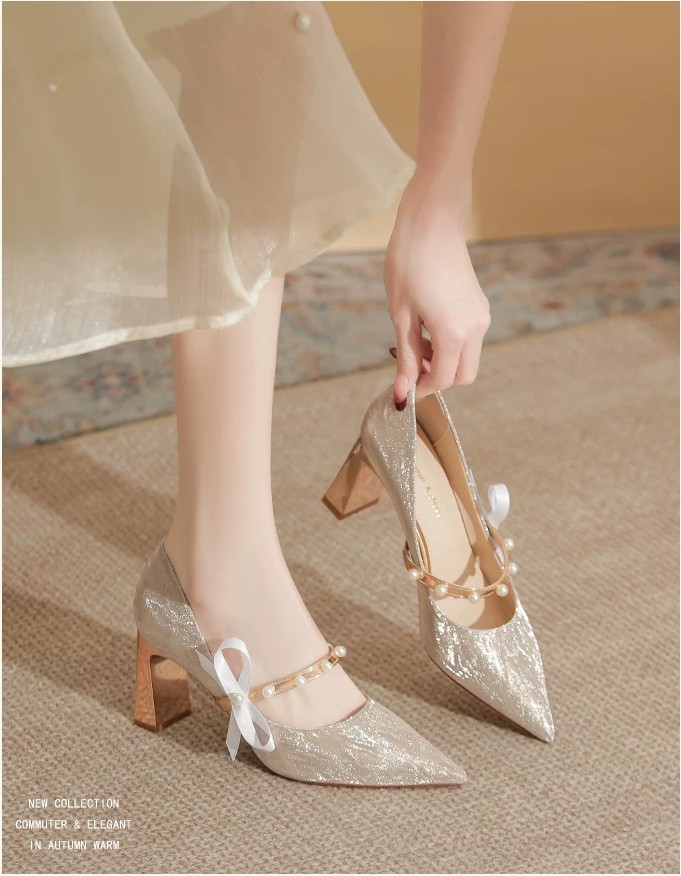
What I look for now is a heel that’s positioned under the actual heel of my foot, not set back behind it. Set it back and the shoe feels like it’s trying to tip you forward all day. A block heel at 55mm is the most forgiving shape I’ve found, because the base is wide enough that a wet pavement doesn’t turn your commute into a balance exercise.
A stiletto at the same height is a different shoe entirely. Same number on the box, completely different day. That’s the bit the size charts never tell you.
The toe box decides whether you’ll actually wear them
Pointed toes look sharper in photos. They also squish your toes together, and if you’re on your feet for a full day, that’s the bit you’ll remember at 4pm. I spent years assuming a pointed toe was the price of looking professional. It isn’t. A soft, slightly squared toe with a bit of room in front of your longest toe looks perfectly smart and doesn’t require you to develop a tolerance for pain.
Here’s the test I use in the shop, and it takes four seconds. Stand up. Wiggle your toes. If you can’t, the shoe is too narrow, no matter what the label says. Then press your thumb down on the top of the toe box just in front of your big toe. If there’s no give, the leather will either stretch over two months or it will never stretch and you’ll get a callus instead. Some leathers give. Patent and coated finishes generally don’t.
Length is where business attire shoes for women go wrong most often, and it’s not the wearer’s fault. Feet get longer during the day. If you try shoes on at 10am in a cold shop, you’re trying them on at their smallest. Buy the pair that feels borderline generous at 10am and it’ll feel right by 4pm. Buy the pair that feels perfect at 10am and you’ll be the person with one shoe off under the desk.
Width matters as much as length and almost nobody measures it. If you’re consistently sizing up to get width, you’re buying shoes that are too long. Look for brands that publish a width fitting, because a 38 in a wide fitting is a completely different shoe from a 39 in a standard one.
Smooth leather earns its money; coated “leather” doesn’t
I’ve had the best luck with plain smooth leather or a soft nappa. It moulds to your foot over a couple of weeks, it takes a polish, and it doesn’t crack at the flex point across the top of the toes. Suede is lovely for autumn and awful in February rain, so unless you enjoy re-proofing things, it’s a fair-weather choice.
What I avoid now is the shiny coated stuff that’s often sold as patent or “premium synthetic.” It looks expensive in the box and cheap at the ankle crease within a month, because the coating cracks instead of bending. I bought a black pair like that for a conference in 2022. They survived the conference. They didn’t survive the winter, and the peeling started right where my foot bends, which is the one place everybody can see.
Cost per wear is the only maths that matters here. A £140 leather pair worn 150 times a year for two years works out at under 50p a wear. A £45 pair that falls apart after 20 wears is more than £2 a wear and a wasted Saturday. Expensive isn’t automatically better, mind. I’ve had a £68 pair outlast a £190 pair, because the £190 pair had a thin leather sole that wore through on pavement.
For warm months, an unlined woven or perforated leather is worth the search. Something like these woven leather heels for summer offices breathe far better than a closed, lined court shoe, and they don’t need socks to be bearable in July.
I’d skip the high-shine pair, and I own one anyway
Fair warning: this is the section where I argue with myself.
My honest advice is to skip anything with a heel over 80mm, a rigid sole, or a toe that pinches before you’ve walked ten steps. That covers a big chunk of what gets marketed as business attire shoes for women. The high-shine pointed pair is the classic trap, because it looks like the shoe in the stock photo, and the stock photo was taken on a model who wore it for eleven minutes.
And yet I own a pair of black patent 85mm courts that I wear maybe six times a year, and I won’t get rid of them. They’re for presentations, interviews, and the kind of meeting where the room is already decided about you before you open your mouth. On those days I’ll take the underground rather than walk, and I’ll have a flat pair in my bag. That’s the trade I’ve made, and it’s a reasonable one as long as you know you’re making it.
What I won’t do is pretend they’re comfortable. They aren’t. Anyone who tells you an 85mm patent court is an all-day shoe is either lying or has different feet from mine.
If your job involves being on your feet, skip the whole category. A low block heel, a loafer, or a smart flat will read just as professional in 2026, and you’ll be the one still standing at the end of the day.
Tights change the fit, and so does 3pm
This is the part nobody puts in the buying guide, and it’s where business attire shoes for women get quietly ruined for the wearer. A shoe that fits over bare feet will be tight over 40 denier tights. Not catastrophically tight. Tight enough that by lunchtime you’re aware of your little toe. If you wear tights four days a week from October to March, try the shoes on with tights, or go up half a size and add a thin insole for the bare-foot months.
Socks with a flat or a loafer are a different problem. A no-show sock that slips off the heel is worse than no sock at all, because it bunches under your arch. The ones with a silicone strip at the heel generally stay put, and the ones without it generally don’t, in my experience, whatever the packet claims.
And then there’s the swelling, which is real and which nobody warns you about. Feet widen through the day, more in summer, more if you’ve been sitting on a plane. That’s why the pair that felt fine at 9am is a different pair at 5pm. Buying in the late afternoon isn’t a myth, it’s just applied physics.
Test them on a hard floor for 15 minutes before you pay
Shops are carpeted for a reason, and the reason isn’t your comfort. Carpet hides everything. It absorbs the impact that a tiled station concourse will send straight up your leg, and it makes a rigid sole feel almost springy.
So do this instead. Ask to walk on the hard floor by the till, or step outside onto the pavement if the shop allows it. Walk for a full 15 minutes if you can get away with it. Not a lap of the shop. Actual walking, at the pace you’d walk to a meeting you’re slightly late for. You’ll learn three things in that quarter of an hour: whether the heel slips, whether the toe creases into your foot, and whether the sole has any bend at all under the ball of your foot.
Heel slip is the one that gets missed. If your heel lifts more than about half a centimetre as you walk, the shoe is too long or too wide at the back, and no amount of breaking in will fix it. You’ll get a blister on the first day and a habit of walking strangely on the second.
One more thing. Buy the pair that fits the foot you have today, not the foot you’re planning to have after six weeks of physio. Feet change slowly, and shoes don’t wait.
Two decent pairs beat one perfect pair
The single best thing I did for my own shoe situation wasn’t finding the perfect pair. It was accepting that no pair does everything, and buying two that split the job. One is a plain leather low heel for the days with meetings. The other is a soft loafer that I can walk a mile in without thinking about it. Between them they cover about 95% of what my week asks for, and neither one is precious.
Rotating also makes them last longer, which is the boring benefit nobody mentions. Leather needs a day off between wears to dry out, and a shoe worn five days straight will crease and smell worse than the same shoe worn on alternate days.
If you’re buying your first proper pair of business attire shoes for women, start with the boring one. Low heel, smooth leather, dark enough to hide a scuff, room in the toe. Wear it for a month before you decide what the second pair should be, because a month of real wear will tell you things a fitting room never will.
And keep a spare pair under your desk. Not for style. For the days when the forecast was wrong, or the meeting ran long, or the heel tip gave up on the walk to the station. Everyone who’s been in an office for more than a year has that story. The ones who look comfortable have a second pair in a drawer.
