

There is a specific noise a lace-up heel makes on a hardwood floor — a soft creak of leather pulling against itself, then the click of the tip. I noticed it first in a hotel lobby in Lisbon, watching a woman in ivory satin heels re-tie her ankle laces while balancing a coffee. She did it in one motion, without looking down, the way people handle something they wear three times a week.
That small gesture explains why womens lace up heels have stayed in circulation for four centuries while dozens of other shoe details vanished. Laces are not decoration. They are an adjustment mechanism, and a heel that can be adjusted to the exact shape of your instep, your ankle, and the width of your foot at 4 p.m. versus 9 p.m. is a heel you can actually keep on. This guide is about that mechanism — where it came from, how it changes fit, what heights and materials work, and how to tie the things so the whole arrangement stays where you put it.
Where the Lace-Up Heel Actually Came From
The laced heel is older than most people assume, and it did not start as a women’s style. Sixteenth-century Venetian platforms called chopines were held to the foot with ties, and the same lacing logic shows up in Persian riding footwear, where a rider needed a heel to lock into a stirrup and laces to keep the boot from rotating. According to the historical record on chopines, the elevated sole and the fastening system evolved together — elevation without fastening was simply unwearable.
European women adopted the laced heel in earnest during the eighteenth century, when slim Louis heels came with ribbon ties that wrapped twice around the ankle and knotted at the front. The ribbons were partly practical and partly a display of leisure: silk ribbon frayed quickly and had to be replaced, which signaled a household that could afford replacement. The Bata Shoe Museum holds several examples where the original ribbon has been lost and only the eyelet row survives, which is a neat summary of the whole category — the shoe outlives the lace.
What changed in the twentieth century was the height. Mid-century stilettos were structurally hostile to lacing: the shank was too thin to support eyelets, and the whole point of a stiletto was a clean, uninterrupted line from toe to heel. Laces returned in the 1970s and 1980s as part of a broader move toward softer, more forgiving construction, and again in the 2010s when designers started treating the ankle tie as a graphic element rather than a fastener. Contemporary versions split into two families: the true lace-up, where eyelets run up the vamp and the laces do the gripping, and the tie-on, where a fixed upper is finished with a decorative ribbon. They look similar in photos and behave completely differently on a foot.
Laces vs. Ankle Straps: The Real Difference in Fit
An ankle strap gives you one adjustment point. Laces give you many, distributed along the instep and up the ankle, and that distribution is why womens lace up heels can fit feet that straps cannot reach. If your foot is narrow at the heel and wide across the ball, a strap will either be too loose at the back or too tight across the front — there is no third option. Lacing lets you cinch the top of the foot independently from the ankle, which is exactly the combination most people need and almost no single-strap shoe provides.
The trade-off is time. Three pairs of eyelets take about six seconds to tie once you have a technique; a strap takes one. If you are someone who kicks shoes off under a desk, laces punish that habit, because a loosely tied lace-up heel will slide at the heel and grind the back of your ankle raw by mid-afternoon. The fix is not tighter lacing but better lacing — more on that below.
There is also a stability difference worth naming. A lace-up distributes pressure across the whole instep, which reduces the load on the two or three square centimeters of skin at the heel counter. That matters on higher heels, where the foot wants to slide forward and the heel wants to lift. A well-laced 90 mm heel feels more secure than a poorly strapped 70 mm one, which is why people who claim they “can’t wear heels” often discover they can wear this specific construction.
One variable people overlook is the cut of the heel counter itself. Lacing can hold a narrow heel in place, but it cannot rescue a counter that is too wide or too low at the back. Before blaming the laces for slipping, press your thumb into the inside of the heel — if it gives easily, no lacing pattern will fix it, and a different pair of womens lace up heels will serve you better than any amount of adjustment.
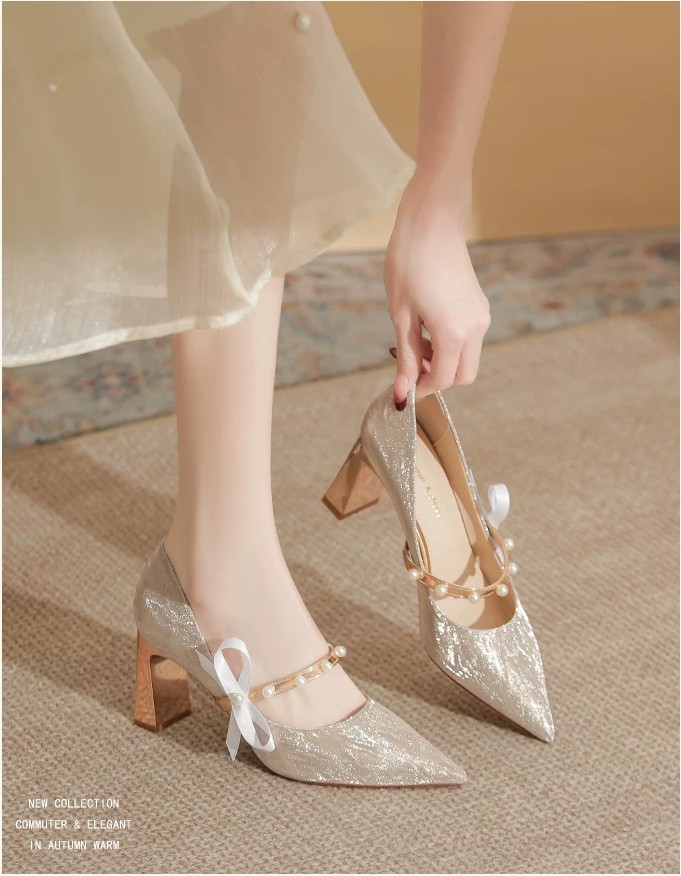
Which Heel Heights Cooperate With Lacing
Lacing works at every height, but it solves different problems at each one. Under 50 mm, the lace is mostly aesthetic and slightly useful — a kitten heel with ties reads as deliberate rather than fast, and the low pitch means the foot is not fighting gravity. Between 60 and 80 mm, lacing earns its keep: this is the range where the heel counter starts to gap and where a lace converts a shoe that would otherwise require a grippy insole into something you can walk a kilometer in.
Above 90 mm, the geometry gets interesting. As the heel rises, the foot slides forward and the toes take more load, so the lacing needs to hold the instep back rather than clamp it down. That means the bottom two eyelets should be snug and the top ones comparatively loose, which is the opposite of how most people lace instinctively. On a 100 mm lace-up, the ankle tie is doing structural work — it is stopping the foot from sliding forward into the toe box, and if you tie it tightly across the front of the ankle instead of above the bone, you will feel it within twenty minutes.
Platform lace-ups are their own category. A 40 mm platform with a 120 mm heel reduces the effective pitch to 80 mm, which is why they feel more stable than the heel height suggests. But the platform adds weight, and weight plus laces means you need a firmer shank, or the shoe will flex where it shouldn’t and the lacing will start pulling unevenly. If you are buying your first pair in this style, start at 70–80 mm with a modest platform and work upward once you know how your foot behaves in laces.
Height also changes the angle at the ball of the foot, and that angle decides whether a pair lasts an hour or an evening. Every 10 mm above roughly 60 mm shifts more load onto the forefoot, so the higher you go, the less lace tension you want across the instep — the ankle does the holding, not the vamp.
Materials, and How Laces Age
Smooth calf leather takes laces well because the upper does not stretch much, so once you find your tension it stays. Suede is softer and more forgiving on the instep but compresses over time, meaning a pair that fits perfectly in October may need an extra half-eyelet of slack by February. Patent is the fussiest of the three: it does not breathe, it shows every crease, and laces pulled tight across a patent vamp leave permanent marks where the tongue meets the upper.
Satin is where most people get burned. A satin lace-up heel is beautiful for about four wears and then the ribbon starts to fray at the knot, because satin ribbon has almost no abrasion resistance and the knot is the highest-friction point on the whole shoe. If you want the look, buy a pair with replaceable ribbon laces and keep a spare set — it is a two-dollar fix that extends the shoe’s life by years. Waxed cotton laces are the most durable option and the least elegant; flat cotton laces sit better against a leather tongue than round ones, which tend to cut in.
One detail worth checking before you buy: whether the eyelets are metal or stitched. Metal eyelets protect the leather from lace friction and will outlast the shoe. Stitched eyelet holes look cleaner and cost less, but the lace saws through the leather edge within a season of regular wear. On a shoe you plan to wear weekly, metal is the right answer. On an occasion shoe, stitched is fine and often prettier.
Lining and tongue padding do quiet work here as well. An unlined leather tongue creases sharply under lace pressure and eventually cracks along the fold; a lightly padded tongue spreads that load across the instep instead. If you wear the shoe without socks, check the lining at the heel too — a rough lining is the difference between a comfortable evening and a blister you will still feel on Wednesday.
What to Wear With Women’s Lace Up Heels
The instinct is to treat laces as casual, and that instinct is only half right. A pointed-toe lace-up in black leather with straight-leg denim and a white shirt is a genuinely good outfit — the laces read as detail rather than decoration, and the pointed toe keeps the whole thing from drifting toward sandal territory. Swap the denim for wide-leg wool trousers and the same shoe becomes office-appropriate in most workplaces that allow an open or laced upper at all.
Dresses need more thought. A lace-up heel with a midi dress creates a lot of visual activity between the hem and the floor, and if the dress already has ties, ruffles, or a busy print, the result is noise. The reliable formula is a plain dress with a lace-up shoe, or a detailed dress with a clean pump. Satin slip dresses are the exception that works both ways, because the lace echoes the fabric’s sheen without competing with it.
For a specific pairing that holds up, look at white high heels for women in woven leather — the texture gives the eye something to do, so the outfit around it can stay simple. White also solves the seasonal problem: it works with summer linen and with winter wool in a way that black sometimes doesn’t.
Skirt length matters more than most guides admit. With a lace-up that ties at the ankle, a hem that lands exactly at the tie creates a horizontal break that shortens the leg. Either go shorter, so the ankle is fully visible, or longer, so the tie is hidden and only the toe shows. Anything in between reads as an accident.
Color is the easiest thing to get wrong and the easiest to get right. Black leather covers the widest range of outfits and hides wear; ivory and cream read formal and photograph well but show scuffs; anything metallic wants a plainer outfit around it, since the shoe is already the loudest element in the frame.

Tying Them So They Stay Put
Most lace-up heel problems are lacing problems, not fit problems. The standard criss-cross is fine for sneakers and mediocre for heels, because it puts equal tension everywhere and the ankle needs less than the instep. Try this instead: lace straight across the bottom two eyelets, then criss-cross from the third eyelet up, leaving the top pair noticeably looser than the bottom. The result holds the foot back without clamping the ankle.
For a heel that slips at the back, the fix is not tighter laces but a heel lock: run the lace back down into the top eyelet on the same side, leaving a small loop, then thread the opposite lace through that loop and pull. It sounds fussy and takes four seconds once learned. It is the single most effective adjustment available on any laced shoe.
Sizing deserves an honest note. Lace-up heels generally run true to size, but a laced upper has less give at the widest part of the foot than a slip-on, so if you are between sizes, size up and tighten the laces rather than sizing down and hoping the leather relaxes. Half-size up plus a thin insole is a better combination than a tight fit plus a shoemaker. And if the shoe arrives with a stiff, heavily finished leather, give it two short wears at home before committing to a full day.
Wide feet need one extra step, and it is not tighter lacing. Re-lace with a gap: skip the criss-cross on the middle pair of eyelets and run the lace straight up each side. That widens the vamp without loosening the ankle, and combined with a heel lock it turns a pair of womens lace up heels that felt tight in the store into something you can wear for a full day. If the shoe still pinches across the ball after that, the last is wrong for your foot and no lacing trick will change it.
Care, Storage, and Repair
Laces are consumables. Treat them that way and the shoe lasts. Waxed cotton and leather laces can be cleaned with a damp cloth and a little saddle soap; satin ribbon cannot and should be replaced rather than washed. Check the knot point every few weeks — that is where fraying starts, and a fraying lace will chew the eyelet edge faster than anything else you do to the shoe.
Storage matters more with laces than with straps, because a tied lace holds the upper in a compressed shape. Untie before storing, loosen the top two eyelets, and use shoe trees if the leather is smooth. For suede, skip the trees and stuff with acid-free paper instead, since cedar can leave marks on damp nap. Never store a lace-up with the laces knotted tight — you are effectively training the leather to crease in the wrong place.
When the sole wears at the toe, resole before the upper is compromised. A leather-soled lace-up heel can usually be resoled twice, and a rubber sole once. The upper is the part that cannot be replaced, so protect it: a water-repellent spray applied twice a season will do more for longevity than any cleaning routine, particularly on suede and nubuck.
Travel is where lace-ups take the most damage. Pack them with the laces untied and the heel resting against something soft; a knotted lace pressed into the upper for eight hours in a suitcase leaves a crease that never fully lifts. Replace heel tips the moment metal shows through — a new tip costs a few dollars and ten minutes, while a worn one left alone will chew through the heel stack and mark your floors. A cobbler can also re-stitch a fraying eyelet row for far less than the shoe cost, which is worth doing before the leather tears.
Who Should Probably Pass on Them
Not everyone needs this shoe, and pretending otherwise wastes money. If you have a high instep that already feels pressure from slip-on styles, a laced vamp can make that worse unless the eyelet row starts low. If you have limited hand mobility or arthritis in the fingers, thin ribbon laces are genuinely difficult, and a strap is the better engineering choice for your foot. If you commute by bike or spend the day on your feet on uneven ground, a lace-up heel is a style decision that will cost you comfort, and there are better answers.
There is also a category of lace-up heel that fails on principle: the ones where the laces are glued shut or threaded through decorative loops that do not actually tighten. These are sold as adjustable and are not. Check before buying by pulling the two lace ends apart — if the upper does not visibly gather, the lacing is cosmetic.
There is a cost argument on both sides. A cheap pair of womens lace up heels with cosmetic lacing will fit nobody properly, so the money is gone regardless of price. A well-made pair with metal eyelets, a firm shank, and replaceable laces costs more upfront but survives two or three resoles, which works out cheaper per wear than replacing a disposable pair every season. The middle of the market is where the real decision sits: at that price you can usually get good hardware or good leather, rarely both, and leather is the part you cannot upgrade later.
Worth noting too that a good cobbler can often rescue a pair that fits badly at the ankle — a half sole, a heel grip, or a re-shaped counter can change the whole experience. Ask before you throw a pair out.
A Short Checklist Before You Pay
Five things worth confirming. First, metal eyelets if you plan to wear them weekly. Second, a lace you can replace — check whether the ends are finished with aglets or just knotted, because knotted ends mean the lace was never meant to come out. Third, a heel counter that holds your heel when you walk on a hard floor barefoot in the store, before you tie anything. Fourth, a shank that does not flex when you twist the shoe lengthwise; if it flexes, the lacing will pull unevenly within a month. Fifth, enough lace length to double-knot without leaving a tail that drags.
Price tiers behave predictably. Under about forty dollars you are buying a fashion upper on a disposable sole, which is fine for a single event and honest about what it is. Mid-range pairs are where construction starts to matter, and this is the range where checking the shank and the eyelets pays off most. Above that, you are paying for leather quality and finishing, and the lacing itself stops being the variable — at that point fit is decided by the last, so try before you buy or buy from somewhere with real returns.
One last thing worth doing in the shop: walk on a hard surface, not carpet. Carpet hides slip, and slip is the exact problem lacing is meant to solve. Ten steps on tile will tell you more about whether the pair works than twenty minutes of sitting down and admiring them.
Womens lace up heels are not a compromise shoe, and they are not a trend that needs defending. They are a construction that solves a real problem — holding a foot in a raised shoe across a range of foot shapes that a strap cannot accommodate. Buy a pair with honest hardware, tie them the way your foot actually needs, and they will outlast most of what is in your closet. The rest is just deciding which color you will still want to wear in three years.
