

The first party of the season is usually the one that wrecks your feet for the rest of it. You buy something gorgeous in a panic on a Thursday afternoon, wear it for four hours, and spend Friday walking like you’ve borrowed someone else’s ankles. I’ve done that three Decembers running. The fourth one I got organised, and it wasn’t by spending more money. It was by buying two pairs instead of one.
So here’s a practical piece about women’s holiday heels. What holds up on a wet pavement at eleven at night, what photographs beautifully and walks badly, and which details are worth checking before you pay. General advice on heels applies all year round, but the holiday version has higher stakes. Fewer chances to change your shoes, more standing, worse weather.
Two pairs, not one. That’s the whole trick, and I’ll come back to it.
One note on spelling before we start, because it says something about how this shopping actually happens. Plenty of people type “womens holiday heels” into a search bar at 11pm with no apostrophe and one thumb, and the shops know it. If you’re reading this in a taxi on the way to dinner, you’re exactly who I’m writing for.
Holiday dressing is mostly standing, and nobody warns you
A party looks like a seated event in the photos. In practice you stand for the first ninety minutes. There’s a glass in one hand, a plate you can’t put down in the other, and every chair in the room is buried under somebody’s coat. Then the playlist changes and you’re up for another hour because sitting down now would look like you’re leaving.
That gap between how a shoe feels in the shop and how it feels at 10:40pm is where most bad purchases happen. Shop carpet is springy. It gives you back some of the energy you put into each step, which flatters a stiff sole and hides a thin one. Marble, tile, and polished concrete give you nothing back. Neither does the pavement outside, especially when it’s wet.
Here’s a rough number worth remembering. A woman of average height walking at a normal pace takes somewhere between 100 and 120 steps a minute. Stand and shift your weight for an hour, wander to the bar twice, then walk fifteen minutes to the station, and you’ve loaded that shoe a few thousand times in one evening. A pair that’s slightly too tight at 7pm is a genuine problem by 11pm, because feet swell over the course of a day and the shoe didn’t get any bigger.
Try shopping in the late afternoon. It’s boring advice and it’s correct. Feet are at their largest by around 6pm, so a pair that fits then will fit at a party. A pair that fits at 10am usually won’t, and the difference is roughly half a size.
What does this mean for choosing? Prioritise the things that don’t change during the evening. A heel that’s stable under a shifting weight, a sole with a little grip on wet stone, and a shape that doesn’t press on the same square centimetre for four hours. Everything else is decoration, and decoration is allowed, just not first. Shops know this and still arrange women’s holiday heels by colour, because colour sells and stability doesn’t.
The walk test beats the mirror test
Most people buy heels standing still in front of a mirror, turning their ankle one way and then the other. That test tells you almost nothing. Static balance is easy. What you need to know is what happens when you’re moving, tired, and slightly distracted.
So do this instead, in the shop, before you commit. Put both shoes on with the socks you’d wear to the event, not the thin ones from the display. Walk forty steps away from the mirror, turn around, walk back, and then do it again at a faster pace. If the heel wobbles sideways at speed, it’ll wobble on a wet pavement too. If your heel lifts out of the back of the shoe on the return trip, you’ll be clenching your toes all night to keep it on.
Add one more thing to the test: stand still for three full minutes while you talk to the sales assistant about something else. Two minutes is where the shoe stops being new and starts being a shape you have to live inside. Most of the discomfort people describe after a party shows up in that third minute.
Heel construction matters here more than brand. The history of the high-heeled shoe is mostly a history of status and posture, which is a polite way of saying the design was never optimised for walking. The parts that help are unglamorous. A heel that sits under the centre of your own heel bone rather than behind it. A shank that doesn’t flex when you twist the shoe in your hands. An insole with a bit of actual padding under the ball of the foot.
I used to think a higher price guaranteed all of that. It doesn’t. I’ve had a 180-dollar pair with a hollow plastic heel and a 45-dollar pair that’s still going four winters later.
Block heel, kitten heel, stiletto: pick by floor surface
Heel type is the single decision that determines whether the night works. Not because one is more elegant than another, but because each one behaves differently on the surfaces you’ll actually meet.
Block heels win on carpet, gravel, decking, and cobbles. A wide base spreads the load, so your ankle isn’t doing correction work every time you shift. On an office Christmas party in a hotel function room, a 70mm block is the pair you forget you’re wearing. It also handles the walk from the car, which is where thin heels fail first.
Kitten heels (35 to 50mm) sit in a strange spot. They look polite and they’re easy to walk in, but a thin kitten heel on wet stone is genuinely sketchy, because there’s very little contact patch and the angle still tips you forward. If you go this route, look for a slightly tapered kitten rather than a true needle, and check the tip for a rubber cap.
Stilettos are for arrivals and photographs. I’m not going to pretend otherwise. A 90mm stiletto on a polished floor is a balancing act, and the walk from the taxi to the door is the risky bit. They’re still worth owning if you love them, because nothing else makes a plain dress look considered.
If the evening has two halves, split them. Wear the not tiring thick heels for dinner and the walking, then swap into something finer once you’re at the venue and the floor is known. Carrying a second pair in a tote sounds fussy until the first time you do it.
There’s a quick way to judge a block heel before you buy it. Turn the shoe over and look at how wide the base is compared to your own heel. If the block is narrower than the back of your heel, the shoe is going to roll outward at some point in the evening, usually on a step. If it’s wider, you’re fine. Measure with your thumb if there’s no tape handy. Nobody in the shop will mind.
Straps are structural, not decorative
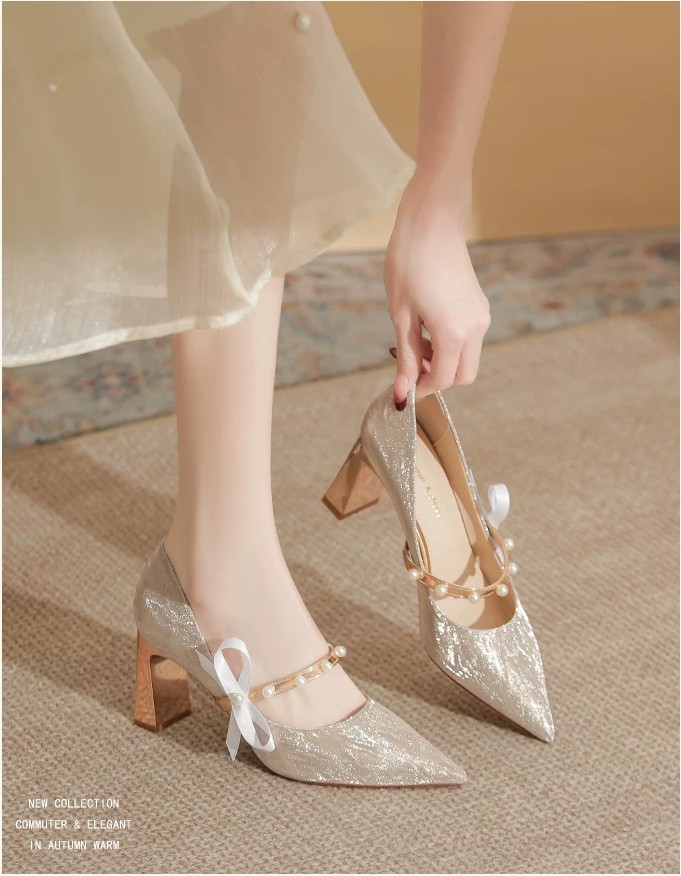
An ankle strap is doing two jobs. It holds the shoe on your foot, and it stops your toes from curling to grip the sole. That second job is the one people miss, and it’s the reason a strappy heel sometimes feels better than a pump at the same height.
It only works if the strap sits in the right place. Too high and it cuts into the tendon at the back of your ankle when you flex. Too low and it slides down over the heel bone, which means you’ll be tugging at it all evening. The good position is just above the ankle bone, snug enough that you can fit one finger underneath and no more.
Then there’s the buckle. A tiny decorative buckle with a blunt prong is the most annoying hardware in womankind. Check that the prong actually enters a hole easily, and check the strap length with your own ankle, not the model’s. Wide ankles and narrow ankles both exist and neither is a flaw.
Slingbacks deserve their own paragraph, because they’re back and they’re everywhere. The elasticated back versions are far more forgiving than the buckled ones, but they loosen over a season. If you buy a slingback, buy it snug. If it’s already comfortable on the loosest hole, it’ll be flapping by February.
One drawback nobody mentions: straps create tan lines and pressure marks, and a strap that felt fine at 8pm leaves a visible groove by midnight. If you’re wearing something backless or with a high slit, look at your ankles in a full-length mirror with the shoes on before you commit. Sounds obsessive. Takes ten seconds, and it’s saved me twice.
Also check where the strap is stitched. A strap anchored to the sole with a single row of stitching will pull away after a season of parties. Two rows, or a rivet, and it’ll hang on. This is the sort of thing nobody photographs and everybody notices at the wrong moment.
Satin is a commitment. So is metallic.
Holiday heels tend to come in three finishes, and each one has a different relationship with reality. Satin looks luxurious under warm light and shows every single scuff, water mark, and crease. One drop of something on the toe and it’s a permanent feature. I love satin and I only buy it in dark colours for that reason.
Metallic finishes, especially the foiled ones, flake at the toe where you scuff against steps. They also crease sharply across the vamp, and once that crease is in, it stays. Cheaper metallics go dull after a couple of wears and start looking like painted cardboard. A textured metallic, something with a bit of grain, ages much better.
Velvet and suede are the forgiving option for the party itself and the unforgiving option for the weather. Rain will mark them, salt will mark them, and neither comes out with a damp cloth. If you’re taking a car everywhere, velvet is lovely. If you’re walking, think again.
Colour is where people overthink. Black, a deep red, and one metallic cover almost every outfit in a December wardrobe. If you want something memorable, buy it in a silhouette you already trust rather than a colour you’ve never worn. A black satin heel will out-earn a novelty colour four to one, and I say that as someone who owns a pair of gold boots she has worn exactly twice.
Fair warning on light satin: it looks incredible for about two hours and faintly grey thereafter. Not a dealbreaker. Just know what you’re buying.
Care is simple enough if you accept it. Brush suede with a soft brush while it’s dry, never rub a wet mark, and let it dry away from a radiator. Satin gets a light spray before the first wear and nothing after that. Metallic gets wiped with a dry cloth and stored away from other shoes so the finish doesn’t rub. Ten minutes of this at the end of the season is why some pairs come back out looking new and others don’t. If you’re buying women’s holiday heels with the idea of wearing them for three Decembers, this is the part that decides it.
Ninety minutes is the real number
Podiatrists tend to talk about heel height in ranges rather than rules, and the general guidance from bodies like the American Podiatric Medical Association is to keep the height modest and vary it rather than wearing the same heel every day. Translation for December: the issue isn’t one party in 90mm heels, it’s four parties in the same 90mm heels plus a working week in them too.
In practical terms, ninety minutes of continuous standing is where most people start shifting from foot to foot without noticing. That’s your cue. Sit down, even for five minutes, and the second half of the evening gets easier. Nobody is watching your posture as closely as you think.
Insoles help more than people expect, but only the right kind. A thin gel pad under the ball of the foot takes pressure off the metatarsal area and costs almost nothing. A full-length insole in a strappy shoe will make it tighter and worse. If the shoe is already snug across the vamp, adding anything inside is a mistake.
There’s a trick worth knowing for the walk home. Take a folded piece of tissue or a plaster and tape your third and fourth toes together. It sounds ridiculous. It reduces the strain on the nerve that causes that burning feeling across the top of the foot, and it costs nothing.
Heel height also changes how you walk, not only how your feet feel. A higher heel shortens your stride and pushes your weight forward, which is why people look like they’re moving faster than they are in heels. That’s fine for a photograph and tiring over a kilometre. If the distance home is longer than you planned, the swap pair is doing real work.
And then there’s the honest answer: if a pair hurts within twenty minutes of trying it on at home, it isn’t going to settle down by the weekend. Leather gives a little. Structure doesn’t.
The two-pair rule, and how to pack it
Back to the thing that changed my Decembers. One pair for the photographs, one pair for the walking. They don’t have to be expensive. The second pair just has to be something you can put on at 11pm without wincing.
My version is a block heel for the journey and the first two hours, then a low mule or a flat I keep in a cloth bag at the bottom of my tote. The bag matters. Loose shoes in a tote end up under a coat, and you spend ten minutes at the end of the night looking for one of them in a pile of outerwear, which is a special kind of misery.
A flat folding ballet shoe also works, and it takes up almost no space. The trade-off is that most of them have a paper-thin sole, so they’re fine for a taxi queue and not fine for a two-mile walk.
For a trip rather than a single night, pack two pairs maximum and pick them so they cover different ground. One pair that handles dinner, one that handles a wet cobbled street at midnight in a city you don’t know. Everything else stays home. I’ve packed three pairs for a four-day trip and worn one of them.
Airline baggage rules are the other argument for packing light. Shoes are heavy and they take up the space you wanted for a coat. Two pairs of women’s holiday heels in a carry-on is about the sensible limit once you’ve added a hairdryer and a pair of boots.
There’s one more piece of kit that earns its place in the bag. A couple of fabric plasters and a blister stick weigh nothing, and they turn a ruined night into a manageable one. I keep them in the same cloth bag as the flats so I can’t forget either.
If you’re travelling for a wedding rather than a party, remember that airport floors are brutal and hotel corridors are worse. Wear the sturdy pair on the plane. Nobody has ever regretted that decision on arrival.
If you only take one thing from this, take that. The shoes you don’t wear are the ones that cost you the most.
Where the money should go
Spend on the structure and save on the surface. A well-made heel unit, a shank that doesn’t twist, and a sole with grip will outlast three pairs of pretty shoes with hollow heels. Nobody at a party has ever complimented a shank, and everybody notices when you’re walking badly.
Save on trends. The trade press tracks what actually sells each season, and if you follow the footwear industry coverage for a month you’ll see the pattern: a shape gets pushed hard, sells for one season, and disappears. Buying the pushed shape at full price in November is the least efficient way to spend money on women’s holiday heels.
Spend a little on maintenance, too. A cobbler can add a rubber cap to a worn heel tip for the price of a coffee, and that single repair is what stops a good pair from becoming a wobbly one. Most people throw the shoes away instead.

Get the shoes on a week before the event, not the afternoon of. Wear them around the house for twenty minutes on two separate days with the tights or socks you plan to use. That’s usually enough to find the rub point while you can still return them, or stick a plaster on it before it becomes a blister.
Sizing is the last thing to get right, and it’s where most returns come from. Heels usually run true to size, but a pointed toe runs short and a slingback runs loose. If you’re between sizes, size up in a closed toe and stay put in an open one. Try both if you can. It takes five extra minutes and saves a fortnight of swapping parcels.
And if the pair you love is a 100mm stiletto that hurts after an hour, buy it anyway, then carry the backup. The point of holiday heels was never practicality. It’s arriving somewhere looking like you made an effort, and then still being able to walk home.
